
‘The Lehman Trilogy’ Is a Theatrical Event
Long, acclaimed Tony-winning play gets fascinating production from Milwaukee Rep.
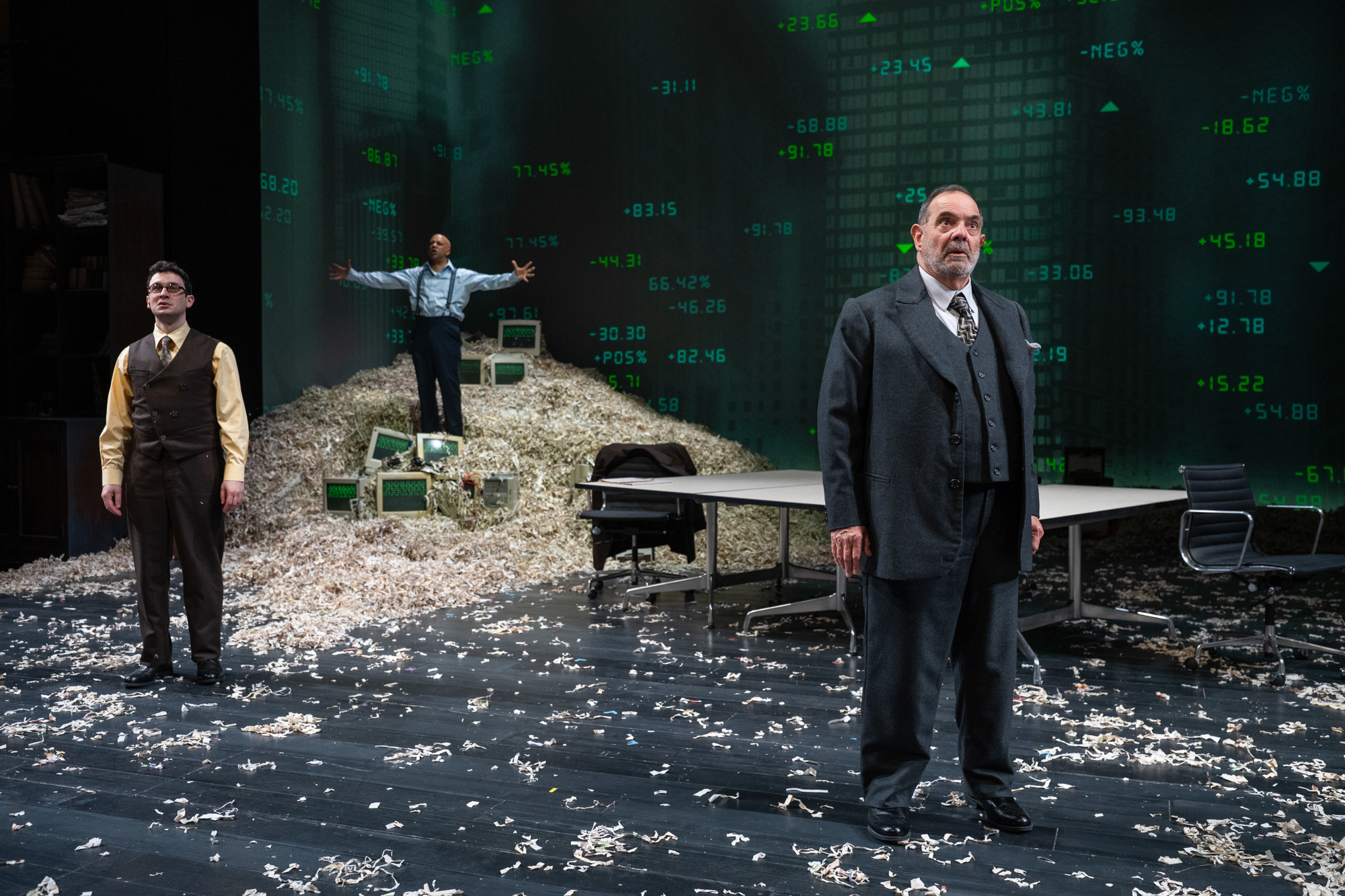
Milwaukee Repertory Theater presents The Lehman Trilogy in the Checota Powerhouse Theater January 13 – February 8, 2026. Pictured L to R: Max Wolkowitz, William Sturdivant, Edward Gero. Photo by Michael Brosilow.
I venture to suggest that the Rep’s version of The Lehman Trilogy will be the only chance for Milwaukeeans to see it. Not because it isn’t an intriguing three hours and 30 minutes of storytelling, worth being in the repertory of many theaters, but because it requires so much exactitude in scope, technical precision and acting finesse that other Milwaukee theaters will be loath to try it. In other words, see it now or miss it.
The second offering in the expanded Powerhouse Theater, now named for major donors Ellen and Joe Checota, it comes as the Rep fully shows off its three active stages in the Associated Bank Theater Center. It arrives here after triumphant runs in London and on Broadway, where it won five Tony Awards, including best play.
To emphasize how much skill is involved, The Lehman Trilogy is a direct transfer from the Guthrie Theater in Minneapolis, with help from D.C.’s Shakespeare Theater Company, where it was also staged. Hardly a slapdash production, you’ll note, and much deeper and more people-oriented than a lesson play on American capitalistic overreach.
The story is actually true, if a bit finessed for the stage. Three immigrant German Jewish brothers arrive from Europe to open a storefront fabric shop in Alabama in 1844. Their Lehman Brothers family rises over 160 years to become one of the largest investment banks in the world — only to succumb to bankruptcy and overreach in 2008.
From fabrics they moved to raw plantation cotton to coffee to other goods, to serving as middlemen, then to a full-blown investment bank. Each turn of the clock — the Civil War, the mechanized textile factories, the Roaring Twenties, the horrible 1929 crash, the arrival of the war munitions machine, the fever for oil and atomic energy, the consistent bursts of technological changes, the advances from trading centers to home computers — carries their fever for money into new philosophies on how to manipulate credit, play the odds in derivatives and engage in rampant speculation.
What a crew of talents has been assembled for all this! With an Italian theater background, playwright Stefano Massini wrote the original novel in Italian – in verse! That may explain the poetic touches that flow through the dialogue and the personalities. Adapter Ben Power shaped the play. While the staging elements had to change since the original direction by Arin Arbus, she is credited, as is the actual director Dan Hasse, who had to rework all the elements of this nimble interaction to thrive in new spaces.
Designer Hannah Wasileski fills the projection backdrop with titles to keep clear the decades unfolding and the landscapes involved — and also images of the Lehman dreams and nightmares of success and failure, aided here by the original music of Michael Costagliola. It is these dreams that move the Lehmans ever forward over time.
Scenic designer Marsha Ginsberg smothers the stage in paper-like shreds of confetti (think cotton, ticker tape, whatever), sometimes hiding plot advancements that pop out of the floor. Each of the three acts moves us to a different furniture style in the story — Alabama storefront, Wall Street with ticker tape station and plush chairs, then slick steel and modern business quarters.
The latticed stage ceiling tilts with the action and even plummets downward during the 1929 Wall Street crash, while sound designer Costagliola and busy lighting designer Yi Zhao combine with the actors to body-slam us during that era’s rash of stockbroker suicides.
If you know your U.S. history, the Lehman brothers were only one of the immigrant families that rose from nothing to great economic power, a testament to their energy and insights but also to the blindness that accompanied these merchants moving into derivatives, profit margins and assets guesswork.
Just three expressive actors, one I suspect fighting off a bad cold, transform themselves into the Lehmans — and into their offspring, wives, paramours, passersby — all in telling the story to the audience in a presentational manner.
A fluttering handkerchief becomes a coy woman or a door slammed in a suitor’s face. A head tilt turns a bearded actor into a flirtatious woman. Another actor mimics a baby’s wail and a three-year old’s howls to interrupt a conversation.
They are all relatively new actors to the Rep, but not to regional theaters. Edward Gero plays the senior Lehman, always watchable, particularly fluid moving into his other family roles. William Sturdivant is the most volatile and demonstrative Lehman, eager to oppose any family maneuver, maintaining his powerful vocalizing in difficult circumstances. Max Wolkowitz plays and ages as the youngest brother who mediates between the elders and reveals shrewdness of his own.
These actors are a show in themselves: what they can do with just a prop; how they can change gender with a gesture; or how they use physical nimbleness and vocal stylings to great effect. They also arrange themselves in tableaus, and even when clearly talking to the audience remain true to the sense of dramatic involvement.
There are limits to this kind of presentational theater — we are delighted in the skills, the incredible coordination of actors and technicians, but we tend to become more focused on how cleverly the story is being told rather than how deeply it speaks to us. By the third act, the audience anticipates the devices used to move the plot along.
The unusual two intermissions allow patrons to get a drink and explore more of the ambiance of the new Powerhouse (including a new refreshment area and Wells Street vista).
I stayed in my seat to enjoy the unintended entr’acte where a squad of stagehands and headphoned supervisors swept the confetti into new arrangements, brought on ramps and carts to add or remove furniture and double-checked some hidden surprises. It was businesslike, but eerily well-orchestrated.
The Lehman Trilogy runs through Feb. 8, giving time for patrons and volunteer ushers to learn more smoothly where the seats and railings are in this fancier new Powerhouse — and to figure out how to unclog the aisles and exit surges. For ticket info: https://www.milwaukeerep.com/shows/show/the-lehman-trilogy/
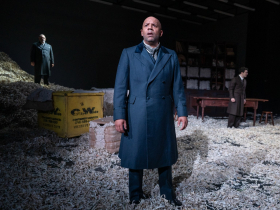
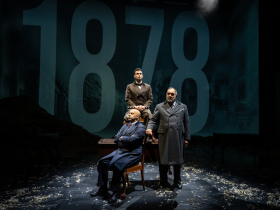
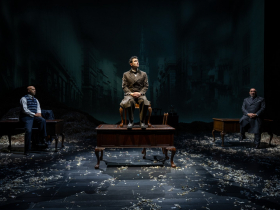
The Lehman Trilogy Gallery
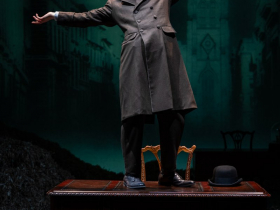
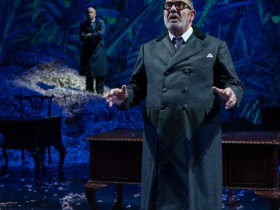
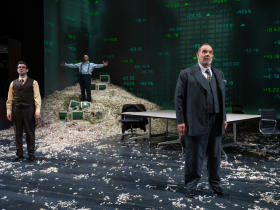
Dominique Paul Noth served for decades as film and drama critic, later senior editor for features at the Milwaukee Journal. You’ll find his blog here and here. For his Dom’s Snippets, an unusual family history and memoir, go to domnoth.substack.com.
If you think stories like this are important, become a member of Urban Milwaukee and help support real, independent journalism. Plus you get some cool added benefits.


Review
-
Cosmos Café Is a Hidden Gem
 Mar 28th, 2026 by Cari Taylor-Carlson
-
‘Barefoot in the Park’ Is a Comic Time Capsule
 Mar 23rd, 2026 by Dominique Paul Noth
-
Oscar-Winning Russian Documentary Takes on Putin
 Mar 21st, 2026 by Dominique Paul Noth
Theater
-
‘Barefoot in the Park’ Is a Comic Time Capsule
Mar 23rd, 2026 by Dominique Paul Noth
-
‘Ain’t Misbehavin’ Is High Quality Fun
 Mar 9th, 2026 by Dominique Paul Noth
-
Rep Hosts National Gathering of Theater Leaders, Critics
 Mar 3rd, 2026 by Dominique Paul Noth















Be prepared for a long evening. Terrific cast and staging. To move through the 164 years, the dialogue gets fairly expository at times.
read noth’s review and was interested in seeing this play. i looked for tickets and saw that the price began at $ 273.00. someone please tell me i’m wrong about this. i went to a panel discussion last thursday at MAM and the concern was how to include community in art events. well, $273.00 doesn’t include me and many others.
@tornado75: I searched for tickets for the Saturday matinee and evening performances on 1/24/2026 and the tickets range from $25 to $125. https://tickets.milwaukeerep.com/the-lehman-trilogy/64933
$25 and up from there is what I found when attending the drama.