Key Questions in Dugan Trial Take Shape on First Day
Was judge acting suspiciously, or doing her best under difficult circumstances?
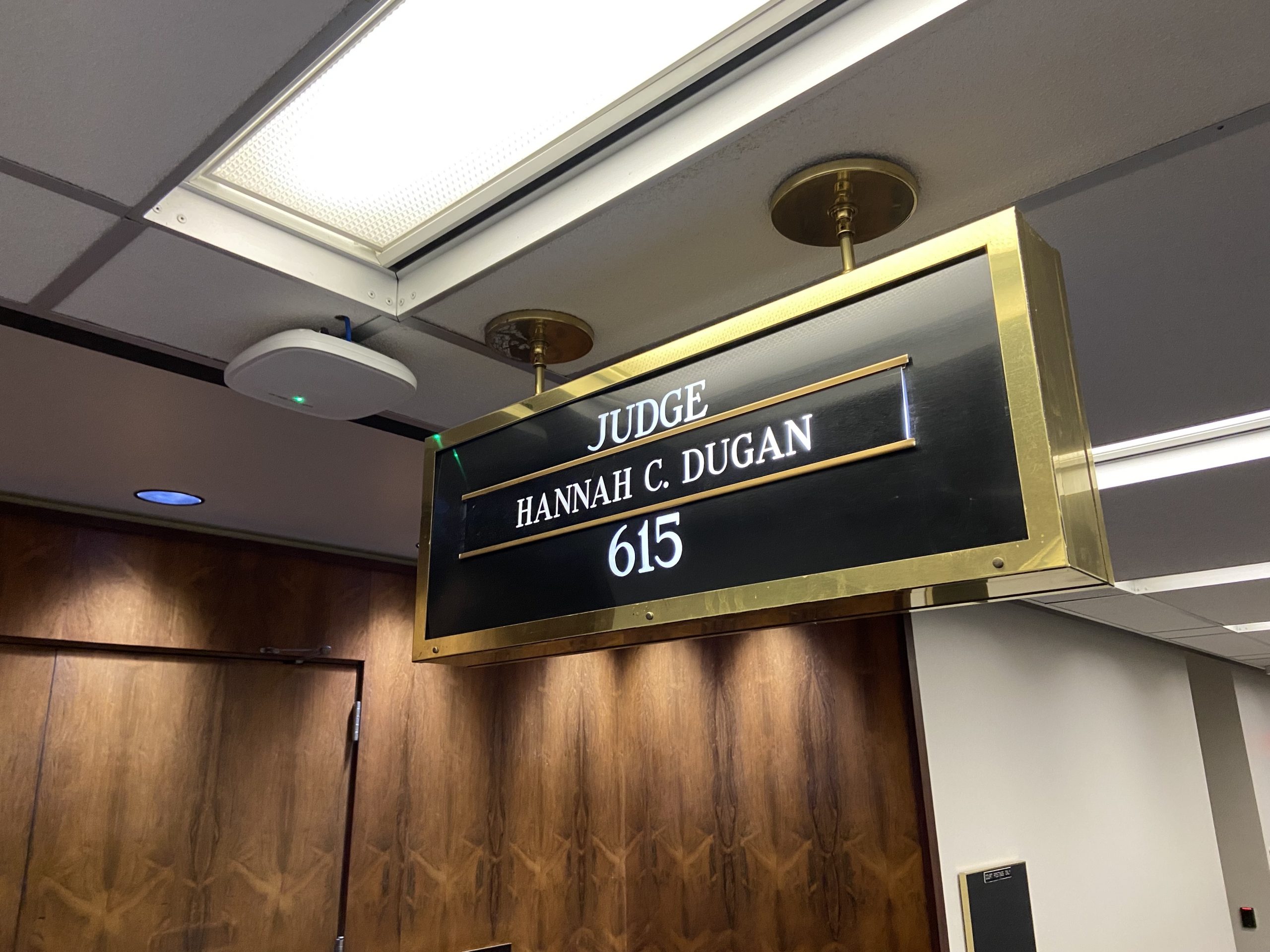
Judge Hannah Dugan’s courtroom on the sixth floor of the Milwaukee County Courthouse. Photo taken by Graham Kilmer.
For the first time since she was arrested in April, attorneys for Milwaukee County Circuit Court Judge Hannah Dugan have offered their version of the events that ultimately led to her arrest by federal agents.
The federal criminal trial of Dugan for allegedly obstructing an U.S. Immigration and Customs Enforcement (ICE) operation began Monday with opening statements by the U.S. attorney’s office and the defense. The statements are not themselves evidence of what happened, but an opportunity for both sides to present the arguments and interpretations of the evidence they plan to marshal during the trial.
The federal government, through its opening statement and examination of witnesses, developed its version of the events at the Milwaukee County Courthouse on April 18: a routine immigration enforcement operation is knowingly derailed by Dugan, who is trying to prevent ICE from arresting an individual in the courthouse. By contrast, the defense depicted a courthouse gripped by uncertainty and paranoia following previous ICE arrests there, and Dugan as a judge blindsided by the appearance of immigration agents, attempting to follow guidance from her superiors while managing a busy court docket.
Assistant U.S. Attorney Keith Alexander spoke for the federal government and Attorney Steven Biskupic for Dugan.
Dugan is charged with obstructing an ICE operation and concealing an individual from arrest. The target of the arrest was Eduardo Flores-Ruiz, who was appearing in Dugan’s court on misdemeanor criminal charges.
On the day in question, an ICE Enforcement and Removal Operation (ERO) team appeared outside Dugan’s courtroom to arrest Flores-Ruiz. Dugan was alerted to their presence by her court clerk and went into the hallway and told them they needed to check in with Chief Judge Carl Ashley. Flores-Ruiz’s case was then adjourned off the record and Dugan directed him and his attorney out of her courtroom through a door reserved for jurors and court staff. Flores-Ruiz was arrested shortly after outside of the courthouse.
The federal government alleges the conduct amounts to an attempt to obstruct the arrest and that she attempted to conceal Flores-Ruiz from the agents in order to prevent his arrest. That her actions that day — everything from wearing her judicial robes in the public hallway to sending the defendant out of the side jury door — were unusual and not routine; that she broke the law to protect Flores-Ruiz from arrest.
Alexander began his opening statement with a quotation of Dugan from an audio recording taken inside her courtroom the day of the incident: “I’ll do it. I’ll get the heat.” The recording was a matter of debate in the weeks leading up to the trial. Dugan’s defense team tried to prevent clips from the recording that caught conversation when Dugan was outside the courtroom.
The audio recording captured conversation between Dugan and other court staff, as well as between Dugan and Flores-Ruiz’ attorney, Mercedes de la Rosa. Dugan is heard asking de la Rosa, off the record, who her client is, and suggesting another date can be scheduled and that Flores-Ruiz can appear by video at his next court date. Later, the audio captured Dugan and her court reporter discussing sending Flores and his attorney out of the jury door, which takes them briefly through a private hallway and ultimately into the public hallway. However, Alexander noted that Dugan and her court reporter can be heard discussing the “stairway” in the private hallway.
The conversation followed an interaction between Dugan and ERO agents in the hallway outside her courtroom. Video evidence presented in court shows Dugan, joined by Judge Kristela Cervera, speaking with the agents and directing them to the chief judge’s office. Alexander said Dugan pulled Cervera out of her courtroom and told her to keep her judicial robe on before speaking with ICE agents. Cervera walked ICE agents to the chief judge’s office while Dugan returned to her courtroom.
“Again, this was not a routine day at the courthouse after the defendant learned that ICE was in the public hallway,” Alexander said.
Dugan’s legal team, on the other hand, is arguing that Dugan was acting in accordance with the law and guidance from the chief judge, that the newly aggressive enforcement operations of ICE — including arrests inside the county courthouse — had sown confusion and paranoia and Dugan was reacting to a difficult situation. Her team agrees the events of April 18 were unusual, but the irregularity comes not from Dugan, but from the ICE agents.
Biskupic, for the first time, began offering an alternative interpretation of the events that day, and included new details the prosecution did not address: Dugan was never actually presented with a warrant, she did not know who the target of the operation was and she spoke with federal agents for less than 20 seconds.
“This week [Dugan]’s on trial because the federal government wanted her to act a certain way with respect to ICE, and she didn’t,” Biskupic said.
Biskupic said the government is asking the jury to presume Dugan’s guilt because of her interaction with the agents. The assumption, he said, is that Dugan knew what she was doing when she spoke to the agents, sent them to the chief judge’s office and rescheduled the Flores-Ruiz case. The “supposition” is that Dugan knew these actions would obstruct the agents’ attempts to arrest Flores-Ruiz.
Biskupic showed the jury emails from other circuit court judges expressing concern, and confusion, about ICE arrests that took place in the courthouse prior to the events on April 18. He also showed draft guidance from the chief judge that court personnel should refer ICE agents to their immediate supervisor when they come in contact with them. Biskupic also noted that off-the-record scheduling in a county misdemeanor court is common, that Dugan had 20 cases on her docket scheduled for 8:30 alone, and that 10 of them would be heard off the record that day.
Biskupic also said Dugan did not call Flores-Ruiz case forward. Rather, it was his attorney who jockeyed to have the matter heard. At no point does the evidence show Dugan knew he was the ICE target, Biskupic said.
Government Calls FBI and ICE Agents to Testify
The first witness for the government was FBI Special Agent Erin Lucker, who was the case agent assigned to investigate Dugan’s conduct on April 18.
U.S. Attorney Richard Frohling led questioning for the government. Frohling walked Lucker through the audio recording and video footage. The FBI agent explained that ICE makes arrests in courthouses because they are secure facilities and safer for arrest operations; that ICE has authority to make arrests in public areas like the courthouse hallways; that Dugan’s actions, like walking through public hallway in judicial robes, were unusual; that the doorway Flores-Ruiz and his attorney exited from was locked to the public.
Attorney Jason Luczak cross-examined Lucker, asking questions to sow doubt about the government’s conclusions and poking holes in the prosecution’s case. In response to Luczak’s questions, Lucker admitted that she had little experience with state court operations, having only worked in the federal justice system.
“You don’t know what a routine day at the courthouse looks like,” Luczak said.
“No, I don’t,” Lucker responded.
Luczak also managed to establish that the government does not have video or audio evidence that Dugan knew ICE was there to arrest Flores-Ruiz. Luczak also took up the issue of the stairway in the private hallway, which was heard mentioned on the courtroom audio. He asked Lucker if she ever personally investigated the stairway, and whether she knew that the stairway would have led Flores-Ruiz and his attorney past security checkpoints. She had not.
Next, the government called ICE agent Anthony Nimtz, the supervisor for the ERO team that arrested Flores-Ruiz. He explained the steps involved in an enforcement action and why ICE uses courthouses for arrests. On the latter, it’s because they offer security that ensures the targets are not armed. Nimtz is the supervisor who signed off on the administrative arrest warrant for Flores-Ruiz. His testimony went to the government’s characterization of the ICE operation as routine.
Through cross-examination, the defense aimed to poke holes in the professionalism and rigor of the ICE operation, noting that the administrative warrant he signed off on included several errors, including the location of the arrest and the listed criminal charges Flores-Ruiz faced in state court.
Attorney Nicole Masnica conducted the cross-examination, and she managed to get Nimtz to admit on the stand that the warrant would not allow ICE agents to enter a private area and that it is against the law for ICE agents to arrest victims appearing in court.
It had already been established that Dugan did not know why exactly ICE was there. Masnica asked Nimtz if judges, like Dugan, had a legal obligation to prevent agents from arresting a victim appearing in their courtroom. Nimtz said that was “true.”
On redirect examination, the prosecution asked Nimtz to clarify that Flores-Ruiz was not a victim.
The prosecution then called FBI Special Agent Jeffrey Baker. The hearing ended Monday after their examination. The trial will resume Tuesday morning with the defense’s cross-examination of Baker.
If you think stories like this are important, become a member of Urban Milwaukee and help support real, independent journalism. Plus you get some cool added benefits.
More about the Courthouse ICE Arrests
- Judge Hannah Dugan Resigns - Sarah Lehr - Jan 4th, 2026
- Hannah Dugan Seeks New Trial - Graham Kilmer - Dec 23rd, 2025
- Op Ed: Making Sense of Judge Dugan’s Conviction - Ruth Conniff - Dec 22nd, 2025
- After Dugan Verdict Comes Politics and Courthouse Uncertainty - Graham Kilmer - Dec 21st, 2025
- Wisconsin Republicans Threaten to Impeach Judge Hannah Dugan - Anya van Wagtendonk - Dec 20th, 2025
- Forward Latino Corrects Misinformation Presented During Judge Hannah Dugan Trial - Forward Latino - Dec 19th, 2025
- United States Thanks Jurors for Their Service and Urges Peaceful Response to Verdict - U.S. Department of Justice - Dec 19th, 2025
- Dugan Must Go - Wisconsin Assembly Speaker Robin Vos - Dec 19th, 2025
- A Dangerous Precedent - Press Release - Dec 19th, 2025
- Verdict Against Judge Dugan Threatens Due Process and Judicial Independence - Voces de la Frontera - Dec 19th, 2025
Read more about Courthouse ICE Arrests here
More about the Judge Hannah Dugan Trial
- Forward Latino Statement Following Sentencing Hearing of Judge Hannah Dugan - Forward Latino - Jul 8th, 2026
- Prosecutors Suggest ‘Serious Sentence,’ Prison for Hannah Dugan - Graham Kilmer - Jul 2nd, 2026
- Sentencing Scheduled for Hannah Dugan - Graham Kilmer - Jun 19th, 2026
- Federal Judge Denies Dugan Acquittal, Again - Graham Kilmer - Jun 16th, 2026
- Judge Listens to Arguments As Dugan Case is Reopened - Graham Kilmer - Jun 3rd, 2026
- MKE County: Dugan Acquittal Motion Gets Hearing - Graham Kilmer - May 27th, 2026
- Prosecutors Ask Court to Disregard Dugan’s New Push for Acquittal - Graham Kilmer - May 7th, 2026
- Dugan Seeks Acquittal Ahead of Sentencing - Graham Kilmer - Apr 29th, 2026
- Sentencing Date Set in Dugan Case - Graham Kilmer - Apr 10th, 2026
- Federal Judge Won’t Vacate Dugan Conviction - Graham Kilmer - Apr 6th, 2026
Read more about Judge Hannah Dugan Trial here


MKE County
-
Incumbents Sweep County Board Elections
 Apr 7th, 2026 by Graham Kilmer
-
Federal Judge Won’t Vacate Dugan Conviction
 Apr 6th, 2026 by Graham Kilmer
-
Sup. Vincent Faces Challenge in Heated Race for District 11
 Apr 6th, 2026 by Graham Kilmer