The Fight Over Wisconsin’s House Districts
Can they be redistricted in just 4 months? Maybe, but it won't be easy.
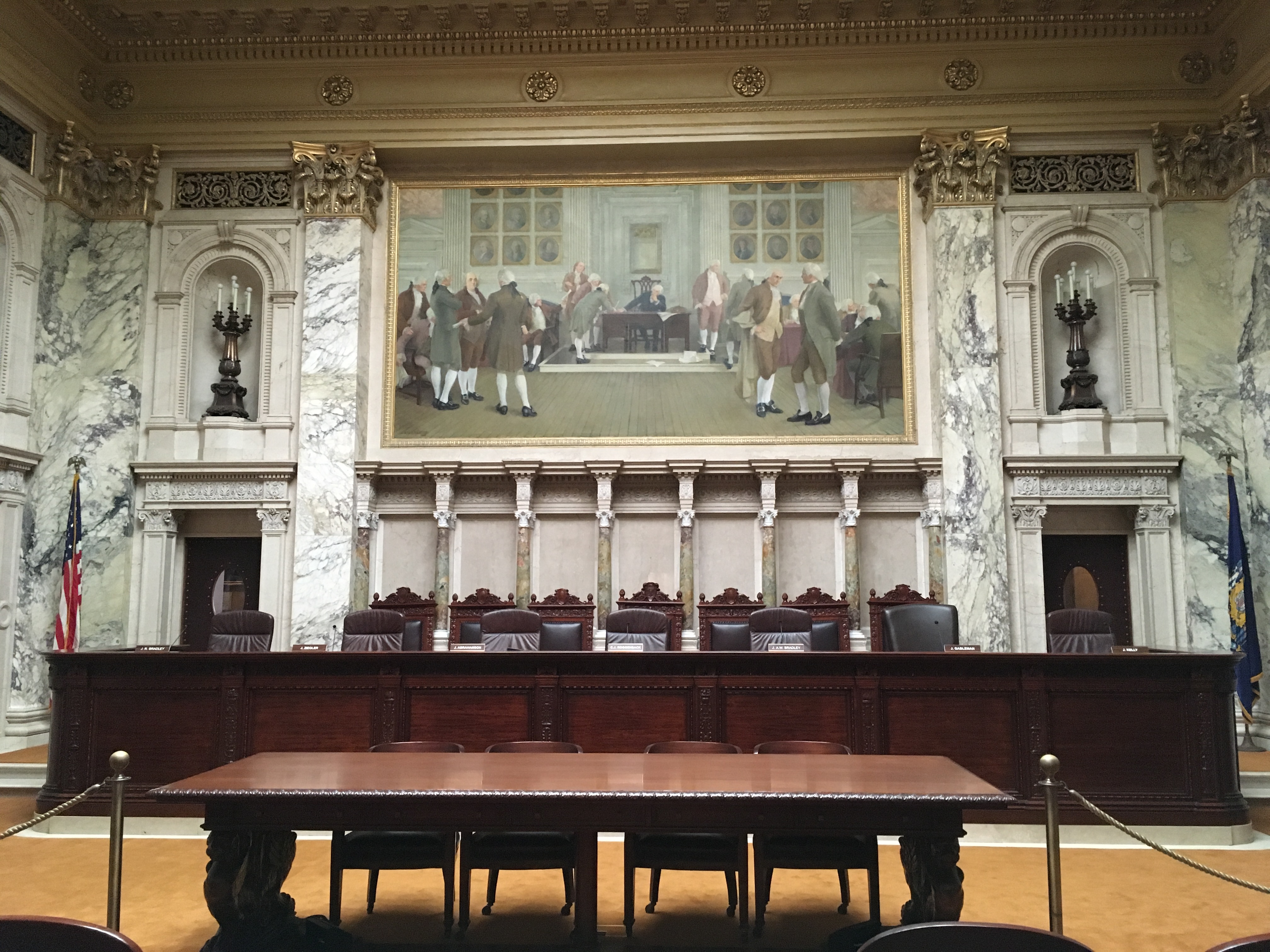
Wisconsin Supreme Court. Photo by Mariiana Tzotcheva.
In just four months — on April 8 — local clerks must post notices of the Aug. 11 partisan primary and the Nov. 3 general election. But a big question must be resolved by then: whether the current boundaries of Wisconsin’s eight U.S. House districts stay in place or will be redrawn.
Political and legal mountains would have to move for the eight new U.S. House district maps to be redrawn in that short time window. One week later, on April 15, candidates for those House seats can begin to circulate nomination papers.
But the possibility of redrawing the eight districts in four months is not out of the question, since the state Supreme Court’s liberal majority already made history by creating two three-judge panels to hear challenges to those districts.
Current U.S. House districts, drawn by Republicans, have given that party control of six of the eight seats since 2022, in a state that is evenly divided between the two parties. New districts would give Democrats a better chance to win one or two of those GOP seats.
The Supreme Court’s creation of three-judge panels to hear the lawsuits leaves these questions unanswered: Will the Court insist that the panels rule quickly? Will the Court speedily resolve appeals of the panels’ rulings? Will the Court ultimately give the Legislature a deadline to redraw the maps — as it did in 2024 — or threaten to draw new districts itself?
“The appointment of the three-judge panel is a significant step,” says Jeff Mandell, one of the lawyers representing groups that are suing to have the existing House districts ruled unconstitutional.
“It’s hard to say exactly what it means in terms of timing, because this (three-judge panel) statute has never been used in Wisconsin before, so we have very little sense of how each panel will interpret and apply its task,” Mandell adds in an email statement.
Mandell says he and other attorneys who represent Business Leaders for Democracy “immediately asked the three-judge panel to establish a schedule for an orderly but efficient adjudication.”
The April 8 deadline for notices of the primary and general elections is set in state law, according to the Wisconsin Elections Commission calendar.
On Nov. 25, the Supreme Court majority created these panels to hear the two cases:
In the suit by Elizabeth Bothfeld and other voters against the Elections Commission, Judge Julie Genovese of Dane County, Judge Emily Lonergan of Outagamie County, and Judge Mark Sanders of Milwaukee County.
In the suit by Business Leaders for Democracy against the Elections Commission, Judge David Conway of Dane County, Judge Patricia Baker of Portage County, and Judge Michael Moran of Marathon County.
In her dissent, conservative Supreme Court Justice Annette Ziegler accused the majority of “delivering partisan, political advantage to the Democratic Party [and] hand picking circuit court judges to perform political maneuvering.”
In a post on X, the Republican Party of Wisconsin said, “Out of 261 circuit judges, the far-left Supreme Court has chosen 6 other far-left judges to oversee redistricting, INCLUDING A FORMER DEM COUNTY CHAIR AND 3 EVERS APPOINTEES.”
Announcing its motion to intervene in the cases, the Wisconsin Institute for Law and Liberty said the two lawsuits “are time-barred, the three-judge panel lacks authority to overrule the Wisconsin Supreme Court, and any attempt to impose new maps in this manner would violate federal law and the U.S. Constitution.”
Republican Congressman Bryan Steil, of Janesville, whose First District is targeted by Democrats, criticized the “lack of transparency from the Supreme Court in selecting district judges to oversee this case, without providing any rationale for why they were chosen” in a statement for WisPolitics.
Lawyers for the six incumbent Republican U.S. House members, who the court allowed to join the cases, requested that two Supreme Court justices — Susan Crawford and Janet Protasiewicz — not participate in the cases.
“Both justices were endorsed by the Democratic Party of Wisconsin,” the MacIver Institute said. “Protasiewicz criticized the maps on the campaign trail, and Crawford’s donors billed her as a justice who could help Democrats flip seats.”
In separate statements on Nov. 25, Crawford and Protasiewicz refused to recuse themselves from the cases challenging the U.S. House districts. The Supreme Court has no rules listing conflicts that require justices to withdraw from pending cases.
Drawing eight new U.S. House districts in four months would make more history, given the appeals and legal maneuvers over delays. But it’s not impossible.
Steven Walters started covering the Capitol in 1988. Contact him at stevenscotwalters@gmail.com.
If you think stories like this are important, become a member of Urban Milwaukee and help support real, independent journalism. Plus you get some cool added benefits.


The State of Politics
-
What Happened to Tax-Cut Negotiations?
 Apr 6th, 2026 by Steven Walters
-
Republicans Badly Divided in Final Senate Session
 Mar 30th, 2026 by Steven Walters
-
Why the Rise in Property Tax Anger?
Mar 16th, 2026 by Steven Walters