Prometheus Trio Goes Bohemian
Performing works by Dvořák and Martinů, both born in Bohemia, along with a Schubert piece.
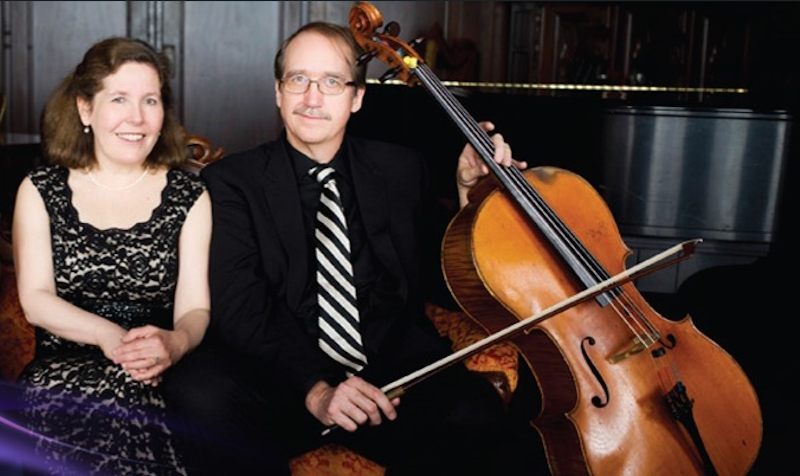
Stefanie Jacob (left) and Scott Tisdel (right).
Chamber music by two composers who share Bohemian roots is featured in the December 8 performance by the Prometheus Trio. Founders Scott Tisdel (cello) and Stefanie Jacob (piano) will be joined by guest violinist Emmy Tisdel Lohr and guest violist Beth Breslin Kiefer.
Antonín Dvořák (1841-1904) is much beloved for his compositions that incorporate rhythms and melodies from the folk music of his native Bohemia. His Trio in E Minor shares its nickname “Dumky” with several of Dvořák’s compositions. These pieces, explains Dvořák scholar Otakar Sourek, “alternate moods of retrospection and yearning with the expression of vigorous and youthful gaiety….” The first two of the six movements comprising the Dumky Trio illustrates this pattern, according to pianist Jacob. “The first dumka opens slowly but dramatically, fortissimo, while the second’s Poco adagio begins with a plaintive pianissimo; the first movement’s Allegro vivace is a sparkling, E-major scrap of mischief, while the second’s Vivace non troppo is a roiling C-sharp minor that finishes the movement almost defiantly.”
In 1890, the year that Dvořák began writing the E Minor Trio, Bohuslav Martinů (1890-1959) was born in a small town in Bohemia, where he gave his first public violin concert at the age of 15. Recognizing his musical talent, townspeople raised funds to send him to the Prague Conservatory. Though he had little interest in his studies and eventually was dismissed from the conservatory for “incorrigible negligence,” Martinů had a great talent for analyzing the new music he heard at concerts in Prague. He turned his attention to composing and, in 1923, moved to Paris to study and write in earnest. As the German army approached Paris in 1940, he and his wife fled France, eventually settling in the United States in 1941.
Music critic David Hurwitz describes Martinů’s Piano Quartet, completed in 1942, as “a spiky, hyperactive work with an exceptionally beautiful slow movement.” Cellist Tisdel calls the piece “a dramatic work which uses each instrument in a highly effective and idiomatic way.” The first movement is strongly rhythmic, with both the pianist and the string players frantically presenting musical ideas. The strings dominate the second movement, with the piano entering only briefly. The melodic final movement begins with a nostalgic piano solo. Stephen Soderberg of the Library of Congress describes the piano theme as “the mesmerizing, irregular rocking of a rowboat tied to a pier.” However, Tisdel says, “Gradually, disruptive elements invade the pastoral mood, and the movement builds to a series of grand climaxes.”
Austrian composer Franz Schubert (1797-1828), considered one of the all-time greats, composed some 1,500 pieces during his short life. His Adagio and Rondo in F Major for piano quartet, which opens the program, was written when he was a teenager. The Rondo movement’s brilliant keyboard part puts the pianist’s skills to the test.
The Prometheus Trio and guest artists perform at 7 p.m. Monday, December 8, at the Wisconsin Conservatory of Music, 1584 N. Prospect Ave., Milwaukee. Free self-parking is available at Milwaukee Eye Care, 1684 N. Prospect Ave. Tickets are available online or by calling the Conservatory at 414-276-5760.
If you think stories like this are important, become a member of Urban Milwaukee and help support real, independent journalism. Plus you get some cool added benefits.


Preview
-
Present Music Celebrates Hindu Festival
 Mar 16th, 2026 by Michael Barndt
-
Frankly Music Showcases Virtuoso Players
 Mar 10th, 2026 by Michael Barndt
-
Six Centuries of Secular Song
 Mar 3rd, 2026 by Michael Barndt