

New Admirals Lease Is a Financial Win For Arena Owner
Two-year extension would keep hockey team at Panther Arena through 2029.
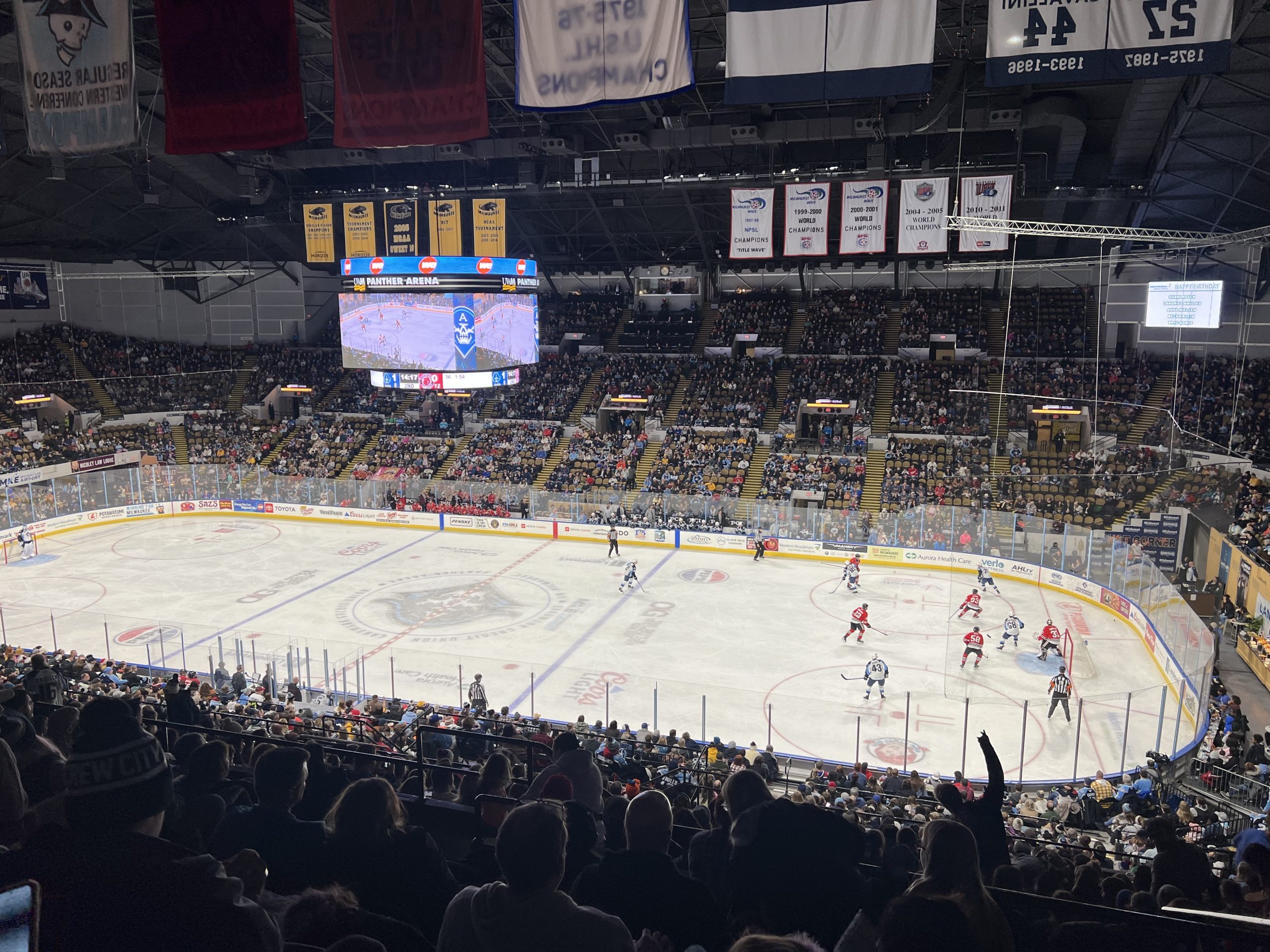
A Milwaukee Admirals game at UW-Milwaukee Panther Arena in December 2025. Photo by Jeramey Jannene.
After spending nearly an hour behind closed doors Friday, the Wisconsin Center District‘s board unanimously approved a new lease agreement with the Milwaukee Admirals, extending the hockey team’s stay at the UW-Milwaukee Panther Arena through June 2029.
The agreement marks a significant turnaround in the relationship between the publicly owned district and one of its most prominent tenants, following months of uncertainty over the future of the arena and a contentious dispute about whether the Admirals were costing the district hundreds of thousands of dollars annually.
The financial terms of the new agreement were not publicly disclosed Friday, but multiple board members confirmed that the revised lease represents a substantial financial improvement for the district.
“The Wisconsin Center District is thrilled to continue its longstanding partnership with the Milwaukee Admirals, working together toward a contract that keeps professional hockey at UW-Milwaukee Panther Arena and in Milwaukee through 2029. Having the Admirals in Milwaukee is a tremendous asset to our city, bringing fans together and adding to the energy and pride of our local sports community. We deeply value our partnership with the Admirals and our shared commitment to delivering great experiences for fans, supporting our community and keeping professional hockey thriving in Milwaukee. We look forward to continuing our work together and creating many more memorable moments for Admirals fans,” said Peggy Williams-Smith, interim WCD president and CEO and Visit Milwaukee CEO, in a statement.
Board chair Omar Shaikh told Urban Milwaukee that the agreement still needs to be signed by the Admirals before it is finalized.
The approval comes just three weeks after Admirals governor and CEO Harris Turer publicly praised the district’s new leadership for dramatically improving negotiations.
“We are grateful for how things have changed in terms of the relationship between the Admirals and the WCD recently,” said Turer at the board’s Oct. 23 meeting.
“The tone of our meetings has changed dramatically and allowed for positive and fruitful discussion,” he said. “While we have some work to do, we believe this will end in an agreement that is great for both sides.”
The two-year extension builds on a 10-year agreement crafted when the Admirals relocated from the Bradley Center to the Panther Arena in 2017. The existing lease expires in June 2027.
The negotiations took place against the backdrop of a high-profile dispute involving former WCD president and CEO Marty Brooks, who was terminated in June.
Brooks had argued that the Admirals’ lease was a financial loser for the district, costing it at least $300,000 annually. He said he was attempting to correct a financially unfavorable arrangement that predated his arrival in 2018.
Following Friday’s vote, multiple board members acknowledged that Brooks’ underlying financial criticism was accurate, even as they emphasized the broader economic benefits of having the Admirals play downtown.
“It does not generate income. However, I think it’s offset by the amount of activity that the Admirals generate,” said Ald. Robert Bauman, a WCD board member, in an interview with Urban Milwaukee and the Milwaukee Journal Sentinel.
Bauman said the issue raised a larger question about the district’s purpose.
“What’s our goal here? Is our goal here to be a profit-making organization or is our goal here to generate economic activity which benefits the broader economy?”
He argued that characterizing the Admirals as a financial loser overlooks the economic activity associated with the team’s games.
“The term loss is kind of a misnomer. Because there may be a technical loss, but overall the Admirals are a big winner,” he said. “The overall impact of the Admirals is financially positive to Milwaukee’s economy even though the revenue may not exceed the expenses.”
He said the district would still lose a “lower six-figures” amount on the agreement.
Asked whether Brooks had been vindicated by the acknowledgment that the previous lease was financially unfavorable, Bauman offered a mixed assessment.
“Technically he was right and he was wrong,” said the alderman.
Brooks secured a $350,000 settlement from the board and district in October.
The district is a public entity funded by a mix of hotel, rental and sales taxes as well as earned revenue.
New Lease Narrows Financial Gap
Although the final terms weren’t released Friday, district officials previously outlined the expected financial improvements during October meetings.
Under the proposed agreement, the district was expected to improve its financial position by approximately $300,000 to $314,000 in the first year and $350,000 to $360,000 in the second year compared to the existing lease.
The improvements included increasing the rent paid by the Admirals for each game from approximately $3,000 to $4,000, while retaining other revenue-sharing arrangements.
WCD CEO Brian Rutkowski previously said the district’s review confirmed that the existing agreement generated an operating loss, but that the revised terms would substantially narrow the gap.
“We did find that there was a greater loss that is associated with that particular deal, and with the modified terms that we’ve come with, we’ve definitely narrowed that gap,” Rutkowski said at an Oct. 15 meeting.
At the Oct. 23 meeting, Rutkowski said the negotiations had included concessions from both sides.
“[There has been] very open and honest dialogue taking place, and some puts and takes on both sides, concessions made, to ultimately get to a deal,” he said.
Turer, meanwhile, pushed back against the idea that the original lease was entirely one-sided.
“Previous management would often tell us what a great deal we had. We, on the other hand, always believed it was one that worked for both of us,” he said.
He said the Admirals had generated more than $20.4 million in revenue for the district over the course of the existing agreement through rent, facility fees, concession and merchandise sales and other revenue sources.
The team, said Turer, also invested $3.2 million in improvements to the arena, exceeding a $2 million obligation in the original lease. Those improvements included restroom renovations, painting, concourse work, a team store and a bar.
The Admirals are the arena’s most prominent regular tenant, playing approximately three dozen home games each season in the 1950 building.

Existing members must be signed in to see the interactive map. Sign in.
If you think stories like this are important, become a member of Urban Milwaukee and help support real, independent journalism. Plus you get some cool added benefits.
More about the Convention Hotel Debate
- New Admirals Lease Is a Financial Win For Arena Owner - Jeramey Jannene - Nov 13th, 2026
- Wisconsin Center District announces settlement with former CEO - Wisconsin Center District - Oct 23rd, 2026
- Milwaukee Admirals, Wisconsin Center District Near Lease Extension - Jeramey Jannene - Oct 23rd, 2026
- Wisconsin Center District Approves Settlement With Fired CEO Marty Brooks - Jeramey Jannene - Oct 23rd, 2026
- Peggy Williams-Smith Given CEO Post at Wisconsin Center District - Jeramey Jannene - Sep 25th, 2026
- 10 Takeaways From Marty Brooks’ Explosive Claims Against Convention Center - Jeramey Jannene - Jul 22nd, 2026
- Marty Brooks Makes Scorched-Earth Case Against Convention Center Board - Jeramey Jannene - Jul 22nd, 2026
- Convention Center CEO Will Appeal His Firing - Jeramey Jannene - Jul 9th, 2026
- Wisconsin Center District Will Pay Acting Leader $30,000 Per Month - Jeramey Jannene - Jun 29th, 2026
- Politicians Deal With Fallout of Fired CEO’s Campaign Contributions - Jeramey Jannene - Jun 9th, 2026
Read more about Convention Hotel Debate here
Political Contributions Tracker
Displaying political contributions between people mentioned in this story. Learn more.
- December 10, 2024 - Robert Bauman received $50 from Peggy Williams-Smith