For First Time in 18 Years, Democrats Control Budget Process
Which legislators will serve on two key committees deciding how to spend $114 billion?
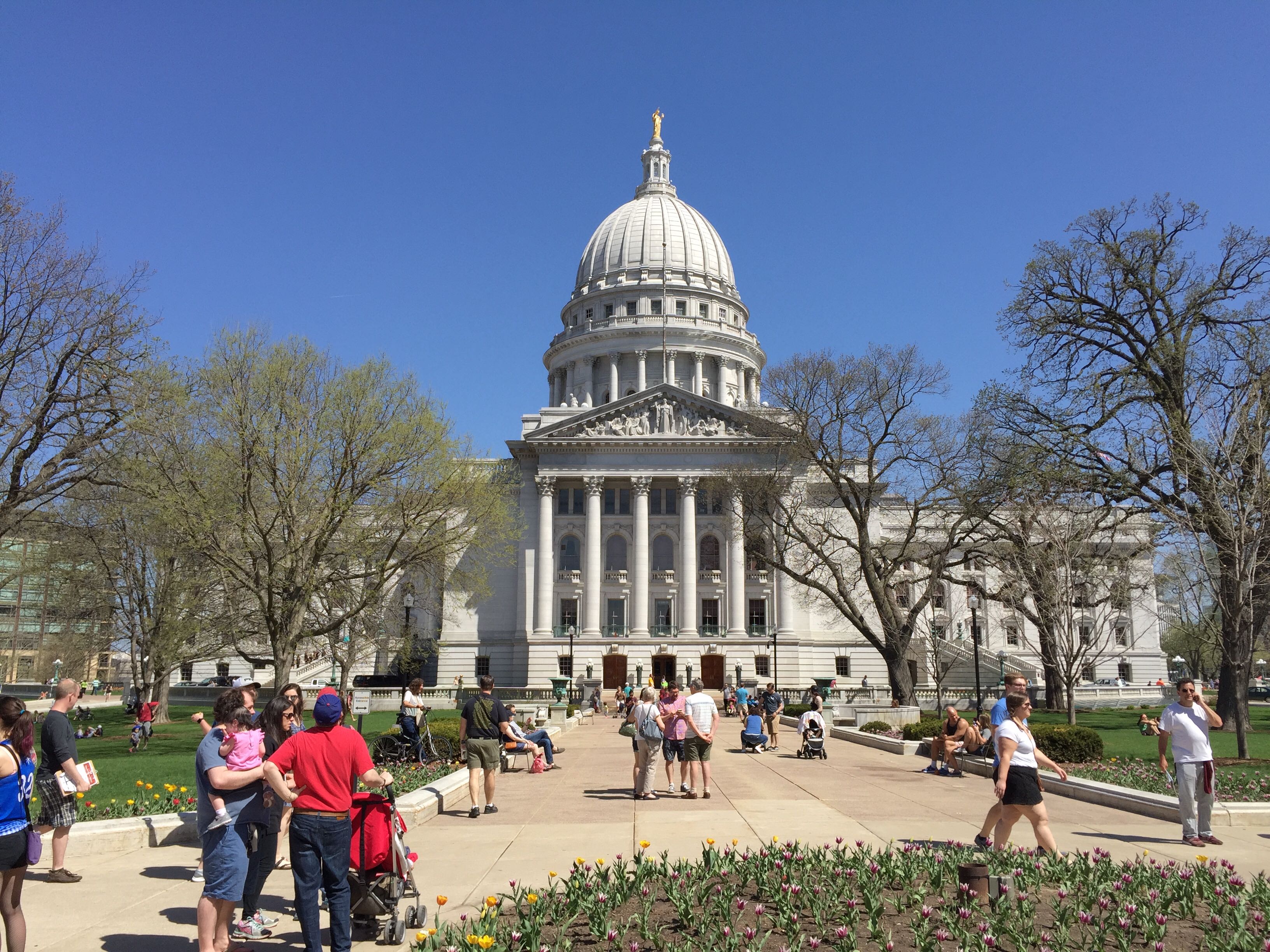
Wisconsin State Capitol. Photo by Dave Reid.
A new cast of elected officials — Governor-elect David Crowley and Democratic legislators — will draft and pass their first state budget next year. It’s an exciting and potentially risky scenario for Democrats. The last time Democrats had such control of the biennial budget was in 2009.
As a result of the Nov. 3 elections, none of the 12 Republican legislators on the Legislature’s Joint Finance Committee who built the current $114 billion, two-year budget will be in charge when the next spending plan takes shape next spring and summer.
Replacing those Republicans on the Finance Committee will be 12 Democrats — six senators and six Assembly members — chosen by that party’s presumptive new leaders in each house, Sen. Dianne Hesselbein and Rep. Greta Neubauer.
The lines forming outside the Capitol offices of Hesselbein and Neubauer are Democratic legislators auditioning for Finance Committee seats, since they traditionally open the door for bigger political roles.
Past Finance Committee co-chairs, for example, included Republicans Robin Vos and John Gard, who became Assembly speakers, and Democratic Congressman Mark Pocan, who will be a leader with Democrats’ new control of the U.S. House.
Republicans will have four members — two each from the Senate and Assembly — on the budget panel next session. The four returning Republicans who had Finance Committee leadership roles last session are Sens. Patrick Testin and Eric Wimberger and Assembly members Mark Born and Tony Kurtz.
Republican Sen. Julian Bradley was elected last week to lead Senate Republicans next session. He will name the Senate’s two GOP members of the Finance Committee.
The Finance Committee’s power shift results from Democrats taking control of the Legislature for the first time in 16 years. They will have 18-15 control of the Senate and a 53-46 margin in the Assembly.
In the Capitol budget-building process, Crowley goes first, presenting his two-year spending recommendations to the full Legislature early next year.
The Finance Committee holds public hearings on the governor’s proposal, holds agency-by-agency votes, and forwards a final version of the budget to the full Legislature in June. The budget cycle starts July 1.
The current $114 billion, two-year state budget is almost 100 times the $1.5 billion spending plan for 2027 that Crowley recommended as Milwaukee County executive. The budget-balancing skills he claimed during the campaign were questioned last week after a $4.5 million error in the county’s 2027 budget surfaced publicly and Crowley said he was aware of that error before his election as governor.
After naming a transition team, Crowley must master the complexities and nuances of the much more complicated state budget he will soon own.
But, because Crowley will succeed another Democrat, retiring two-term Gov. Tony Evers, the new governor and his advisors will lean heavily on Evers appointees in the state Department of Administration for budget advice. State agencies have already submitted budget requests through mid-2029.
Who might be the next Senate Democrats on the Finance Committee? Bet on several being women, since they make up 10 of the 18 Senate Democrats.
Two Democratic senators — Kelda Roys, of Madison, and LaTonya Johnson, of Milwaukee — were the Senate’s minority-party committee members last session. Could one of them be the next Senate committee co-chair?
Roys has run for governor twice and once for the U.S. House. If she is considering running for the U.S. Senate seat of Republican Ron Johnson in 2028, would that potential campaign get in the way of the intense job of Finance Committee co-chair?
And, because regional representation on the committee is important, would outstate Democrats object to two Capitol leaders — Crowley and Johnson — coming from Milwaukee?
The two Assembly Democrats who served on the committee were Tip McGuire, a lawyer from Kenosha, and Deb Andraca, of Whitefish Bay. Do either of those Neubauer appointees want to be the Finance Committee co-chairs?
What potential risks are there for Democrats writing a budget for the first time?
Bitter splits could emerge over what to include in that budget. Three Republican senators, for example, joined all Senate Democrats and blocked a tax-cut bill their party’s leaders had agreed to on May 13.
Democrats could also overreach politically, making controversial changes on social issues or spending so much that it threatens a future tax increase.
Barry Burden, a veteran UW-Madison political science professor, thinks a political overreach is unlikely.
“Their majorities won’t be big — a few seats in the Assembly, a couple seats in the Senate,” Burden says in an interview. “Just to keep their caucuses together, I think they’re going to have to be somewhat modest.”
Besides, Burden adds, “They have the benefit of working with a [$3.3 billion] surplus, so it’s possible to do a lot without exacting much pain on taxpayers.”
Steven Walters started covering the Capitol in 1988. Contact him at stevenscotwalters@gmail.com.
If you think stories like this are important, become a member of Urban Milwaukee and help support real, independent journalism. Plus you get some cool added benefits.
Political Contributions Tracker
Displaying political contributions between people mentioned in this story. Learn more.


The State of Politics
-
2026 Election Has Parallels with 1982
 Nov 2nd, 2026 by Steven Walters
-
How The Tax Break for Data Centers Was Passed
 Oct 26th, 2026 by Steven Walters
-
Lt Governor Race Offers Stark Contrasts
 Oct 19th, 2026 by Steven Walters