“Welcome Home, Jenny Sutter” Offers Poignant Look at Veteran’s Return
With a focus on forever-changed daily routines, Next Act Theater examines the wounds of war.

Chelsea D. Harrison and Tami Workentin in “Welcome Home, Jenny Sutter.” Photo by Alex Clark
The danger of sentimentality hovers over any play about a returning war veteran suffering nightmares and injuries. The topic is so social relevant that the sheer weight of our concern can easily wreck any dramatic balance.
“Welcome Home, Jenny Sutter” is rescued from such derailment by the caliber of the ensemble, the indirect psychology in the story’s unfolding and the humorous poignant punches allowed to sneak up on the audience at the Next Act Theatre through Oct. 12.
That is, if the patrons’ fear of being preached to doesn’t interfere. Knowledge of nothing more than the subject — not its treatment — seemed to be the reason there were 80 empty seats on opening night. The cast, even more than the topic, deserves better than this.
Director Deborah Staples, a noted actress herself, smoothly dispatches the players, even through barely justified exits and entrances. But she early establishes this as an ensemble piece, a drama not a lecture, anchored by skilled actors with formidable presence who can dig under the skin whether gentle warmth or outrageous antics are called for – and both are.This approach of cooperative trust (isn’t that what soldiers do?) is aided by the simple but surprisingly stirring sound design from Next Act artistic director David Cecsarini, mixing Willie Nelson and old hymns.
The play is disjointed in structure, perhaps to avoid preachiness and perhaps because the talented writer, Julie Marie Myatt, favors eccentric musings. She wanders inside her troubled characters’ minds using riffs on their daily routines. That forces the production to depend quite heavily on its actors to slip insights over to us that are more subtle than what can be written.
Myatt’s style in dialogue and construction seems more cinematically inclined than is helpful for three-sided staging. But she had one piece of enormous theatrical common sense, making sure that Jenny Sutter, the returning Marine mom who lost her leg in Iraq, is the central focus, but not the only powerful role. The object of constant curiosity, Jenny is revealed more in the mirror of others and the anticipation that what she went through on the battlefield will finally erupt.

Chelsea D. Harrison as Jenny. Photo by Alex Clark
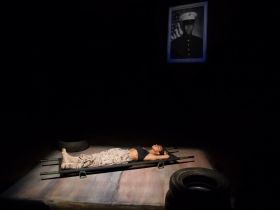
Chelsea D. Harrison is convincing as Jenny while carefully minimalistic and mysterious. She faultlessly conveys the physicality of a below-the-knee amputation, and seldom breaks from the sullen hostility of a mother afraid to face her kids with a marred body and consuming war guilt. Little breaks of revelation and emotion are carefully done to keep us on edge for some sign of softening.
To bring her out requires a nonmilitary collection of American misfits. In reality, it might take a big-screen convoy of townspeople to convince us there is such a barren village refuge with denizens worth our time. In theater it’s amazing how a few talented actors can humanize this sandbox of despair.
Tami Workentin regales the audience as irrepressible Louise, the annoying compulsive (an addict to gambling, liquor, smoking, sex, whatever is handy). She is the despair of the self-appointed psychologist (formerly hairdresser) humorously outlined by Deborah Clifton. But Workentin’s eager, invasive manner sucks Jenny and the audience in with a delightful performance.
Equally essential to the play is its Buddy, a mentally muddled but sincerely helpful and strangely angelic desert rat. John Kishline disguises his artistry in Buddy’s ramblings, making the complex seem simple. Hand shaking, eyes piercing as the radio onstage blares “Oh Happy Day,” Kishline gives the play its central moment of emotional power and meaning.
Myatt has also inserted a cynical outcast to shatter any glorification of Jenny – Donald, who seeks his own connection with her. A self-proclaimed disrupter and peacenik, Donald literally bursts the balloon of those honoring Jenny. The character is not whole or totally in control of his faculties, but the actor is — Ryan Schabach fluidly alternates street-rally fury and sheepishness.
The nosy bus-room attendant played by Nate Press comes across as the most contrived character, but largely because the actor substitutes energy for the subtle humanity of the rest of the cast.
“Welcome Home, Jenny Sutter” roams around a bit to land some inviting human touches and dramatic truths. The physical losses of combat veterans draw the eye and the politicians’ speeches, to be sure, but it is the psychological damage that needs the most nurturing. Here artistry, not sermons, reveal that the best guides to coming home are the many troubled souls already surviving among us with humor and forgiveness.
Dominique Paul Noth served for decades as film and drama critic, later senior editor for features at the Milwaukee Journal. You can find his blog here.
“Welcome Home, Jenny Sutter” Gallery







Review
-
Cosmos Café Is a Hidden Gem
 Mar 28th, 2026 by Cari Taylor-Carlson
-
‘Barefoot in the Park’ Is a Comic Time Capsule
 Mar 23rd, 2026 by Dominique Paul Noth
-
Oscar-Winning Russian Documentary Takes on Putin
 Mar 21st, 2026 by Dominique Paul Noth
Theater
-
‘Barefoot in the Park’ Is a Comic Time Capsule
Mar 23rd, 2026 by Dominique Paul Noth
-
‘Ain’t Misbehavin’ Is High Quality Fun
 Mar 9th, 2026 by Dominique Paul Noth
-
Rep Hosts National Gathering of Theater Leaders, Critics
 Mar 3rd, 2026 by Dominique Paul Noth