
City Backs Free Designs To Jumpstart Backyard Carriage Homes
Hoan Foundation to fund two standardized designs homeowners could use at no cost.

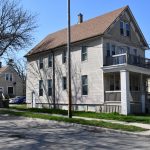
House and Carriage House at 3401-3403 N. 1st St. Photo taken April 23, 2025 by Jeramey Jannene.
Milwaukee homeowners could get free plans for a backyard home under a proposal unanimously recommended Tuesday by the Common Council’s Zoning, Neighborhoods and Development Committee.
The proposal aims to kick-start development of accessory dwelling units, or ADUs, a “missing middle” housing type that the city relegalized in 2025 as part of a broader strategy to address the housing affordability crisis.
The Daniel W. Hoan Foundation would provide up to $10,000 to Montavius Jones‘ Narvarte Development to create two accessory dwelling unit designs for use in Milwaukee. Narvarte will work with architecture firm DreamBuilders, led by Nicholas Hans Robinson, on the plans.
The grant would pay for the designs, not construction. The city would receive a perpetual, royalty-free license to publish and distribute the plans, which residents could download for personal use and project planning.
The package would include one design for a carriage house with a garage and one design for a cottage without a garage. City officials said the plans would address common structural and code questions, potentially saving homeowners time and design costs. Homeowners could customize some features, such as exterior cladding, though changes to the plans could still require technical review.
The designs would be intended for a standard Milwaukee lot. A civil engineer would still need to evaluate site-specific conditions, and a homeowner would still need to obtain required permits, but the designs would be more affordable and faster to build than starting from scratch.
“The hope with this is to save homeowners time and money,” said Jim Bohl, city innovation director.
Common Council President José G. Pérez, the resolution’s sponsor, told the Zoning, Neighborhoods and Development Committee Tuesday that he believes his district has the first ADU project in the works. He said the proposed unit may need Board of Zoning Appeals approval because of its size, and argued that streamlining the process would help homeowners.
Tanya Fonseca, planning manager with the Department of City Development, said the goal is for residents to be able to take compliant plans to the Development Center and get a permit without additional legislative approval.
Pérez said the city would need to be willing to compromise on site-specific challenges. “If we really want to remove bureaucracy, we have to be flexible,” he said.
Robinson, the architect, said the plans would address “the big problems” like structural challenges while allowing homeowners to make some choices about appearance.
Ald. Robert Bauman compared the proposal to creating a design book, saying standardized plans could help homeowners avoid some of the soft costs involved in designing a project from scratch. He noted that the Historic Preservation Commission had previously produced plans for historic homes, though few were built from them. Robinson serves on the commission with Bauman.
Dan Steininger of the Hoan Foundation said the foundation was offering money to help the city spur new housing construction. “We have to facilitate new construction in this city,” he said, pointing to Milwaukee’s affordable housing crisis. Steininger is the grandson of former mayor Daniel Hoan.
Jones, who developed the idea and won a Hoan Foundation contest, said the goal is to package solutions to common design problems so they do not need to be worked out repeatedly. Robinson said he hopes to get feedback on the designs, including how they might fit in historic districts.
“Let’s get something out there on the market and see what the response is,” said Jones.
Carriage homes were common in Milwaukee 100 years ago and still dot many of the city’s oldest neighborhoods, but the city’s zoning code eventually prohibited them.
“Are we going to call these Hoan houses?” asked Bauman.
“You could do that,” said Steininger, comparing them to Frank Lloyd Wright‘s system-built homes project.
Milwaukee approved accessory dwelling units, also known as carriage homes, in 2025 by one vote. The smaller homes can be built on the same lot as a single-family or two-family home, subject to zoning and building rules. The applicant must be an owner-occupant of a unit on the property.
The committee unanimously endorsed the proposal. The full council is slated to consider the proposal at its Nov. 4 meeting.
Earlier in 2026, Steininger’s Hoan Foundation also funded a pilot program to use AI detection technology on city vehicles to find potholes.
If you think stories like this are important, become a member of Urban Milwaukee and help support real, independent journalism. Plus you get some cool added benefits.
More about the Growing MKE proposal
- City Backs Free Designs To Jumpstart Backyard Carriage Homes - Jeramey Jannene - Oct 27th, 2026
- Milwaukee Seeks ‘Missing Middle’ Housing Developers - Jeramey Jannene - Nov 24th, 2025
- Milwaukee Aims To Build ‘Missing Middle’ Housing in 2026 - Jeramey Jannene - Oct 29th, 2025
- Despite Its Passage, ‘Growing MKE’ Still Not A Done Deal - Jeramey Jannene - Sep 16th, 2025
- Mayor Signs Housing Legislation, Praises Late Jonathan Brostoff - Jeramey Jannene - Jul 16th, 2025
- Council Adopts Growing MKE Plan - Jeramey Jannene - Jul 15th, 2025
- After Lengthy Debate, Council Legalizes Carriage Homes - Jeramey Jannene - Jul 15th, 2025
- Housing Plan Wins Key Council Committee Endorsement - Jeramey Jannene - Jul 9th, 2025
- City Hall: Committee Waters Down Proposed ‘Granny Flat’ Plan - Jeramey Jannene - Jun 17th, 2025
- Madison Pursuing Its Own Zoning Reform Similar To ‘Growing MKE’ - Sarah Lehr - Jun 12th, 2025
Read more about Growing MKE proposal here
Political Contributions Tracker
Displaying political contributions between people mentioned in this story. Learn more.