
County Covers Flock Cameras
Milwaukee County Executive David Crowley signs resolution barring Flock in parks.
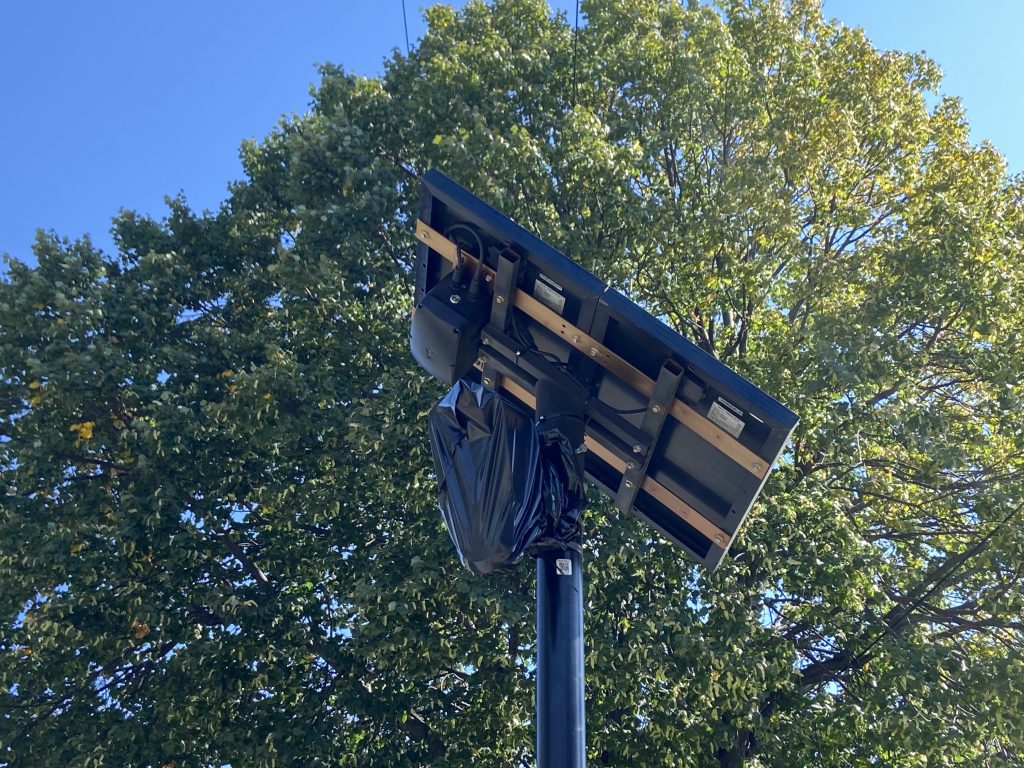
A covered Flock camera in Carver Park. Photo taken by Graham Kilmer.
Milwaukee County Executive David Crowley signed a resolution Monday banning Flock surveillance cameras from Milwaukee County Parks.
The county executive formally signed the change to the county’s local ordinances in Carver Park, within view of a Flock camera that was recently covered with a black plastic bag. The Milwaukee County Sheriff’s Office (MCSO) opposed the ordinance change, arguing crime could increase in county parks if Flock is removed.
“Residents and lawmakers on both sides of the aisle are asking whether the convenience of this technology is worth the cost to our privacy, and who is accountable for how it is actually being used,” Crowley said at the signing ceremony. “We should not have to wait for a data breach or a scandal for us to get those answers. Here in Wisconsin and across the nation, Flock executives have shown a pattern of misleading the public about their business practices, their safety record, and their commitment to privacy, and their efforts to protect vulnerable populations.”
In response to public pushback, elected officials and law enforcement leaders have begun to scrutinize the surveillance cameras and systems sold by the company Flock Safety. In particular, they are examining cameras with automated license plate reader (ALPR) technology, which passively scans all license plates that pass in front of the camera and stores them in a database that law enforcement can search. The database is maintained by Flock Safety and it also stores the make and model of vehicles as well as aftermarket alterations.
Opponents say the cameras pose civil liberties concerns, as an individual’s movements could be reconstructed using data captured by Flock’s nationwide surveillance system. Three Milwaukee Police Department officers have been investigated for misusing Flock searches. One officer, Josue Ayala, recently pleaded guilty to misconduct in public office for using the Flock system to track his ex-girlfriend. There has not been a similar incident reported by the MCSO. Crowley said that wasn’t “a good enough reason to keep this technology in place.”
There are currently 42 Flock cameras located in 11 county parks. The sheriff’s office operates most of them, with 25 Flock ALPR cameras and six Flock Condor cameras, which do not have ALPR capabilities but can be controlled by MCSO personnel to track people or objects. There are also six other Flock cameras on county roads and equipment operated by municipal police departments.
Sup. Justin Bielinski authored the county ordinance change, which directs Milwaukee County Parks to remove all Flock Safety cameras from county parkland, including both traditional video surveillance cameras and ALPR cameras. It was passed unanimously by the Milwaukee County Board of Supervisors.
The resolution does not ban surveillance cameras in general, nor ALPR technology. It leaves room for a surveillance camera system controlled by the county. Bielinski has repeatedly called for a policy of requiring a judicial warrant to access data passively captured by an ALPR system. The supervisor likened ALPR cameras for law enforcement to performance-enhancing drugs for athletes; while law enforcement might like to use them, they are “an unacceptable risk,” Bielinski said.
“Public safety, when people think of that term, they often think of police, and that that is an important part of it,” Bielinski said. “But when we’re talking about parks, also a big element of public safety is lighting. It’s the physical presence of people. It’s programming. And I think we need to make sure that we’re looking at a holistic approach to public safety in whatever we do at Milwaukee County and at every level of government.”
In September, Crowley called for a policy framework limiting how long the county’s Flock data is stored and who has access to it. Sheriff Denita Ball announced the agency would no longer maintain Flock data for 30 days, shortening the retention period to seven days. She also said MCSO had opted out of the Flock program that shares data captured by MCSO cameras with other local, state or federal law enforcement authorities.
“I appreciate the Milwaukee County Sheriff’s Office for working in good faith to strengthen accountability in this policy framework, and I also know they have described a positive relationship with Flock’s leadership, but even the strongest policy framework is only as trustworthy as the company behind the technology, and a good partnership with the vendor does not safeguard our residents’ data,” Crowley said.
The ordinance is focused on cameras located in parks because the county board has control over county parkland; it cannot remove cameras elsewhere in the county controlled by local municipalities or the state.
“These are parks where kids play, families gather, neighbors come to enjoy little peace, to find respite when life gets hard, to find joy when things are tough,” Milwaukee County Board Chairwoman Marcelia Nicholson-Bovell said. “Government has a responsibility to protect people from harm, but that doesn’t give us a blank check to monitor their movements, especially in communities that have experienced more than their fair share of surveillance and overpolicing.”
If you think stories like this are important, become a member of Urban Milwaukee and help support real, independent journalism. Plus you get some cool added benefits.
Political Contributions Tracker
Displaying political contributions between people mentioned in this story. Learn more.


MKE County
-
New $245 Million Forensic Science Facility Is a ‘Watershed Moment’
 Oct 11th, 2026 by Graham Kilmer
-
Crowley Halts Tablet Messaging In County-Run Prison
 Oct 9th, 2026 by Graham Kilmer
-
The Big Business Behind a Decade of China Lights
 Oct 9th, 2026 by Graham Kilmer