
Sherman Park Home Showcases City’s Growing Lead Hazard Crackdown
Mayor Johnson touts partnerships that turned one aging house into a model for lead safety work.
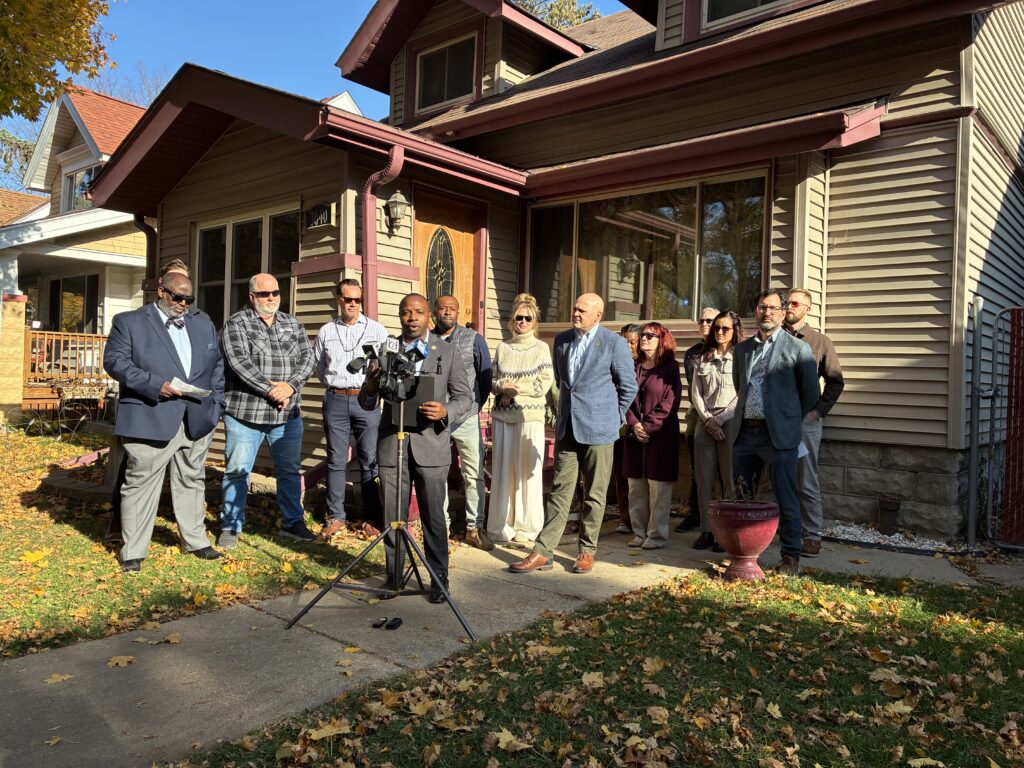
Mayor Cavalier Johnson speaks outside Sherman Park home cleaned up lead hazards through city program. Photo taken Nov. 19, 2026 by Graham Kilmer.
Mayor Cavalier Johnson visited a home in the Sherman Park neighborhood Thursday as the city nears an important milestone for its home lead removal program.
The city has spent approximately $23.7 million of federal, pandemic-era aid on its home lead hazard reduction, and it is on track to finish remediating lead hazards in more than 3o0 homes by the end of the year. In Sherman Park, the mayor, Milwaukee Health Department officials and representatives of Habitat for Humanity gathered outside one of the homes to mark the occasion, and announce a new federal grant for the program.
“The City of Milwaukee, we take lead prevention very seriously. It is a priority,” Johnson said. “We work constantly to invest resources, to deploy people, to build the partnerships necessary so that our residents, and not even just our residents, but particularly the children, our kids, are safe from the scourge.”
More than 2,000 children in Milwaukee test positive for elevated blood levels each year. The city’s health department advises parents to test children as young as 12 months for lead.
“We have over 2,000 children a year that test positive in the city of Milwaukee, at 3.5 micrograms a deciliter and above,” said Tyler Weber, deputy commissioner of the department’s Environmental Health Division.
The home lead hazard program is a collaboration between the city, Milwaukee Habitat for Humanity and Revitalize Milwaukee to identify homes with lead hazards and remove the lead at no cost the homeowner. The program was focused on neighborhoods with old housing, where lead paint is likely present, and high rates of childhood lead poisoning. Contractors and teams from Habitat for Humanity remove windows doors and other deteriorating surfaces, while making other repairs.
The funding for the program came from the American Rescue Plan Act (ARPA). The city used a portion of its $394.2 million ARPA grant to staff up the complex public health program, purchase new equipment and pay for lead remediation in hundreds of homes. The program will also continue for another four years and rid another 300 homes of lead hazards thanks to a $7.7 million U.S. Housing and Urban Development Grant, Weber said.
Habitat partnered on the program through its home preservation initiative, performing some of the lead removal work, said Al Smith, COO of Milwaukee Habitat for Humanity. Habitat worked on the home in Sherman Park visited by the mayor and others Tuesday. It needed $40,000 in lead remediation and repairs. The city covered the entire cost.
“For many homeowners a $40,000 repair is simply out of reach,” Smith said.
The repairs are just one of the final steps of a complicated, multi-layered process devised by city officials, Weber said. It begins when the health department receives test results showing elevated blood lead levels. Next the nursing team makes contact with the family and begins coordinating with home inspectors. A lead risk assessment is conducted on the property. A scope of work is designed. The work is bid out. The family is temporarily relocated, sometimes with the help of nonprofit Revitalize Milwaukee. Work is performed and, ultimately, the family is able to move back in.
“That takes significant effort and coordination and we had to to that 300 times over and over again,” Webber said. “And so, this is what it takes to make a lead safe Milwaukee, it takes partnership it take collaboration, and it takes working with homeowners. It takes working with landlords.”
Health Commissioner Mike Totoraitis said the incredibly labor intensive program has required “countless hours of review, construction, inspection, community education.”
“We wouldn’t be able to do that without the dedicated members of our Home Environmental Health Team,” he said. “This is the same team that responded to the MPS lead crisis last year.”
Organizations, including the Coalition on Lead Emergency and Sixteenth Street Community Health Centers, have assisted the health department with outreach to the families, Weber said. “Because not everyone, honestly, trusts a government badge when they’re at the door.”

Existing members must be signed in to see the interactive map. Sign in.
If you think stories like this are important, become a member of Urban Milwaukee and help support real, independent journalism. Plus you get some cool added benefits.
More about the American Rescue Plan Act
- Sherman Park Home Showcases City’s Growing Lead Hazard Crackdown - Graham Kilmer - Nov 20th, 2026
- Milwaukee Scrambles To Spend Last of $400 Million Federal Grant - Jeramey Jannene - Nov 18th, 2026
- Divided Council Reaches Deal on Leftover Federal Pandemic Funds - Jeramey Jannene - May 13th, 2026
- City Hall: So Many Needs, So Few ARPA Dollars Left to Spend - Jeramey Jannene - May 6th, 2026
- City Hall: Who Will Be Funded by Council’s Transformation Fund? - Jeramey Jannene - Mar 31st, 2025
- Homes MKE Putting First-Time Buyers Into Rehabbed Homes - Nick Rommel - Nov 21st, 2024
- City Hall: Proposal Seeks Big Impact With Small Piece of Federal ARPA Grant - Jeramey Jannene - Oct 8th, 2024
- MKE County: As Deadline Looms, County Should Shift Stimulus Funding - Graham Kilmer - Dec 8th, 2023
- A Mix of Speed Hump and Crosswalk, New Street Feature All About Safety - Jeramey Jannene - Oct 30th, 2023
- Transportation: Construction Underway on Traffic Calming Projects - Jeramey Jannene - Oct 12th, 2022
Read more about American Rescue Plan Act here
More about the Lead Crisis
- Sherman Park Home Showcases City’s Growing Lead Hazard Crackdown - Graham Kilmer - Nov 20th, 2026
- DNR Lead Service Line Replacement Outreach Grant Program Finishes Strong - Wisconsin Department of Natural Resources - Sep 15th, 2026
- Why Milwaukee’s Lead Pipe Program Is Cheaper, Faster — And Still At Risk - Jeramey Jannene - Jun 1st, 2026
- EPA Announces $94 Million for Wisconsin to Replace Lead Pipes - Danielle Kaeding - May 20th, 2026
- New Documentary Exposes Federal Funding Cliff at the End of 2026, Wisconsins Push to Replace All Lead Pipes - Wisconsin Conservation Voters - May 5th, 2026
- Gov. Evers Signs New PFAS, Lead Regulations - Danielle Kaeding - Mar 2nd, 2026
- City Receives $400,000 Grant For Lead Screening - Sophie Bolich - Feb 24th, 2026
- Rep. Madison Proposes Restoring Local Control Over Lead Inspections - State Rep. Darrin Madison - Jan 6th, 2026
- $43 Million Later, MPS Says Classrooms Are Safe From Lead Dust - Corrinne Hess - Dec 18th, 2025
- MPS Buildings Cleared of Lead-Paint Risks after 10-Plus Months of Work - Milwaukee Public Schools - Dec 17th, 2025
Read more about Lead Crisis here