
Milwaukee Scrambles To Spend Last of $400 Million Federal Grant
But how to spend $1.8 million of remaining ARPA money has council, mayor at odds.
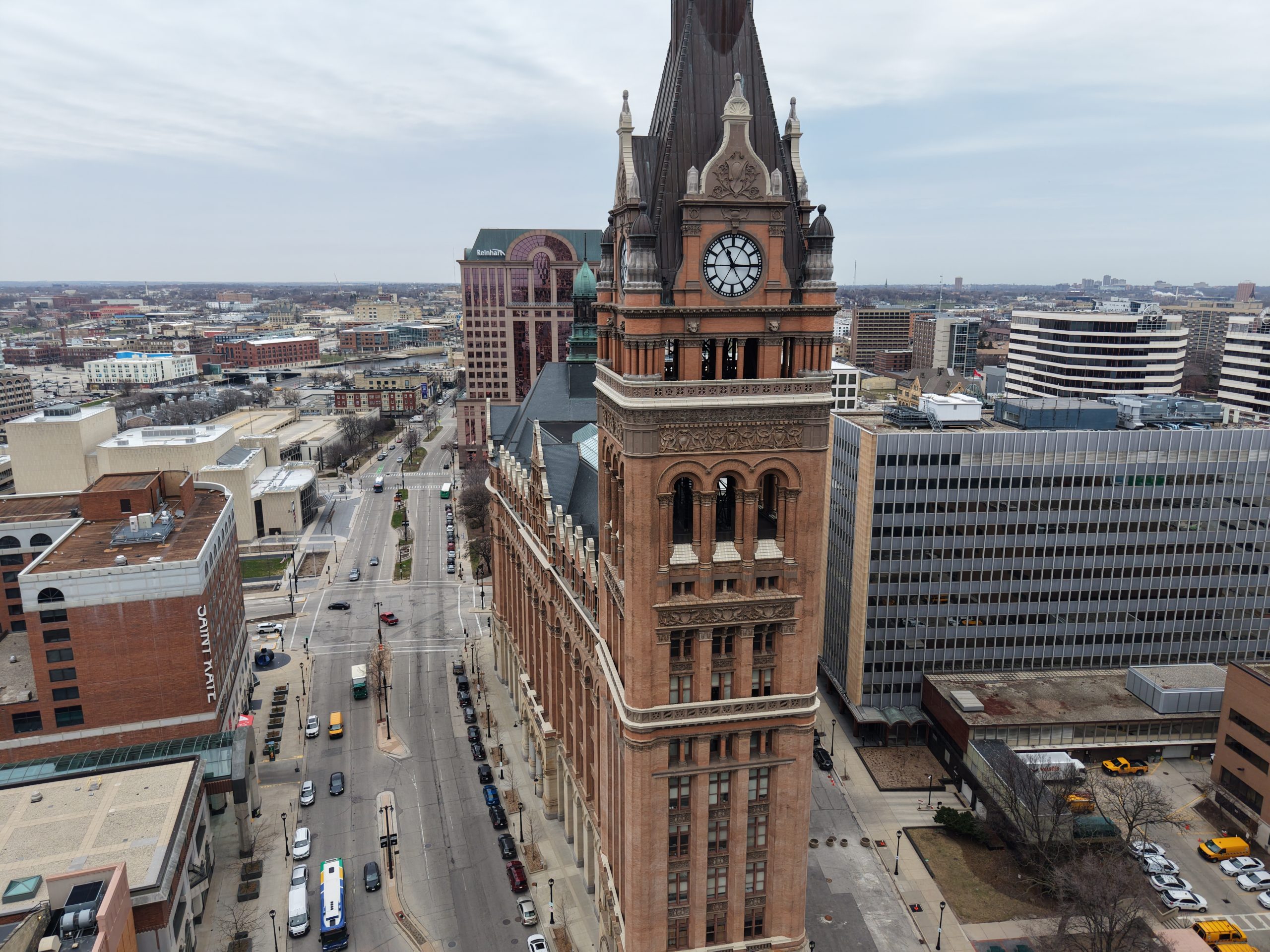
Milwaukee City Hall. Photo by Urban Milwaukee staff.
Milwaukee finds itself in a use-it-or-lose-it situation with a tight timeline for the final portion of a $394.2 million federal grant.
By the end of 2026, the city must use the American Rescue Plan Act grant or return the money to the federal government.
All of the grant was allocated by the end of 2024, but the city is now trying to make sure it spends the money.
“I’m trying to spend this money like everybody else. I’m trying to spend it down,” Matthew Balistreri, Community Development Grants Administration ARPA director, told the Finance & Personnel Committee Wednesday.
But how much is slated to remain unspent is still a bit of a guessing game.
And the council could decide to spend whatever remains differently than Mayor Cavalier Johnson wants. Spending the final portion of the grant has been a tug-of-war, both within the council and between the council and administration.
“I’m sure the administration has some ideas. [The council] has many ideas,” said Ald. Marina Dimitrijevic, the committee chair.
An administration-authored resolution says up to $1.8 million could need to be reallocated. But Balistreri said he’s confident only about $1.1 million is at risk of being lost. He said he continues to do a “deep dive” into every program to which the city allocated money.
Dimitrijevic is proposing to allocate the money to the City Clerk‘s Office, effectively giving the council control of it. The budget office is asking to put the money into the Department of Public Works to avoid borrowing money.
Vaccine Issue
The bulk of the unspent money is tied to the reason for ARPA’s existence: the COVID-19 pandemic.
The at-risk funding comes from the Milwaukee Health Department (MHD) and the Department of Neighborhood Services (DNS). MHD has about $1 million targeted at COVID-19 vaccines. DNS has about $140,000 for demolition that is also slated to go unspent.
MHD originally planned to purchase a large amount of vaccine doses at the end of 2026, then use them as long as they lasted into 2027. But that plan was deemed infeasible in recent months.
“Our staff came back and said we can’t spend $1 million on vaccines, there just isn’t the demand,” said Aaron Szopinski, MHD budget and administration manager.
The department also explored buying a large amount of tests. But after pivoting to buying a combined COVID-19/influenza test, MHD discovered the tests are cheaper on a per-unit cost than expected, said Szopinski.
And even if it did buy the tests, it would run into two other issues.
“We don’t have a space big enough to store that many,” said MHD Aaron Szopinski. “And it would be a volume we would be severely challenged to get rid of before their shelf life ends.”
Other departments could add some “small, small balances” to the reallocation pool, said Balistreri, but $1.1 million is the likely amount the city needs to reallocate.
Contingent Borrowing, DPW Surprises
Council members asked why the issue didn’t come up during the recently concluded budget process.
“I found out about this last week,” said Budget Director Nik Kovac.
He said he also learned, via a U.S. Treasury posting and a City Attorney’s Office review, that the city could use money to pay for salaries. It had originally used much of the grant, under a revenue loss provision, to pay for city salaries. Using a sanctioned accounting method from the U.S. Treasury, the city could allocate the grant dollars to cover already paid salaries.
A proposed amendment would spend the remainder on salaries for the Department of Public Works, said Kovac. The measure is intended to avoid borrowing to close the city’s 2026 fiscal year. The 2026 contingency fund, Kovac said, has less than $300,000 remaining, pending another council action to pay a legal settlement.
“I think it’s likely we will have to borrow something,” said Kovac, describing how the city had a $900,000 margin in 2025 and avoided borrowing by only $1,200. “Our goal was to reallocate it in a way that would reduce the risk or the amount if there is borrowing to close out the 2026 books. If you do [borrow], you’re paying interest for 10 years just to operate what you did in 2026.”
He said the city is being particularly squeezed this year by the higher-than-expected cost of the new contract with the Milwaukee Police Association, which has drawn down a wage stabilization fund.
“The simultaneous reporting of a surplus and a deficit is hard for this body to observe,” said Dimitrijevic of the $2.1 million in excess revenue. She said her goal was to add “time and additional transparency and thoughtfulness” by temporarily giving the clerk the money.
She said the funding could then be transferred to a department that needs it. “Nope,” said Kovac. “The City Attorney can weigh in on that.” A web of regulations prevents transferring funds between departments once budgeted, though with certain funding sources a surplus in one department can offset a deficit in another at the end of the year.
Ald. Peter Burgelis said before he votes to give the money to DPW he wants to know how much was spent on overtime for pothole filling, the April flood response and late leaves cleanup.
“The actual biggest driver for us is the increased cost for vehicle repair and parts,” said Chuck Schumacher, DPW operations administration manager. He said the department expects to be $1.3 million over budget and the “bulk of that” is related to vehicle issues. “Between inflation and the Trump tariffs, we have absolutely been seeing an increase in the cost of vehicle repairs.”
Kovac said the department is also running $350,000 beyond its $850,000 overtime allocation.
“There is also a new wrinkle we just found out about,” said Kovac. DPW owes $260,000 to the Village of Menomonee Falls for an improper allocation over the past decade of a road on the border of the two municipalities. “DPW is the most obvious department that is going to go over budget and therefore could use relief.”
Several council members, including Scott Spiker and Milele A. Coggs, expressed frustration that the issues weren’t discussed as part of the budget process.
Kovac said DPW has both the size and need to respond to unexpected events that makes it susceptible to deviations from its budget.
He asked that the committee split the funding, half to the City Clerk‘s Office to cover an up to $500,000 deficit and the remainder to DPW.
Dimitrijevic said she would take that under advisement as the committee explores possible changes on the council floor or in a subsequent meeting. The committee then unanimously recommended adoption of her plan to authorize giving the entire $1.8 million to the clerk.
“What I’m trying to do is create time,” said Dimitrijevic. “The number is changing. It changed even from last week to today.”
If you think stories like this are important, become a member of Urban Milwaukee and help support real, independent journalism. Plus you get some cool added benefits.
More about the American Rescue Plan Act
- Milwaukee Scrambles To Spend Last of $400 Million Federal Grant - Jeramey Jannene - Nov 18th, 2026
- Divided Council Reaches Deal on Leftover Federal Pandemic Funds - Jeramey Jannene - May 13th, 2026
- City Hall: So Many Needs, So Few ARPA Dollars Left to Spend - Jeramey Jannene - May 6th, 2026
- City Hall: Who Will Be Funded by Council’s Transformation Fund? - Jeramey Jannene - Mar 31st, 2025
- Homes MKE Putting First-Time Buyers Into Rehabbed Homes - Nick Rommel - Nov 21st, 2024
- City Hall: Proposal Seeks Big Impact With Small Piece of Federal ARPA Grant - Jeramey Jannene - Oct 8th, 2024
- MKE County: As Deadline Looms, County Should Shift Stimulus Funding - Graham Kilmer - Dec 8th, 2023
- A Mix of Speed Hump and Crosswalk, New Street Feature All About Safety - Jeramey Jannene - Oct 30th, 2023
- Transportation: Construction Underway on Traffic Calming Projects - Jeramey Jannene - Oct 12th, 2022
- Eyes on Milwaukee: City Seeking Affordable Housing Developers Who Need Funding - Jeramey Jannene - Jul 25th, 2022
Read more about American Rescue Plan Act here
Political Contributions Tracker
Displaying political contributions between people mentioned in this story. Learn more.
- May 7, 2015 - Nik Kovac received $10 from Cavalier Johnson