

Milwaukee’s Data Center Moratorium Takes Key Step Forward
But will a hyperscaler ever seek to build in Milwaukee?
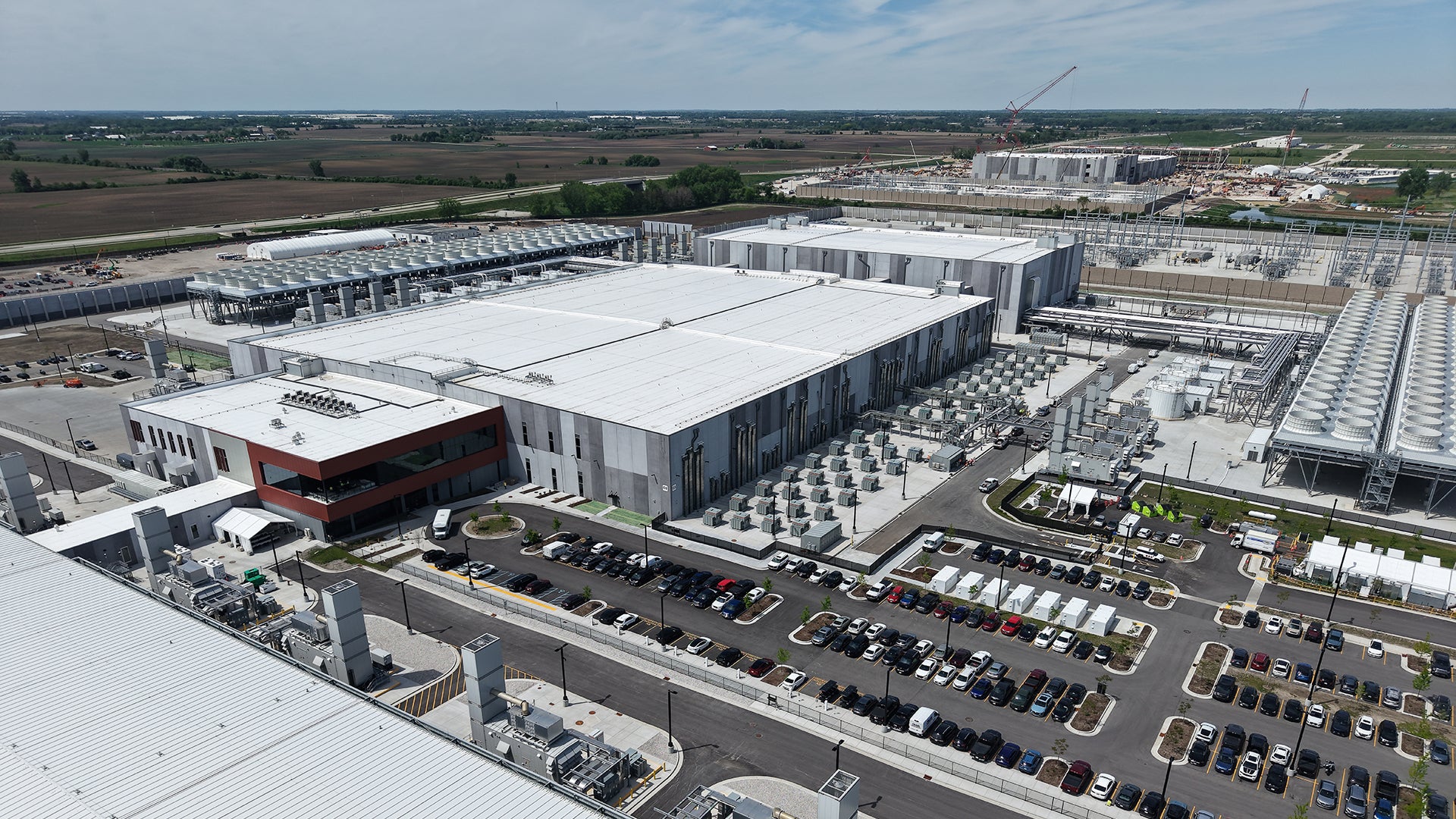
A Microsoft data center in Mount Pleasant, Wisconsin appears in a June 2026 photo. Photo courtesy of Microsoft
Milwaukee’s proposed one-year pause on new data centers is one step from final approval after a Common Council committee unanimously endorsed the measure Tuesday.
The Zoning, Neighborhoods & Development Committee backed the moratorium without opposition, advancing it to the full Common Council.
The proposal would generally prevent new data centers from moving forward while city officials develop permanent zoning regulations addressing their potential impacts, including noise, energy use and air quality.
But the moratorium would not amount to an absolute ban on new projects.
Department of City Development planning manager Tanya Fonseca confirmed that a developer could still pursue a site-specific Detailed Planned Development zoning change for a data center. Such a proposal would require public hearings and approvals from both the City Plan Commission and zoning committee before reaching the full council.
“There is a lot of discussion on this issue and I think we are in a good place to get regulations in place within a year,” Fonseca said.
She said the city is “certainly” trying to meet the one-year deadline, though state law would allow the moratorium to be extended for an additional six months if “absolutely necessary.”
The legislation would also add, for the first time, a definition of a data center to Milwaukee’s zoning code.
It defines one as a facility used primarily to operate or provide access to computer and network infrastructure for transmitting data, voice, internet traffic, video or other information, along with supporting equipment such as air handlers, generators, fuel storage, cooling systems and utility infrastructure. The definition specifically excludes ordinary server rooms and facilities serving another principal use on the same property.
“This pause is really important so we can get it defined in the code,” Fonseca said.
Existing data centers could continue operating during the moratorium, but they could not expand unless they obtained the necessary zoning approvals, she said.
Ald. Marina Dimitrijevic, the proposal’s lead sponsor, said the pause gives the city time to develop a regulatory structure while ensuring residents have a meaningful role before projects are approved.
“If we did nothing, it would be basically unregulated, and there would be very little public process,” she said.
Dimitrijevic said the city has spent months trying to develop permanent rules but repeatedly encountered the difficulty of regulating a rapidly evolving industry whose facilities can vary dramatically in size and impact.
She said the council explored several potential approaches, including regulating data centers according to existing industrial zoning districts, but found that industrial land is unevenly distributed across Milwaukee. “Not every district in the city is the same,” she said.
Dimitrijevic said Milwaukee is joining communities across Wisconsin and the country that have temporarily halted data center development while they determine how the facilities should be regulated. The eventual regulations, she said, should ensure residents know when a project is proposed and understand its expected impacts on water, air quality, land use and noise.
“We’re still going to get the regulation done, because we have to,” she said.
The moratorium would end once permanent regulations are adopted, even if that occurs before the one-year period expires.
Dimitrijevic also credited residents for pushing the issue onto the city’s agenda.
“This is a great example of how the legislative branch, which is the closest to the people, hears this in the communities, and then brings that work to City Hall and takes action,” she said.
Several committee members praised Dimitrijevic for taking the lead on the issue. Council members Peter Burgelis and DiAndre Jackson also asked to be added as cosponsors during Tuesday’s meeting and praised Dimitrijevic for leading on the issue. Council members Alex Brower, Russell W. Stamper II, Robert Bauman and Sharlen P. Moore are already cosponsors.
The committee did not consider an amendment that would have exempted the Forest County Potawatomi Community from the moratorium. The amendment also no longer appears in the city’s legislative record system.
Ald. Bauman, who had previously been listed as proposing the exemption, instead used Tuesday’s discussion to argue that data centers should not all be treated alike.
“It seems to me there are data centers and then there are data centers,” Bauman said, emphasizing the latter.
He pointed to the Potawatomi-affiliated data center on W. Highland Boulevard, which has operated since 2013.
“I have single-family, owner-occupied homes 20 feet away from that data center and there’s never been a complaint, never been an issue,” Bauman said. “It seems that we’ve been roping all data centers into one bucket and I don’t know that they’re negative with their impact on the community. Some certainly are.”
He said those artificial intelligence uses that occupy large rural sites have drawn the opposition.
Fonseca said city planners are examining how noise and air-quality impacts could distinguish data centers from conventional office and industrial uses, while being careful about how such standards are crafted.
The committee also spent time discussing the potential economic benefits.
Council President José G. Pérez pressed Fonseca on whether DCD’s review would account for possible positive fiscal impacts, rather than focusing solely on potential problems.
“We are doing a full comprehensive review of the impacts, both positive and negative,” Fonseca said.
Bauman noted that the city-owned Milwaukee Water Works has substantial capacity and suggested data centers could potentially generate revenue for the city.
Fonseca cautioned that newer data center systems appear to be using less water than some earlier designs.
She also said Milwaukee is unlikely to attract the sprawling hyperscale campuses being developed elsewhere.
“Hyperscale facilities we likely won’t see in this community. We simply don’t have the land,” Fonseca said.
“I’m told they can go vertical,” Bauman responded.
Fonseca said the city would continue researching the issue.
The committee held no new public hearing Tuesday because the proposal had already been discussed by the committee earlier in the summer. The City Plan Commission unanimously recommended the moratorium after nearly two hours of discussion and testimony.
At that hearing, supporters argued the city should establish rules before allowing potentially intensive data center projects to proceed. Opponents, including the Metropolitan Milwaukee Association of Commerce and Building Advantage, warned that a broad moratorium could cost Milwaukee investment, jobs and tax revenue.
The moratorium was introduced as controversy grew over a proposal to redevelop the vacant Midtown Center Walmart, 5825 W. Hope Ave., with a mixed-use project that included a 19,000-square-foot data center. But the zoning framework initially proposed by Dimitrijevic would not have applied to the development because it was less than 20,000 square feet.
The moratorium applies to all facilities that meet the definition of a data center, regardless of size.
The full council is slated to consider the proposal next week at its Oct. 13 meeting.
Legislation Link - Urban Milwaukee members see direct links to legislation mentioned in this article. Join today
If you think stories like this are important, become a member of Urban Milwaukee and help support real, independent journalism. Plus you get some cool added benefits.
More about the Milwaukee data center regulations
- Council Unanimously Approves Data Center Moratorium - Jeramey Jannene - Oct 13th, 2026
- Milwaukee’s Data Center Moratorium Takes Key Step Forward - Jeramey Jannene - Oct 6th, 2026
- Commission Endorses Milwaukee Data Center Moratorium After Fiery Hearing - Jeramey Jannene - Sep 30th, 2026
- Milwaukee’s Data Center Moratorium Heads To First Public Hearing - Jeramey Jannene - Sep 17th, 2026
- Op Ed: Why We Support a Temporary Moratorium on New Data Centers - Ald. Marina Dimitrijevic and Ald. Russell W. Stamper, II - Jul 27th, 2026
- Milwaukee Will Pursue Data Center Moratorium - Jeramey Jannene - Jul 24th, 2026
- City Hall: Milwaukee Introduces Data Center Regulations - Jeramey Jannene - May 20th, 2026
- City Hall: Alderwoman Seeks To Regulate Data Centers in Milwaukee - Jeramey Jannene - Dec 19th, 2025
Read more about Milwaukee data center regulations here
Political Contributions Tracker
Displaying political contributions between people mentioned in this story. Learn more.
- October 23, 2024 - DiAndre Jackson received $75 from Sharlen P. Moore






















If there’s one thing Milwaukee doesn’t have, it’s an abundance of underutilized or fully abandoned industrial sites. If there’s one thing the city doesn’t need, it’s a new sources of tax revenue.