

Will Voters Reject Three Constitutional Amendments?
Republicans seek three amendments. Voters have rejected only one in past 30 years.
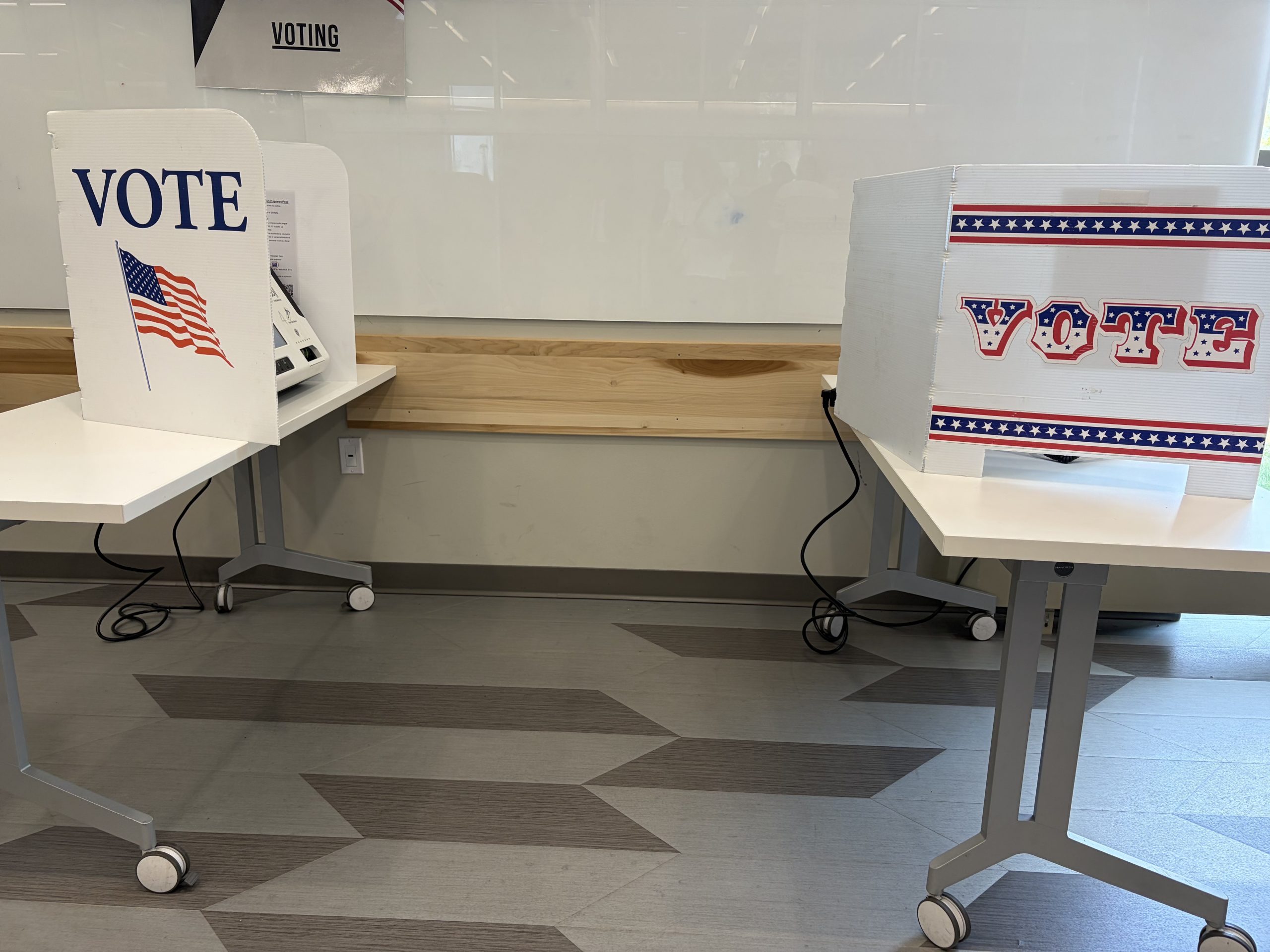
Voting booths at Good Hope Library. Photo taken July 28, 2026 by Sophie Bolich.
Republican legislators who put three proposed constitutional amendments before voters on Nov. 3, bypassing Democratic Gov. Tony Evers, have history on their side: Wisconsin voters have rejected only one of 14 proposed constitutional changes in the past 30 years.
Amending the Wisconsin Constitution is a process that requires approval by two successive sessions of the Legislature, which takes at least three years, and then passage by voters statewide. It’s the Legislature’s prerogative; governors play no role. Republicans have controlled the Legislature since 2011.
The 13 approved constitutional changes since 1996 have passed by an average of 71%. The only rejected change was in 2018, when 62% of voters refused to abolish the office of state treasurer.
Legislators have put constitutional amendments before November voters five times since 1996, drawing turnouts that varied from 1.5 million to 2.1 million. The biggest turnout was in November 2006, when a proposed amendment defining marriage as being between one man and one woman passed by a 59% to 41% margin.
In 2015, the U.S. Supreme Court voided Wisconsin’s constitutional definition by legalizing same-sex marriages nationally.
Voters got a chance to vote on constitutional changes in April nonpartisan general elections nine other times. April voter turnouts ranged widely — from 1.7 million votes in 2023 to only 711,000 votes in 2005, when four-year terms for county officials were approved.
On Nov. 3, voters will decide whether to prohibit state or local governments from closing religious gatherings during health or other emergencies, prevent state agencies from offering advantages or incentives based on race or other individual characteristics, and put new limits on future governors’ veto powers.
Summaries of all three proposed amendments are on the website of the nonpartisan Legislative Reference Bureau.
*Prohibit government shutdowns of religious gatherings
Responding to the national COVID-19 pandemic, which killed more than 16,700 people in Wisconsin, Evers in 2020 issued a Safer at Home emergency order that limited houses of worship to 10 or fewer people and listed businesses, including liquor stores, and organizations that could stay open. The state Supreme Court voided that order in May 2020.
Republican legislators then drew up the following proposed constitutional amendment, which goes before voters in less than a month:
“Shall section 18 of Article 1 of the Constitution, which deals with religious liberty, be amended to prohibit the state or a political subdivision … from ordering the closure of, or forbidding gatherings in, places of worship in response to a state of emergency, including a public health emergency?”
Groups that have lobbied for and against this change include the League of Women Voters of Wisconsin and Wisconsin Family Action. Their reasons for those positions are on their respective websites.
*Government discrimination
Responding to the push by President Donald Trump’s administration to eliminate all diversity, equity and inclusion (DEI) programs in the federal government and in colleges and universities, Republican legislators proposed this constitutional change on the Nov. 3 ballot:
“Shall section 27 of Article 1 of the constitution be created to prohibit government entities in the state from discriminating against, or granting preferential treatment to, any individual or group on the basis of race, sex, color, ethnicity, or national origin in public employment, public education, public contracting or public administration?”
The amendment would bar DEI programs at public schools, colleges and universities, state agencies and by state contractors.
The Wisconsin Institute for Law and Liberty supports the change. The Wisconsin Democracy Campaign, the League of Women Voters and public education groups oppose it.
*Governor’s veto authority
When he signed the 2023-25 state budget into law, Evers vetoed it in a way to let public schools raise their spending by $325 per pupil for 400 years — from the 2023-25 school year, as passed by Republican legislators, to 2425. That veto continued the biggest increase in property taxes for schools in decades, according to the Wisconsin Policy Forum.
Republicans sued, but the state Supreme Court upheld the broad veto power of Wisconsin governors. So Republicans put this change on the Nov. 3 ballot:
“Shall section 10 of Article V … be amended to prohibit the governor, in exercising his veto authority, from creating or authorizing the creation of any tax or fee?”
Groups urging passage of the amendment include Wisconsin Manufacturers and Commerce, the Wisconsin Institute for Law and Liberty and Americans for Prosperity.
The Wisconsin Education Association Council and the League of Women Voters oppose the amendment.
Steven Walters started covering the Capitol in 1988. Contact him at stevenscotwalters@gmail.com
If you think stories like this are important, become a member of Urban Milwaukee and help support real, independent journalism. Plus you get some cool added benefits.


The State of Politics
-
Lt Governor Race Offers Stark Contrasts
 Oct 19th, 2026 by Steven Walters
-
Will Fox Valley Voters Disappoint Democrats?
 Oct 12th, 2026 by Steven Walters
-
As Legislators Tiffany, Crowley Had Very Different Goals
Sep 28th, 2026 by Steven Walters




















Vote “No” whenever WILL wants to write the Constitution. They don’t represent you even if their slick wording and emotional appeals seems like it does.
Just vote “NO” on all three proposed amendments.
Always vote no ballot referendums. Compel legislators to fulfill their constitutional duties.
If Republicans want something–that is reason enough to be skeptical about what’s in it for them. I never used to vote for or against any one party, but ever since the Porky Pig politics started on January 20, 2017, it is now necessary to do.
All three will pass due to the slick misleading wording.
NO NO and NO
Interesting that none of these referendums are anything anyone would ask for. Single payer healthcare maybe?
Gonna have to live with this crap. Wisconsin voters are too stupid to make their own decisions THEREFORE they will cave to Fox news every time.
My children are gonna have to claw back democracy over the next 30 years if they can remember what that was like.
Democracy leads to Oligarchy, then comes Aristocracy, then Monarchy, then Revolution, then Democracy. Same as it ever was.
Just say “No!”
Any republican action is to protect rapists. Vote NO!