

Immigration Judge Orders Deportation of Milwaukee Muslim Leader
Judge orders deportation based on letter from Sec. of State Marco Rubio.
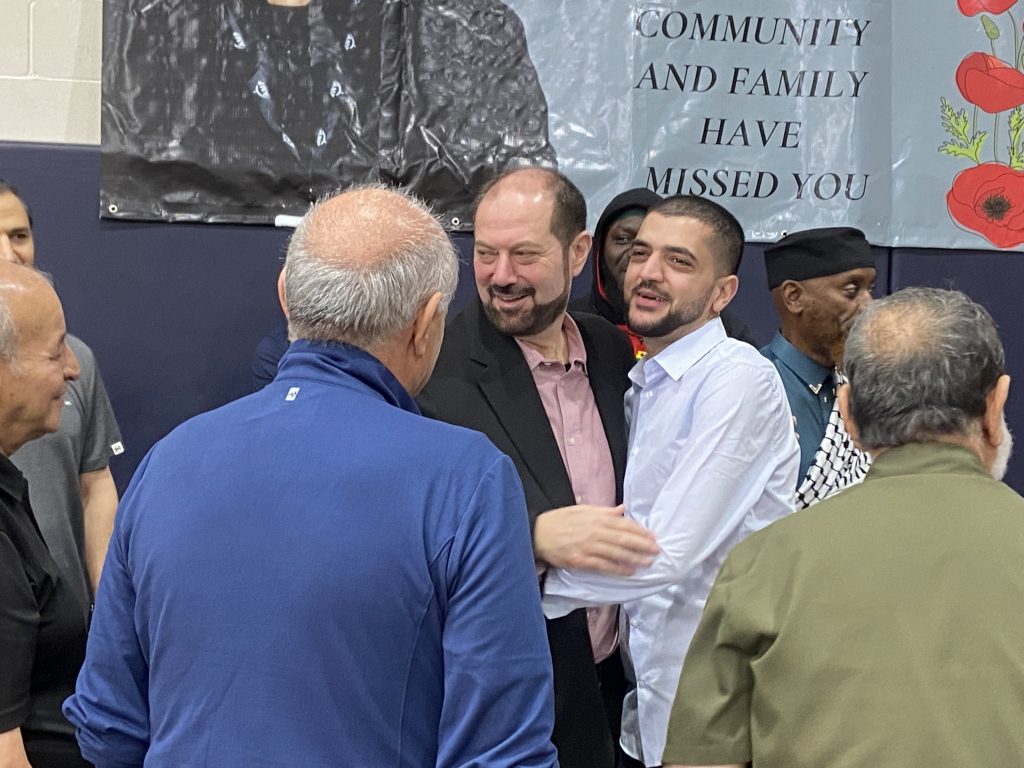
Salah Sarsour (center) surrounded by friends and supporters. Photo taken June 19, 2026 by Graham Kilmer.
Salah Sarsour, president of the largest mosque in Wisconsin, was ordered deported by a federal immigration judge Wednesday.
Sarsour and his attorneys have spent the past six months fighting for his freedom and ability to stay in the U.S., where he has lived since 1994.
He was arrested by by U.S. Immigration and Customs Enforcement (ICE) agents on March 30 and taken to a jail in Indiana and detained for 81 days. He was only released after a federal judge found evidence suggesting the federal government targeted him for protected speech. Sarsour, who is Palestinian and a leader of the Islamic Society of Milwaukee, is a prominent advocate for Palestine and a critic of Israel.
Judge Jayme Salinardi ordered Sarsour removed from the U.S. on the grounds that he is deportable because Secretary of State Marco Rubio decided he posed a substantial risk to U.S. Foreign Policy, according to Sarsour’s attorneys.
“It was all about deferring to Secretary Rubio’s letter,” said Patrick Taurel, Sarsour’s immigration attorney, during a media briefing Wednesday. “I’m looking at it now, and it was a very short analysis.”
Under Trump Administration, the State Department has employed a federal statute allowing the secretary of state to mark someone for deportation if there is a compelling foreign policy interest. Before going after Sarsour, the administration has similarly targeted pro-Palestinian activists for deportation.
“So you have to ask yourself: If you’re an immigrant, ‘Do I have the right to speak out about issues that matter to me? What if I draw a political cartoon? Am I going to be arrested and detained because of that? Is the government going to bring charges against me and potentially remove me from this country?’,” said Attorney Luna Droubi, who is arguing a separate case against Sarsour’s detention in federal court. “That is significant, and I think it does chill the speech of immigrants and non-citizens in this country, and it should really terrify all of us.”
To make its case for Sarsour’s deportation, the federal government relied on cases from Israeli Military Courts that are more than 30 years old. As a teenager, Sarsour was convicted for stone-throwing. His family and attorneys have maintained the conviction relied on a confession made under duress, and that he was so severely tortured by Israeli security forces he had to be hospitalized. In another case, Sarsour took a plea deal after being charged with procuring a weapon for someone alleged to be a Hamas operative. He was sentenced to time served. Taurel said the sentence was uncharacteristically light for a terrorism related charge in Israel.
“He has denied the allegations in sworn declarations, and he continues to deny that he committed the crimes that he was accused of in Israel in 1994 and 1988,” Taurel said.
Salinardi declined to rule on the Israeli cases and instead deferred to the government’s presentation of evidence. The government also brought charges that he had lied on immigration documents and illegally claimed to be a U.S. citizen while living in America. Salinardi rejected both charges.
Salinardi ordered Sarsour removed to either Israel or Jordan, Taurel said. But on Tuesday, the U.S. Supreme Court upheld a Trump administration policy of deporting immigrants to unspecified third countries.
The U.S. government has never officially recognized the state of Palestine, making it unlikely Sarsour would be ordered to Palestine, Taurel said. The Israeli government also cooperated with ICE in its case against Sarsour, supplying documents entered in federal immigration court, Taurel said.
“And presumably they know that the reason to provide those documents and to authorize their use in immigration court was to facilitate Salah’s return,” Taurel said.
Sarsour initially traveled to the U.S. using Jordanian travel documents. Jordan frequently issues passports to stateless refugees from the Israeli-occupied West Bank and Gaza.
“So our belief, and this will likely become an issue in the case, is that if he were returned to Jordan, he would be immediately repatriated to the West Bank and to Israeli custody,” Taurel said.
Sarsour’s fight is not over. He still has an active case in federal court arguing he was illegally detained by ICE for protected free speech. In his immigration case, his attorneys will next make the case for asylum. That argument will also occur before a different federal immigration judge. Shortly after issuing his order in the Sarsour case, Salinardi announced he was retiring and would pass the case to another judge.
Unlike federal district courts, which are set up as a separate and co-equal branch of the federal government, federal immigration courts are overseen by the executive branch. Immigration judges have faced pressure under the Trump administration. Two judges have already been fired after ruling against the government in similar deportation cases against pro-Palestinian advocates Rumeysa Ozturk and Mohsen Mahdawi.
“It does feel odd,” Droubi said. “We can’t speak more to that, other than to say it seems odd that it’s happening.”
If you think stories like this are important, become a member of Urban Milwaukee and help support real, independent journalism. Plus you get some cool added benefits.
More about the Arrest of Salah Sarsour
- Immigration Judge Orders Deportation of Milwaukee Muslim Leader - Graham Kilmer - Sep 30th, 2026
- Deportation Trial for Milwaukee Muslim Leader Wraps Up - Graham Kilmer - Sep 15th, 2026
- PTSD and Torture Claims by Salah Sarsour Contested in Federal Hearing - Isiah Holmes - Jul 30th, 2026
- Palestinian Community Leader Salah Sarsour Continues to Face Accelerated Deportation Proceedings in Immigration Court - Press Release - Jul 29th, 2026
- After 81 Days In ICE Detention, Salah Sarsour Fights To Stay In Milwaukee - Anya van Wagtendonk - Jul 23rd, 2026
- Libertarian Party of Wisconsin Calls ICE Detention of Milwaukee Mosque Leader a Threat to Free Speech - Libertarian Party of Wisconsin - Jun 23rd, 2026
- Judge Orders Release of Milwaukee Islamic Leader - Graham Kilmer - Jun 18th, 2026
- Congresswoman Gwen Moore Applauds Court Order Requiring Release of Salah Sarsour From ICE Detention - U.S. Rep. Gwen Moore - Jun 18th, 2026
- Congresswoman Gwen Moore Statement on Second Visit to Conduct Wellness Check on Salah Sarsour - U.S. Rep. Gwen Moore - Jun 15th, 2026
- Muslim Leader’s Health Deteriorating in Immigration Lockup - Graham Kilmer - Jun 9th, 2026
Read more about Arrest of Salah Sarsour here





















Marco Rubio another pro-child rape advocate and a republican.
First they came for the socialists, and I did not speak out—because I was not a socialist.
Then they came for the trade unionists, and I did not speak out—because I was not a trade unionist.
Then they came for the Jews, and I did not speak out—because I was not a Jew.
Then they came for me—and there was no one left to speak for me.
—Martin Niemöller
Now is the time for all of us to speak out. This is not the America I was born in. This is not the America that welcomes all with open arms.
Let your position be heard with your vote. If you don’t vote, someone else will be voting for you.
The article states that there is another case pending in which Sarsour’s attorney will seek asylum and that case will be heard before a different judge as Judge Salinardi announced he was retiring after this ruling. Maybe that is a good thing because regarding Judge Salinardi and his rulings on those seeking aylum seemed harsh,
“Detailed data on decisions by Judge Salinardi were examined for the period covering fiscal years 2019 through 2024 court records show that Judge Salinardi decided 733 asylum claims…and denied 94.1 percent (690 cases) and granted 5.9 percent of asylum cases. Compared to Judge Salinardi’s denial rate of 94.1 percent, Immigration Court judges across the country denied 57.7 percent of asylum claims during this same period”.