

New Dashboard Tracks Displacement Risk
Community Development Alliance and Data You Can Use partner on new tool.
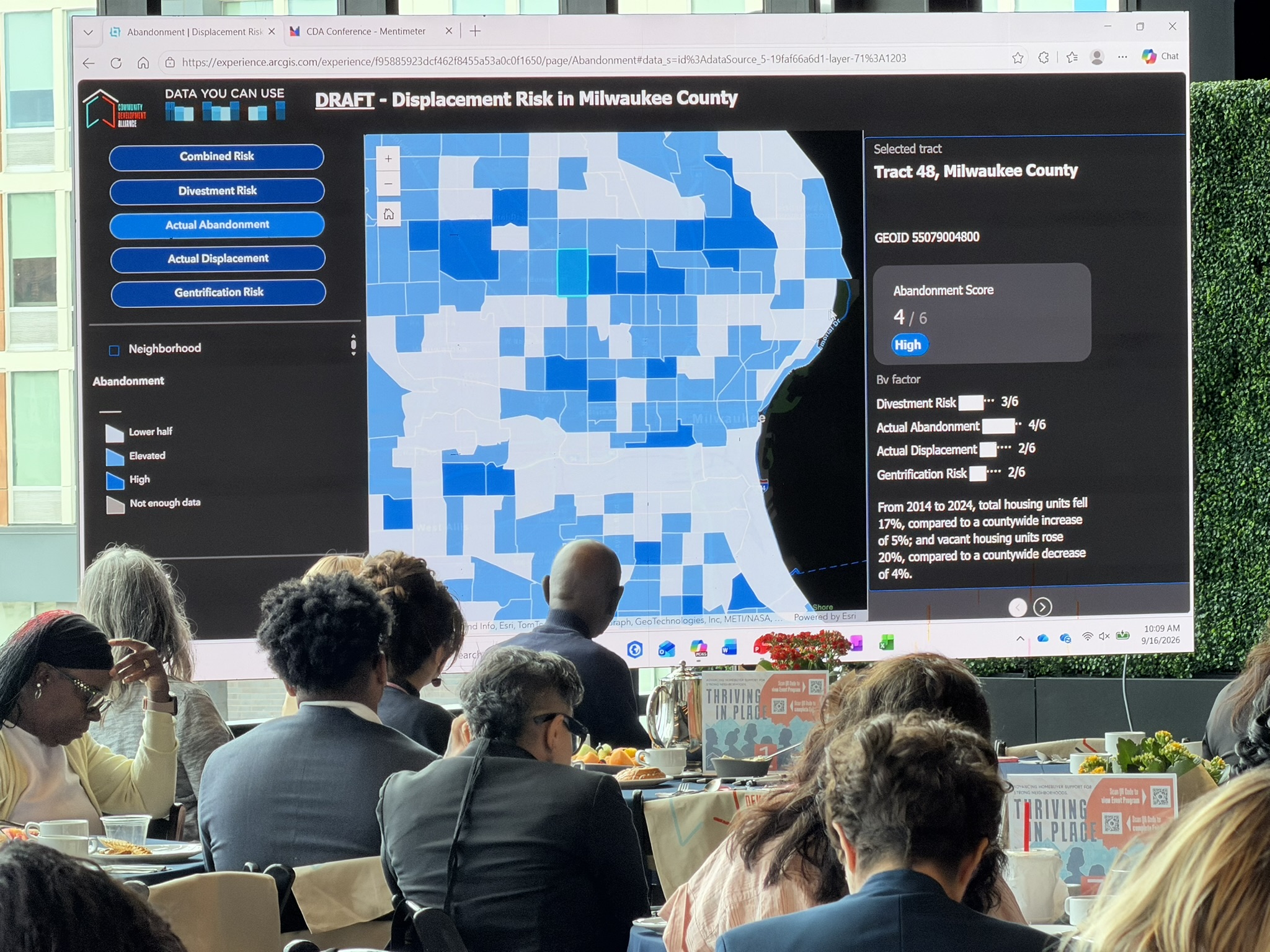
Displacement Risk Dashboard draft. Photo by Jeramey Jannene.
A new database aims to identify neighborhoods at risk of displacement, whether through gentrification or disinvestment, and empower advocates and policymakers to deliver the right solution to the right neighborhood at the right time.
“We need to protect neighborhoods that are vulnerable to displacement,” said Teig Whaley-Smith, chief alliance officer at the Community Development Alliance (CDA), during the alliance’s annual conference Wednesday. “It is our time. It is our challenge. We don’t want to look back and say we missed our opportunity.”
Whaley-Smith said the coalition already has missed opportunities to buy homes and place them into forever affordable programs like the Milwaukee Community Land Trust because resources haven’t been available. But based on input from members, it has stood up things like the Acts Housing acquisition fund and secured public funding to build new homes.
“The other thing we didn’t have was data,” he said. That’s led to bifurcated community meetings, Whaley-Smith said, where some residents show up to complain about spiking property taxes while others talk about blighted homes lowering property values. “We now have data to elevate the conversation.”
The dashboard, due for public release in the next month, tracks eight data points by census tract for four key areas: divestment, abandonment, displacement and gentrification. Covering all of Milwaukee County, it includes data points from 2014 and 2024 to track changes.
“We have all of these indicators. The real question is how do we map those?” said Rohan Katti, senior program manager at Data You Can Use. The nonprofit built the dashboard with support from CDA.
A shaded map for each of the four areas, and one for the four areas combined, was created by ranking each tract against the others. Factors analyzed include vacant homes, the number of new mortgages issued, changes in property values or reported rents, changes in area incomes and the tract’s racial composition.
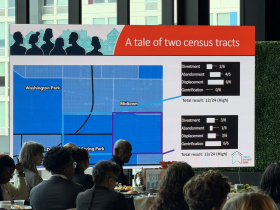
The map produces some unexpected outcomes. Two neighboring census tracts just east of Washington Park both show high combined scores, but for very different reasons. The tract to the west has a high score because of disinvestment, with fewer housing units, a growing number of vacant homes and a high level of racial composition change. In the neighboring tract, displacement is a risk because of traditional gentrification factors, like rising prices and rental prices.
Unlike many maps of Milwaukee, which often fall simply along racial or income lines, the draft dashboard map shows specific areas to target across the entire county.
Whaley-Smith said the goal is to use the dashboard as a guide for where to target efforts and what efforts to use to maintain stability. In some areas that could mean purchasing homes and placing them in a land trust to preserve affordability, while in another it might involve building new homes. “That is why we think this data is so important, so we can develop these strategies without displacing people and people can thrive in place,” he said.
Attendees of the conference, the very policymakers, housing advocates and philanthropists who are intended to use the data, were able to provide their input in advance of the tool’s public launch. The daylong event was held at GATHER in Deer District.
“Ultimately, the goal here is to interrupt this cycle,” said Whaley-Smith.
The conference also included several other presentations, including an update from City Attorney Evan Goyke on the city’s effort to fight nuisance properties, a briefing on homebuyer support systems by Acts Housing‘s Dee Kemp and Jordan Villegas of the United Community Center, and a discussion of new construction systems from CDA Deputy Director Frank Martinez.
The alliance, which launched in 2021, has a goal of creating 32,000 new Black and Brown homeowners over multiple decades to erase Milwaukee’s racial housing divide.
Photos



Existing members must be signed in to see the interactive map. Sign in.
If you think stories like this are important, become a member of Urban Milwaukee and help support real, independent journalism. Plus you get some cool added benefits.






















Am I missing something? This is a city where nearly half of people are low income and huge swaths of the city have not only not gotten better but have gotten measurably worse in my life time all while the city has lost a net 60,000 residents in 30 years and we’re still holding catered lunches about gentrification?