Next Attorney General Will Control $219 Million Legal Settlement
Could spending of settlement cash from Meta and Facebook become issue in fall election?
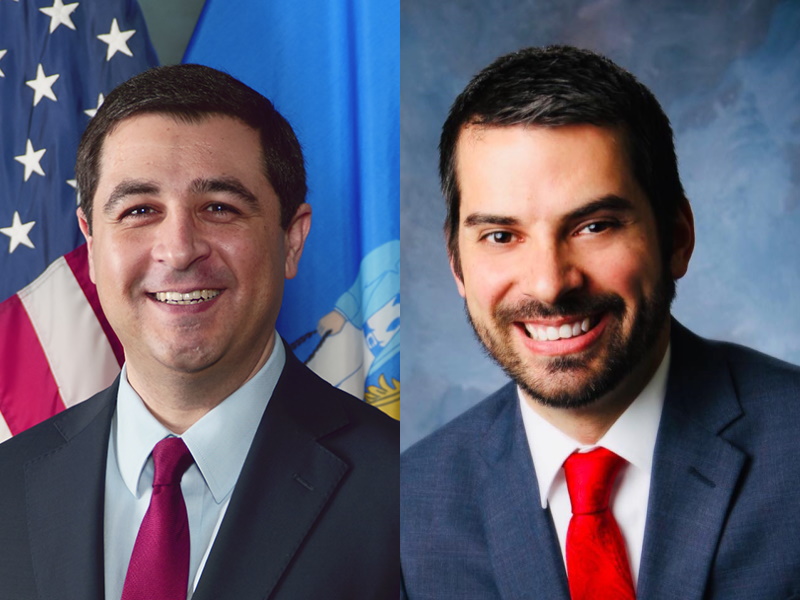
Josh Kaul and Eric Toney.
A July ruling by the Wisconsin Supreme Court will let the attorney general elected on Nov. 3 decide how to spend Wisconsin’s share of a national settlement of up to $17 billion with Meta Platforms over social media practices that targeted and addicted young users.
Democratic Attorney General Josh Kaul, whose Justice Department joined dozens of other states in suing Meta, said in a statement Wisconsin would receive at least $219 million, and could get up to $313 million, over several years.
Kaul faces Republican Eric Toney, the Fond du Lac County district attorney, on Nov. 3. Kaul narrowly won a second term in 2022 when he beat Toney.
Praising the many safety reforms Facebook and Instagram must make under the federal settlement, Kaul said, “This resolution provides for several changes that prioritize kids’ well-being over Meta’s profits. This is a monumental step in changing the role of social media in kids’ lives for the better.”
If he is reelected, Kaul said he plans to spend the $219 million on mental health programs for youths but offered no specifics. He also said the settlement should send a “message” to other social media firms that “engage in conduct that harms our kids.”
Toney’s campaign website does not include any statement on how the Republican would spend the $219 million, if he is elected attorney general. Will he seek to make it a campaign issue?
Kaul said the Meta consumer protection settlement is the second biggest in Wisconsin history, after only the 1998 settlement with tobacco firms.
In a July decision, the state Supreme Court ruled that the attorney general has the sole authority to disperse federal settlement funds.
The decision ended a seven-year fight over whether the attorney general had authority to disburse settlement funds or whether the Legislature had oversight over those funds.
Before Kaul and Democratic Gov. Tony Evers took office in January 2019, outgoing Republican Gov. Scott Walker and Republicans who controlled the Legislature tried to limit the powers of those two state officers. One change required the attorney general to deposit settlement funds in the state’s general fund, which is subject to the spending decisions of legislators.
In the July ruling, Justice Rebecca Dallet said the court’s five-justice majority found that state law “provides in its entirety that ‘[t]he attorney general shall deposit all settlement funds into the general fund.’”
“This simple, declarative sentence identifies a class of state money (‘settlement funds’) and imposes a single, narrow restriction on where that money must be deposited (into the state treasury, specifically ‘the general fund’),” Dallet said.
After that, however, Dallet added, “It says nothing whatsoever about where that money may or must be credited after it is deposited.”
Dissenting Justice Rebecca Bradley accused the majority of ignoring the law to side with the Democratic governor and attorney general.
“The majority refuses to apply the law, which favors the Republican-controlled Legislature,” Bradley wrote. “This is not the first time justice has taken a back seat to political interests.”
The Meta settlement is one of three large settlements Wisconsin has been a part of since 1998.
Under the biggest settlement, 45 tobacco manufacturers signed a Master Settlement Agreement (MSA) in 1998 that requires them to pay billions of dollars in perpetuity to dozens of states to treat smoking-related illnesses. The MSA also required new limits on advertising, promoting and marketing cigarettes.
The website of the National Association of Attorneys General estimates that Wisconsin has received $3.5 billion in payments under the tobacco settlement since 1999.
A summary from the nonpartisan Legislative Fiscal Bureau says Wisconsin’s payments under the tobacco settlement go to the state’s Medical Assistance Trust Fund.
The national opioid settlement was reached in 2021 in response to what the National Institutes of Health (NIH) calls “one of the most severe and devastating public health problems of the 21st century.” One million Americans died of drug overdoses since 1999, NIH reports.
The settlement calls for pharmaceutical manufacturers, medical supply distributors, pharmacy chains and retailers who misrepresented the effects of opioids, offered marketing incentives to physicians to prescribe them, and violated Medicaid rules, to pay billions of dollars to states and local governments over 18 years, according to the NIH.
The national opioid settlement meant that Wisconsin and local governments will receive $866 million between 2022 and 2038, according to the Legislative Fiscal Bureau.
The 2021-2023 state budget says 70% of those payments goes to local governments — primarily counties — and 30% goes to state government.
Steven Walters started covering the Capitol in 1988. Contact him at stevenscotwalters@gmail.com.
If you think stories like this are important, become a member of Urban Milwaukee and help support real, independent journalism. Plus you get some cool added benefits.


The State of Politics
-
It’s Been a Hot Summer for News
 Aug 31st, 2026 by Steven Walters
-
Wikler Predicts Democratic Wave in November
 Aug 24th, 2026 by Steven Walters
-
What Wisconsin Primary Fight Means for 8 Democrats
 Aug 17th, 2026 by Steven Walters