Milwaukee Chamber Music Festival Is Unique Event
Great music, great views of the lake and the most intimate setting.
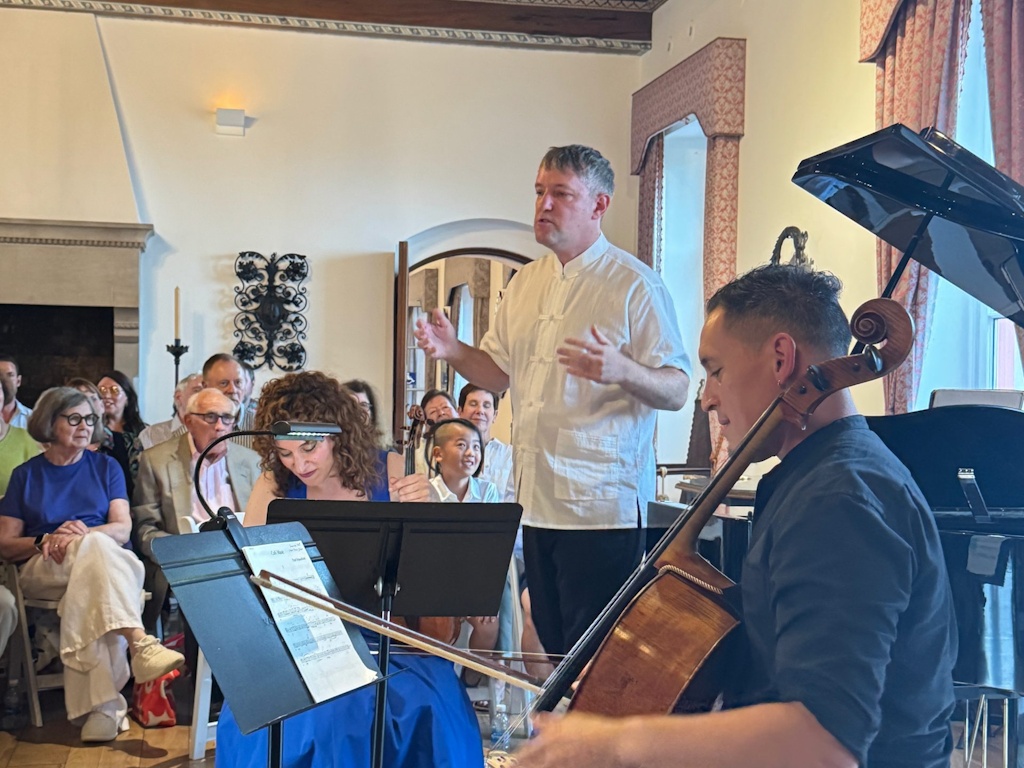
Ilana Setapen, Yaniv Dinur, and Peter Thomas – Milwaukee Chamber Music Festival in 2025. Photo by Michael Barndt
Now in its third year, the Milwaukee Chamber Music Festival will present the complete cycle of Ludwig van Beethoven‘s three “Razumovsky” string quartets. The quartets will be performed by members of the Milwaukee Symphony Orchestra and paired with Russian, Czech, Estonian, German, and French repertoire that speaks to each quartet’s character.
The festival is the creation of pianist and conductor Yaniv Dinur, who has crafted a unique festival for chamber music lovers — a carefully curated series of three concerts (Aug. 27, 28 and 30) featuring many of the Milwaukee Symphony Orchestra’s best players in intimate chamber performances. The large living room of the Villa Terrace, an East Side mansion perched above Lake Michigan, provides an ideal visual and acoustic experience. But the limited seating leads to a hot ticket; this summer’s concerts sold out the weekend before the performances.
The Razumovsky quartets (Op. 59) are dedicated to the Russian ambassador to Vienna, who commissioned them. I recommend musicologist Kai Christiansen (Earsense) for the details of these expansive quartets. These middle-period works, in their symphonic scope and emotional depth, changed the course of the string quartet as a genre.
Dinur has paired each of the quartets with music that matches the focus of the evening.
Thursday evening, Beethoven’s String Quartet No. 7 in F major, Op. 59, No. 1, which introduces Russian folk melodies, will be paired with Russian and Czech works incorporating folk music elements. The first of the Beethoven quartets will be performed by violinists Ilana Setapen and Alexander Ayers, violist Elizabeth Breslin and cellist Madeleine Kabat.
The first Razumovsky quartet also taps intense emotions in a minor-key third movement that Christiansen suggests contains “the incredibly delicate sorrow that achieves an astonishing lightness and clarity of texture.”
Dinur will join violinist Setapen and cellist Kabat for two piano trios:
Russian composer Sergei Rachmaninoff‘s early Trio élégiaque No. 1 in G minor reinforces the Razumovsky quartet’s Russian character in a compact and turbulent work.
Bedřich Smetana‘s Piano Trio in G minor, Op. 15 is infused with Czech folk melodies but was also shaped by the death of his 4-year-old daughter. Each trio includes a funeral march and is cast in G minor.
Friday evening, the second Razumovsky quartet, String Quartet No. 8 in E minor, Op. 59, No. 2, includes a transcendent Adagio movement reportedly conceived while “contemplating the starry sky and thinking of the music of the spheres.”
With changing personnel, the quartet will be performed by violinists Jeanyi Kim and Ji-Yeon Lee, violist Nathan Hackett, and Kabat, returning on cello.
They will be joined by clarinetist Todd Levy for Johannes Brahms’ Clarinet Quintet. Brahms was inspired to postpone retirement after hearing virtuoso clarinetist Richard Mühlfeld. Brahms’ Clarinet Quintet in B minor, Op. 115 adds more weight to the form that Mozart‘s Clarinet Quintet pioneered nearly a century earlier. The second movement has been called “one of the most astonishing things Brahms ever composed.” Muted strings create a hazy, otherworldly backdrop for the clarinet’s serene opening melody, but the movement’s center is given over to a long, minor-key middle section in Brahms’ “Hungarian” or “gypsy” idiom.
Dinur has also paired this quartet with a minimalist work by Estonian Arvo Pärt, Spiegel im Spiegel. In the work, whose title translates as “mirror in the mirror,” Pärt builds from two elemental layers: a slow, stepwise line in the solo instrument, each ascending phrase answered by its mirror image, over steady triadic arpeggios in the piano. The clarinet-and-piano version is especially effective.
Sunday afternoon, the third Razumovsky quartet, String Quartet No. 9 in C major, Op. 59, No. 3, is paired with French works known for their color. Violinists Jeanyi Kim and Ji-Yeon Lee, violist Alejandro Duque and cellist Peter Thomas play the Beethoven quartet.
This Beethoven quartet begins in obscurity: a brooding series of diminished chords, the outer voices diverging in a wedge until any sense of motion disintegrates. The quartet pulls itself together, ending the series of three quartets in triumphant fashion. Dinur draws upon the experimental character of the opening to program works by Claude Debussy and César Franck.
Debussy’s innovative Sonata for Flute, Viola and Harp explores timbres in rare combinations. The viola alternates between anchoring the ensemble and coloring it, stretched to match the flexible lines of flute and harp, with the flute taking the soprano role and the harp filling the space between. Violist Duque, flutist Jennifer Bouton Schaub and harpist Julia Coronelli explore the work.
One of the favorites in the sonata literature, Franck’s Sonata for Cello and Piano (originally for violin) employs a cyclic pattern, as themes from earlier movements return transformed in the finale. Dinur suggests that this gives the piece its distinctive, memory-like emotional pull. Substituting the cello for the violin adds a fresh dimension to the work.
Each work discussed here can be heard at the included YouTube links. Compare the cello version of the Franck sonata with the original violin version. Thomas performed a pair of cello sonatas with Dinur last year with an intensity that should serve this choice well.
Although much of the repertoire is familiar, the works are rarely experienced this close up.
The performances Thursday, Aug. 27, and Friday, Aug. 28, begin at 7 p.m. The concert on Sunday, Aug. 30, begins at 2 p.m. Villa Terrace, at 2220 N. Terrace Ave., has no lot, so plan on street parking. That is generally not difficult for an audience this size.

Existing members must be signed in to see the interactive map. Sign in.
If you think stories like this are important, become a member of Urban Milwaukee and help support real, independent journalism. Plus you get some cool added benefits.