

Tiffany’s Vote for 2025 Medicaid Cuts Could Be Issue in Race for Governor
45,000 people in Wisconsin lost health coverage. 'Biggest cut we've ever seen in this country.'
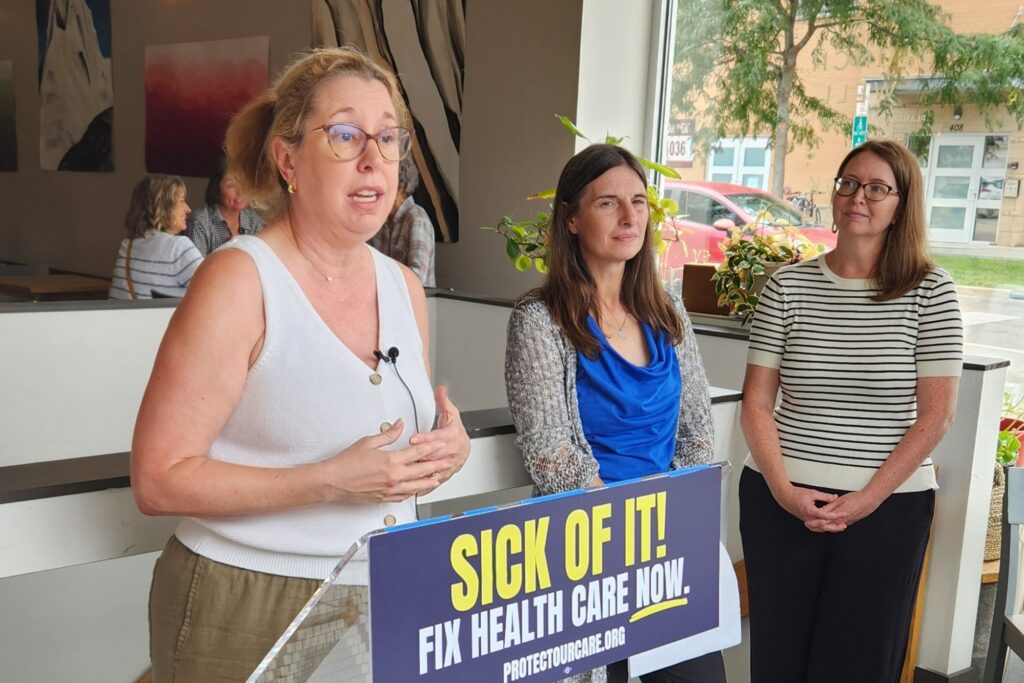
Flanked by Corrine Hendrickson, center, and Nancy Higgs, right, Macy Buhler talks about the impact of increased health insurance costs on her workforce of childcare teachers at a news conference Tuesday criticizing Republican candidate for governor Tom Tiffany, organized by Main Street Action and Protect Our Care. (Photo by Erik Gunn/Wisconsin Examiner)
A vote that U.S. Rep. Tom Tiffany cast in June 2025 has become a centerpiece of healthcare advocates’ criticism of the Republican candidate for governor.
Tiffany, along with all Republican members of Congress and no Democrats, joined in the passage of the 2025 HR 1 — the legislation that President Donald Trump and U.S. House Republican leaders dubbed “The One Big Beautiful Bill Act.”
The measure made cuts to Medicaid and federal nutrition benefits over the next 10 years, along with a range of other changes to federal programs. The Medicaid changes alone have been projected to cut $900 billion to $1 trillion from the health insurance plan for people with low incomes.
The legislation also extended a series of tax cuts that were passed in Trump’s first term — cuts that primarily benefit wealthy Americans, according to the Center on Budget and Policy Priorities in Washington.
After the bill’s final passage in July 2025, Tiffany issued a statement praising the outcome for “providing tax cuts for seniors, parents, workers and small businesses” as well as for funding federal immigration agencies that have been deployed across the country.
Tiffany also said he would “remain committed to protecting Social Security, Medicare, and Medicaid for our seniors and the most vulnerable, while rooting out waste and curbing the reckless spending that threatens future generations.”
But in press conferences last week and Tuesday, healthcare advocates said that bill was central to their opposition to Tiffany’s healthcare record.
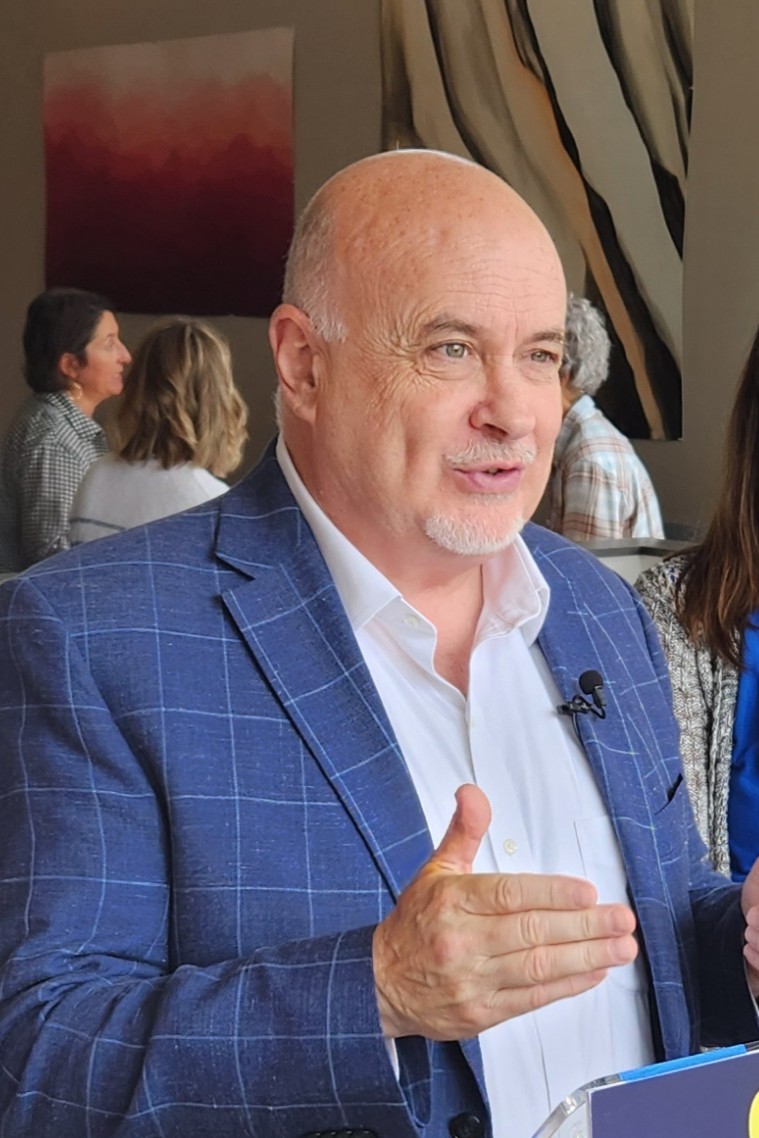
U.S. Rep. Mark Pocan (D- Black Earth) talks about the impact that increased healthcare costs due to the loss of enhanced premium subsidies has had on small business owners he’s met. (Photo by Erik Gunn/Wisconsin Examiner)
“When he voted for the one big beautiful bill, he essentially voted for a $1.1 trillion cut in healthcare,” U.S. Rep. Mark Pocan (D-Black Earth) said at a press conference Tuesday organized by the groups Main Street Action and Protect Our Care. “And that’s the biggest cut we’ve ever seen in this country.”
In addition to benefit cuts, advocates have focused on what HR 1 lacked. U.S. House Democrats tried to persuade the Republican majority to extend enhanced health insurance subsidies for people buying their health coverage on the Affordable Care Act marketplace.
The enhanced subsidies were enacted in 2021 and expired at the end of 2025. Democrats’ repeated attempts to extend them were rejected, not only during debate on HR 1 but several times later in 2025 as well as early in 2026.
Pocan said he’s spoken with small business owners across his South Central Wisconsin district who have been affected by the ACA premium increases that resulted.
“We’ve seen small business owners in Baraboo on the Affordable Care Act say that their monthly portion they pay in has doubled or even tripled,” Pocan said. One constituent he spoke with “just got out of the [insurance] system altogether,” setting aside the cash that would have gone to an insurance premium in hopes that it would be enough to cover a healthcare emergency.
“That’s not a healthcare plan,” Pocan said. “That’s not about making health insurance more affordable. That’s about taking insurance away from people.”
According to a July 28 report from KFF, a nonprofit healthcare policy analysis and news organization, coverage through the ACA fell nationwide by 2.6 million in 2026 from 2025 after seven years of steady increases. In Wisconsin, coverage fell 16%, by 45,000 people.
Gov. Tony Evers issued a statement Tuesday blasting Wisconsin’s Republican congressional delegation for letting the enhanced subsidies expire.
“Congressional Republicans’ refusal to extend the tax credits caused healthcare coverage costs to skyrocket, pricing families in Wisconsin and across the country out of having coverage at all,” Evers said.
Macy Buhler, a De Forest childcare provider and Main Street Action member who joined the press conference with Pocan, said that without those additional subsidies, the cost of insurance for some of her employees rose to unsustainable levels.
Buhler said she can’t cover healthcare for her childcare teachers directly, but has been providing them a stipend to help teachers who need health insurance purchase it on the federal ACA marketplace, HealthCare.gov. She doubled that stipend for 2026, she said — a $40,000 increase in just that expense.
“Early childhood teachers deserve real access to healthcare and medication, not a Congress who makes it impossible for them to afford both,” Buhler told reporters. “Tom Tiffany voted for this bill. We cannot trust him with our healthcare.”
Buhler told the Wisconsin Examiner that she’s “lost some staff and closed a classroom because they can no longer afford to be an early childhood educator, a teacher.”
Nancy Higgs, a self-employed interior designer specializing in affordable approaches for her customers, has been in business since 2023. The ACA coverage made it possible to get health coverage, she told the Wisconsin Examiner.
After a good first year, the business struggled following the 2024 election. Because her net income was too low, she switched to enroll in Medicaid — called BadgerCare in Wisconsin — for her healthcare.
Higgs said she isn’t sure what will happen to that coverage under the HR 1 changes, which don’t take effect until January 2027.
During a virtual news conference on Thursday, Aug. 13, Dr. Sophie Kramer, a Madison internal medicine physician, said the loss of insurance coverage, whether from Medicaid or an ACA policy, will lead to poorer health. The news conference was sponsored by the Committee to Protect Health Care.
“So much of what we do depends on patients having consistent access to healthcare. I treat patients with chronic diseases like diabetes, cancer, heart disease, hypertension — and those don’t disappear when someone loses insurance, they just become harder to manage,” said Kramer. “I’ve seen too many patients suffer from treatable conditions simply because they didn’t have access to affordable care.”
Dr. Kristen Dall-Winther, another participant in that news conference, owns her own practice in Wisconsin’s 7th Congressional District. Tiffany has been her U.S. representative since 2019.
“I see first hand what happens when patients struggle to afford care, when rural hospitals are under financial pressure, and when people put off seeing a doctor because they are worried about what it will cost,” Dall-Winther said. “Tom Tiffany has repeatedly voted for policies that make those problems worse.”
Dall-Winther cited forecasts that HR 1 could eventually cost more than 250,000 Wisconsin residents their healthcare coverage.
Kramer also cited Tiffany’s vote against a federal bill that would have codified a right to abortion in September 2021. The measure passed the House on a party-line vote but stalled in the U.S. Senate.
Nine months later, in June 2022, the U.S. Supreme Court overturned the nearly 50-year-old decision in Roe v. Wade that had legalized abortion nationwide. An 1849 Wisconsin statute that was interpreted as an abortion ban went into effect as a result.
“Tom Tiffany could have voted to protect that federal right to abortion in law, but he voted against it, allowing state bans like ours to interfere in personal medical decisions,” Kramer said.
The Wisconsin Supreme Court subsequently ruled that the Wisconsin law didn’t apply to elective abortion.
Advocates say Tiffany’s vote for 2025 Medicaid cuts bodes ill for healthcare was originally published by Wisconsin Examiner.





















Let’s simplify Tommy T’s voting record in the House. He’s voted the way that Mike Johnson, Kevin McCarthy and Steve Scalise told him to vote. And these Three Stooges got their marching orders from Frump, whether he was POTUS or just another felon on the streets.