

Consultants Offered A Roadmap For Prison Mental Health. Can DOC Follow It?
A new slideshow shows which promised changes are moving ahead and which are stuck in neutral or reverse.
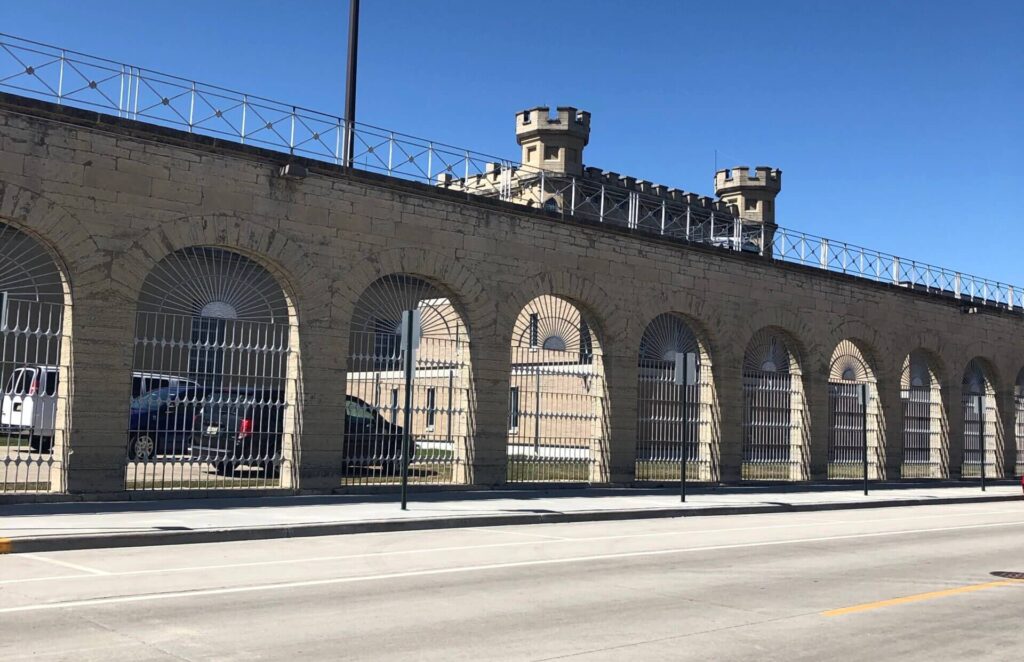
The Waupun Correctional Institution, Wisconsin’s oldest prison. The Department of Corrections has been facing obstacles in implementing a consultant’s recommendations for improving mental health care in prison, where nearly half of those incarcerated have a mental illness diagnosis. (Wisconsin Examiner photo)

The Wisconsin Examiner’s Criminal Justice Reporting Project shines a light on incarceration, law enforcement and criminal justice issues with support from the Public Welfare Foundation.
While consultants have recommended reforms to how Wisconsin addresses mental health in prison, the Wisconsin Department of Corrections reports obstacles in the way of many of the reforms, according to a document obtained by the Examiner. In Wisconsin’s adult prisons, nearly half of incarcerated people have a mental health diagnosis.
“We are seeing that more and more individuals that come into our facilities are sicker than many of their peers in the community,” Jared Hoy, secretary of the Department of Corrections, said at a webinar in March.
Hoy said he believes this is the result of a lack of affordable healthcare and mental health resources in the community. He said that people coming into the system may not have had consistent mental healthcare, meaning that clinicians are often trying to solve more advanced problems.
“And we kind of become this safety net, to meet those needs that maybe have not been met in the community,” Hoy said.
In November, the DOC released a report with recommendations for change to the prison system as part of its partnership with the consulting firm Falcon Correctional and Community Services, Inc. One recommendation involves keeping incarcerated people with a serious mental illness from ending up in restrictive housing — also known as solitary confinement — by instead sending them to alternative units if they commit a violation.
The DOC reports that it is facing hurdles to implementing this proposal and some of the other recommendations for change to the prison system’s response to mental illness, according to a slideshow document received by the Examiner.
Mental Health Director Kevin Kallas and Psychology Director Marlena Larson of the DOC presented the slideshow to a committee of the Wisconsin Mental Health Action Partnership, according to a member of MHAP who shared the document with the Examiner. The Department of Corrections did not respond to an inquiry about whether the agency produced the document.
For some of the recommendations, the department indicated in the slideshow that it would need at least one of the following: additional staffing, material resources, new construction or remodeling, technology upgrades or significant changes to current policies or operations. Among the recommendations DOC said it needs more resources to address is sending people with a serious mental illness to a mental health unit instead of restrictive housing.
Falcon’s 137-page report stated that the majority of its recommendations will require funding, and often budget approval.
It’s unclear whether the DOC’s understanding of what’s needed to implement the report’s recommendations has changed since agency officials presented the slideshow in March. A department spokesperson said Kallas was not available for an interview and did not respond to further requests for comment.
It’s also unclear how much progress the DOC has made so far on putting Falcon’s ideas into action. In November, DOC communications director Beth Hardtke told the Examiner that after receiving the recommendations in the report, the DOC immediately began implementing many of the changes.
The Examiner reported last month on the process of implementing reforms laid out in the contract between the DOC and Falcon, which the Examiner obtained in mid-May.
Susan Franzen of the prison reform advocacy group Ladies of SCI questioned the DOC slideshow’s representation that it does not have the resources to implement a proposal about providing meaningful out-of-cell time and programming to people on clinical observation. Franzen argued the agency can make change with the resources it has. Incarcerated people can be placed on clinical observation for a deteriorating mental illness or a risk of physical harm to self or others.
“Because that seems to be a go-to all the time — of, if we have to get them out of their cell, we need more staff, we need more ‘this,’” Franzen said. “No, you need to be more creative in your scheduling and think outside the box.”
The Wisconsin DOC and many other corrections departments use suicide-resistant cells for at-risk patients without regard for the specific causes of the individual patient’s problems, the Falcon report says. The report says that these cells are designed to minimize self-harm, but they don’t guarantee safety or provide what’s needed to reduce the patient’s risk of self-harm and help them become more resilient.
The report promotes providing these incarcerated people with meaningful time out of their cells, as well as personalized re-assessment, treatment and programming.
Focusing on the most severe needs
Nearly half of people incarcerated in adult prisons are identified as needing mental health services, as of May 2025 — a “much higher” rate than other state correctional departments, according to the Falcon report.
In the slideshow, DOC indicated its intent to focus more on patients with “acute needs or recurrent problematic behavior.”
An “unsustainable” number of incarcerated people have to be seen by psychological services every six months, and this interferes with the more intensive care needed for patients with higher needs, according to discussions with prison staff about mental health that were cited in the Falcon report. The report advises that the agency remove people who no longer need the infrequent appointments from the caseload.
While the report doesn’t delve into the impact of unfilled psychologist positions in the prison system, the DOC is facing a vacancy rate of about 30% for psychological services staff.
Tom Denk was released from prison in 2022 and is now co-president of
ESTHER, an advocacy group in northeast Wisconsin that works on criminal justice issues. He said there are more people with mental and physical illnesses in prison than outside it, and that most people in prison need some sort of care.
“And out here, there’s a shortage of providers, so we can imagine how much more of a shortage there is when basically almost everyone really needs that kind of thing,” Denk said.
Suicide watch
The Falcon report includes recommendations for protocols when an incarcerated person is under observation due to a deteriorating mental illness or a risk of physical harm to self or others. In the slideshow, the DOC indicated the agency could implement a proposal to replace small sleeping mats with suicide-resistant mattresses.
The agency labeled the following recommendations in red, indicating there are obstacles to implementing them:
- Moving clinical observation rooms out of restrictive housing and into more appropriate environments
- Providing meaningful out-of-cell time and programming
- Reducing restraint use through increased use of one-on-one observation by staff
- Analyzing why someone ends up in suicide observation and developing targeted interventions
At one of Wisconsin’s oldest prisons, Green Bay Correctional Institution, almost three quarters of incarcerated people have a mental illness diagnosis, as of a fiscal year 2025 report.
Former GBCI officer Jeff Hoffman told the Examiner that he was the assigned sergeant in the restrictive housing unit, and saw these issues “up close and personal.”
“Staff working on these units aren’t properly trained to understand and deal with these individuals,” said Hoffman, who left the prison in early 2023 after almost 23 years. “We were trained in the security aspect. Not mental health.”
Hoffman added that staffing levels are a concern, with staff either being too few in number or too tired from extra hours of work, and that mental health is an issue for staff and healthcare workers as well as incarcerated people.
DOC policy states that adult prisons must provide at least six hours of mental health training to security staff at the start of their employment, including for suicide prevention, symptoms of mental illness and proper response to incarcerated people with mental health problems. Adult prisons are required to provide training to new employees on preventing staff suicide.
Adult prison staff who have contact with incarcerated people take an annual update training in suicide prevention, and prisons are required to conduct quarterly drills simulating staff members’ response to a suicide attempt by an incarcerated person.
Green Bay Correctional saw “a large number” of episodes of self-harming and/or disruptive behavior, according to GBCI’s annual report for fiscal year 2025. The report attributes this to the “unique features” of the incarcerated population there, which reportedly includes a high number of young men, many of whom have “poor coping skills with lengthy prison sentences.”
Suicide attempts, self-harm behaviors and threats of self harm have historically led to a high number of placements of incarcerated people on observation at the prison, the GBCI report said. There was a “drastic upward trend” in these placements in fiscal year 2025, with 900 observation placements to date, the GBCI report said.
Hoffman said that staff frequently have to move incarcerated people to suicide observation for making false claims that they are going to commit suicide. According to psychologist and jail suicide expert Lisa Boesky, incarcerated people might resort to this as an attempt to be moved out of a chaotic housing unit or away from a cellmate, for example. Meanwhile, the rise in suicide threats within the prison puts additional pressure on the system.
Solitary confinement
In the slideshow, a few proposals for reform of restrictive housing — also called solitary confinement — were labeled green, meaning that the department could significantly implement those ideas.
The Examiner reported last year on how the Department of Corrections employs incarcerated peer specialists to mentor their fellow prisoners. The department said it could review how certified peer specialists are used in restrictive housing units and expand their role. The agency also indicated it could continue efforts to limit the amount of time incarcerated people spend in solitary.
Denk said he didn’t hear about peer support when he was in prison, but that it’s a great help to staff and incarcerated people.
“I wish there was even more of that, because when it comes to clinical staff, there’s only so many of them,” Denk said.
The following solitary confinement proposals were labeled red, meaning there are obstacles to implementing them:
- Providing each incarcerated person with at least two hours of time outside their cell each day.
- Tracking how much time incarcerated people spend outside their cells in real time, and tracking their participation in programming.
- Staff from different disciplines reviewing the “status, programming and needs” of people in solitary each week, instead of every 30 days. Under current policy, if a person has a solitary sentence of 60 days or more and a serious mental illness — such as schizophrenia or clinical depression — reviews must take place at least every other week.
Under another proposal marked red, the department would have a method to understand the root causes behind why an incarcerated person is repeatedly being placed in solitary confinement. Prison staff would develop individualized plans for these people to try to break the cycle.
For example, if a person keeps ending up in solitary because they have received threats and fear the area of the prison where the general population of incarcerated people live, staff could work with the person to identify specific areas where they would feel safe, the Falcon report suggests.
Over two-thirds of people sent to restrictive housing for over 120 days were on the department’s lists of people identified to be receiving mental health services, the report found; 17% of people sent for over 120 days met the definition of having a “serious mental illness,” such as schizophrenia or clinical depression.
Incarcerated people can be placed in solitary due to safety concerns about them staying in the general population, but most placements are punishment for a violation.
Wisconsin prisons are struggling to improve mental healthcare was originally published by Wisconsin Examiner.























The prisons would not be full if people with serious mental illness (SMI) were treated in the community FIRST. People who are psychotic are unaware that they are ill, a condition called anosognosia. Psychosis is very treatable with medication, and people who have medication can live successfully in the community.
Instead, too many of our loved ones with SMI languish in prisons or are homeless. It is inhumane. Call your legislators and ask them to reform our laws.