

Mayor Johnson, Police Chief Norman Talk About Growing Up Around Gun Violence
Both emphasized the role of parents, adult mentors in dealing with issue.

Milwaukee Police Chief Jeffrey Norman (left) and Mayor Cavalier Johnson discuss the stability and support provided by adults in their lives. (Photos by Jonathan Aguilar / Milwaukee Neighborhood News Service / CatchLight Local)
In May, Milwaukee Mayor Cavalier Johnson and Milwaukee Police Chief Jeffrey Norman sat on a panel at Sherman Phoenix to discuss gun violence, along with four women whose loved ones had been killed or injured by gunfire.
The panel discussed a range of factors contributing to gun violence and ways to reduce it. But both men pointed to one factor as a uniquely influential force in their lives, one that helped steer them away from gun violence growing up in Milwaukee — parenting.
“Everything begins at home,” Johnson said that day.
Both men spoke with NNS recently about their experiences as children growing up in Milwaukee, and their experiences as parents.
‘Lulled to sleep by the sound of gunfire’
For Johnson, childhood meant constant change.
His parents separated when he was 3 years old. He moved frequently with his mother, living at addresses across Milwaukee and attending six elementary schools before he graduated from Bay View High School.
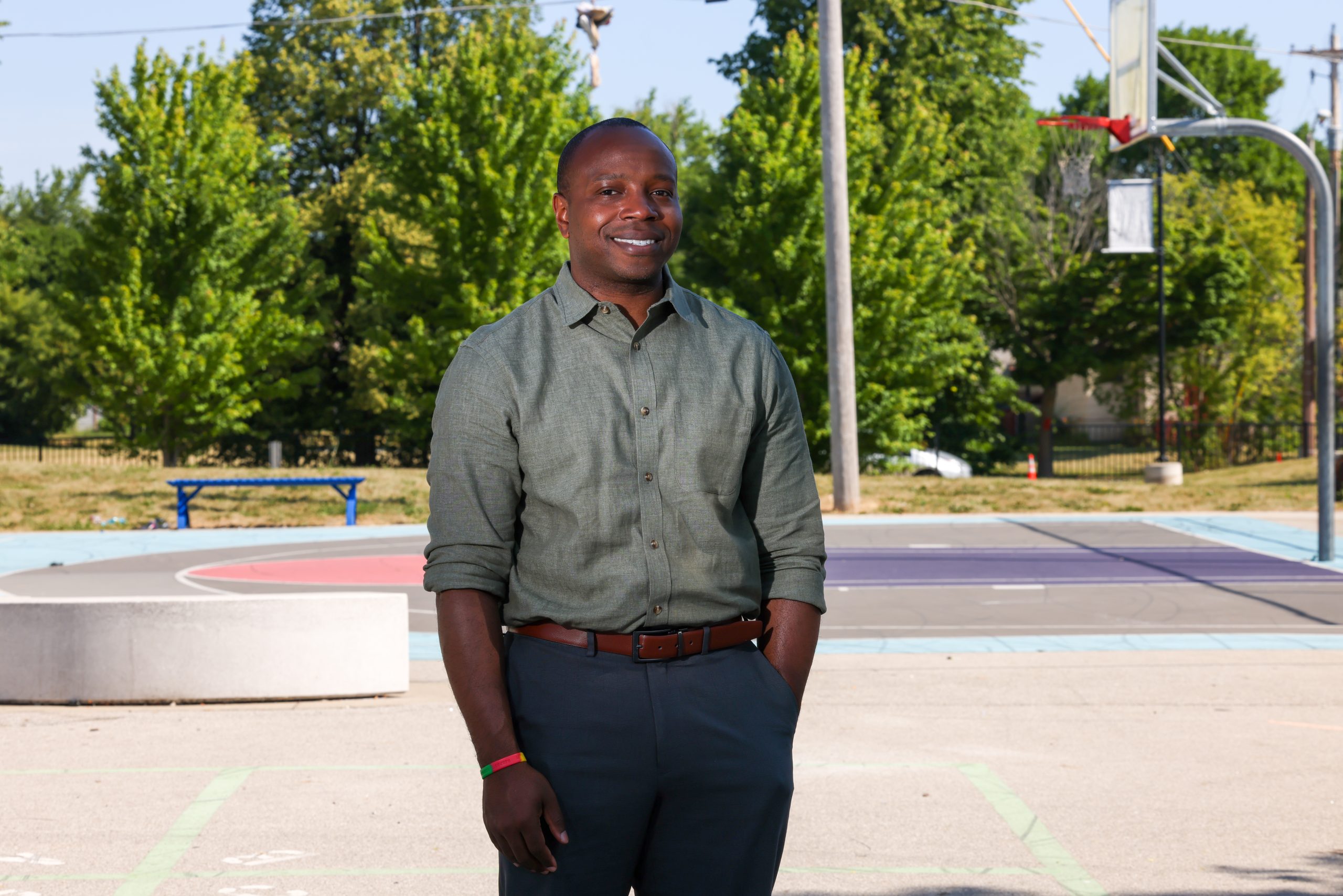
Mayor Cavalier Johnson poses for a photograph on Monday, July 13, 2026 in Milwaukee. (Photo by Jonathan Aguilar / Milwaukee Neighborhood News Service / CatchLight Local)
Johnson recalled times of food insecurity and nights of routine gunfire.
“Too many kids, myself included, were living in neighborhoods where we were sort of lulled to sleep by the sound of gunfire,” he said. “I have seen it all. Everything you see on the news, everything you read about, all the negative social indicators – I have seen it and lived it all.”
Despite this instability, he smiles when talking about his grandmother’s house on West Walnut Street.
“I think of all the places that I lived growing up, that’s the one that seemed the most familiar, the most stable,” Johnson said.
Though separated from his mother, his father remained a consistent presence in his life.
Together, those sources of stability helped him navigate the challenges, he said. Sometimes, that support came in the form of discipline.
“If we made a decision to go out and do something that we weren’t supposed to, you’d be held accountable for that at home,” he said. “Because you knew that there was a consequence, you were less likely to partake in that behavior.”
He said other adults from his neighborhood reinforced these lessons.
“You had folks in the neighborhood that were mentors and held kids accountable,” Johnson said.
Today, Johnson said, he speaks with children facing similar circumstances, hoping to help them envision a different path.
“My hope is that I am planting the seed for them to think more broadly and have a bigger vision for themselves and their lives above and beyond what they may be exposed to,” he said.
Research backs up his theory.
“If you see multiple paths, you’re going to make less rash decisions in the moment,” said Dr. Michael Levas, a professor of pediatric emergency medicine at the Medical College of Wisconsin and Children’s Wisconsin.
‘Our children are a reflection’
Norman, who’s led the Milwaukee Police Department since 2020, said his parents divorced when he was in sixth grade. His father remained actively involved in raising him and his brother.
Norman described him as demanding and a disciplinarian.
“I’m very appreciative,” Norman said.
Growing up, he regularly encountered opportunities to make bad decisions, including the use of violence.
Norman said one of his close childhood friends was killed over an article of clothing. He said he was able to make different choices because of the adults in his life.
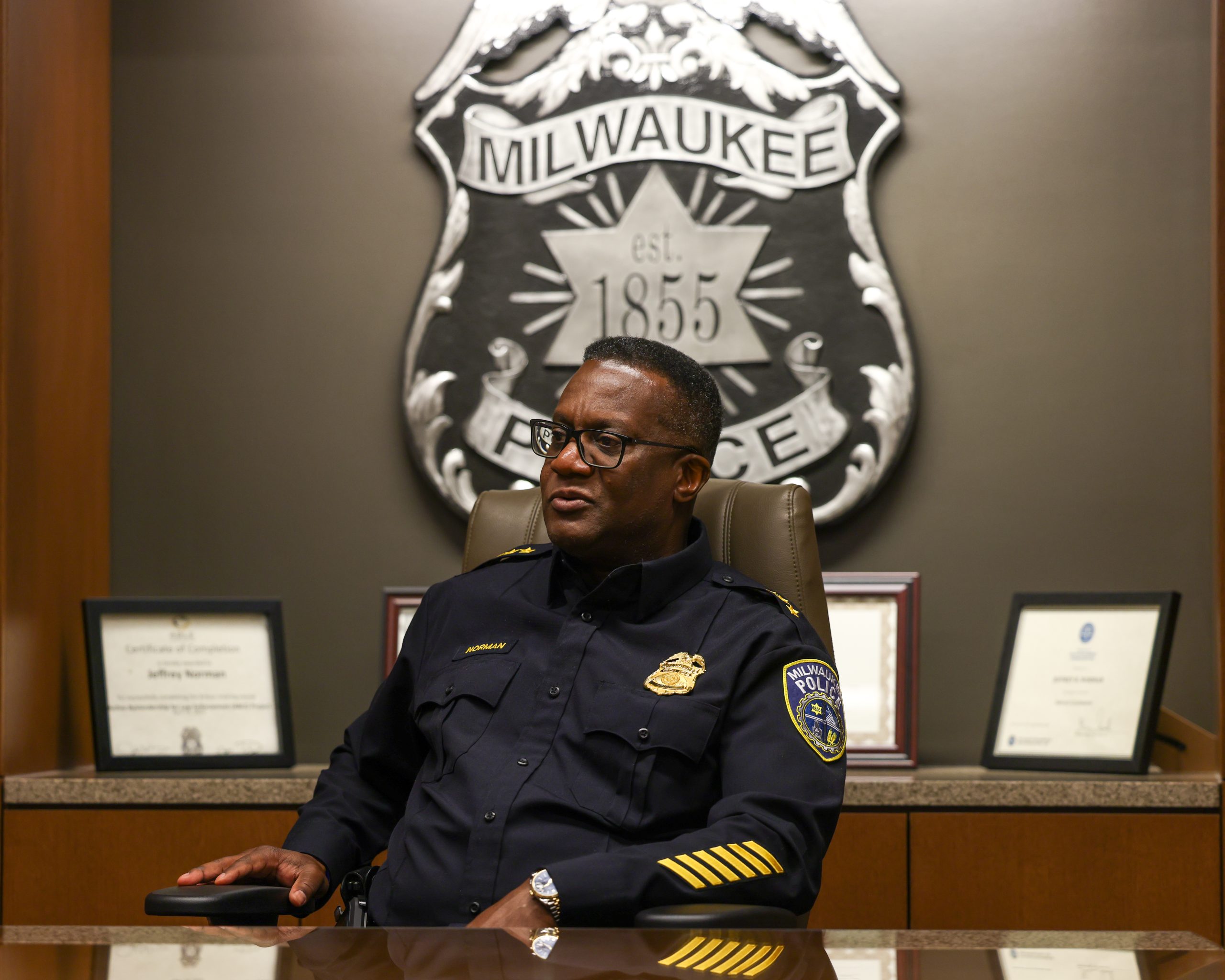
Milwaukee Chief of Police Jeffrey Norman listens during an interview at the Milwaukee Police Administration Building on Thursday, July 9, 2026 in Milwaukee. (Photo by Jonathan Aguilar / Milwaukee Neighborhood News Service / CatchLight Local)
He did the same for his children, often working the late shift while sleeping only a few hours each day so he could attend meaningful moments such as rehearsals and parent-teacher conferences.
“They saw that,” Norman said. “Sometimes our children are a reflection of what they were – or were not – given.”
This, too, is backed up by evidence.
“We’re a product of our experiences from birth to the present,” Levas said. “All of those experiences shape us.”
While parenting can contribute to a lower risk for gun violence, there are limits.
“There are some really, really good adults, parents, role models out there who are really trying,” Levas said.
Levas said privilege and environment are big factors.
“If you don’t have a choice about what school you’re going to, and it’s a school that is chaotic, or doesn’t have a lot of resources, that’s an eight-hour period where your kid’s not with you,” he said.
Johnson said as mayor he’s working to address challenges related to poverty, housing instability and neighborhood violence.
He pointed to his Year of Housing initiative, efforts to expand affordable homeownership and targeted neighborhood investments as examples of how his administration is trying to address the conditions he experienced growing up.
Norman said even though police cannot solve these issues, parents’ consistent commitment is still crucial to improving the lives of their children.
“It ain’t about the material things,” Norman said. “Kids want to see that you’re there for them, that you have worked your ass off, no matter what little bit you have.”
Although today’s children face some added risks such as cellphones and social media, what children need has not changed, Norman said.
For parents who may be busy with work, parents can recruit other responsible mentors, Levas said.
“I think it’s trying to expand the community,” he said.
Levas said there are three traits that make a good mentor: “I think it’s availability, affability and ability, in that order.”
‘Bare minimum’
Aries Anthony, a father of four whose three youngest children attend Milwaukee Public Schools, said he agrees on the importance of parents being present in their children’s lives.
For Anthony, that means maintaining close relationships with his children’s teachers, principal and other school staff.
“I try to take initiative,” Anthony said. “I want to be active. I want to know all of the people – everyone that works at the school.”
But, he said, he feels like those things are the bare minimum.
Anthony said he also works to model the right behavior for his kids, recalling a recent incident when he was rear-ended by another driver who then fled the scene.
His first instinct, he said, was to chase the vehicle. But he stopped himself.
“I had that emotional intelligence to be like, ‘OK, I’m not going to take this person down and gun them down because they rear-ended me.’” he said. “I can’t do that if I’m saying that I want to see different in the world.”
What Anthony wants are more resources to help teach children both firearm safety and conflict resolution.
“Education would be the best combatant of gun violence,” he said.
Levas said talking with children about firearms is important, as is storing guns properly, including having them unloaded, locked and separate from ammunition.
What do you think?
Are you a parent worried about gun violence? What would help you as a parent? What resources does your family need?
Reach out to dblake@milwaukeenns.org with your thoughts and opinions.
Jonathan Aguilar is a visual journalist at Milwaukee Neighborhood News Service who is supported through a partnership between CatchLight Local and Report for America.
This article first appeared on Milwaukee Neighborhood News Service and is republished here under a Creative Commons Attribution-NoDerivatives 4.0 International License.



















Only Nixon could go to China.