Why Wisconsin’s Clean Energy Market Is Booming Without New Tax Breaks
Cheaper renewables, data centers and leftover federal funds are reshaping the state’s power mix.
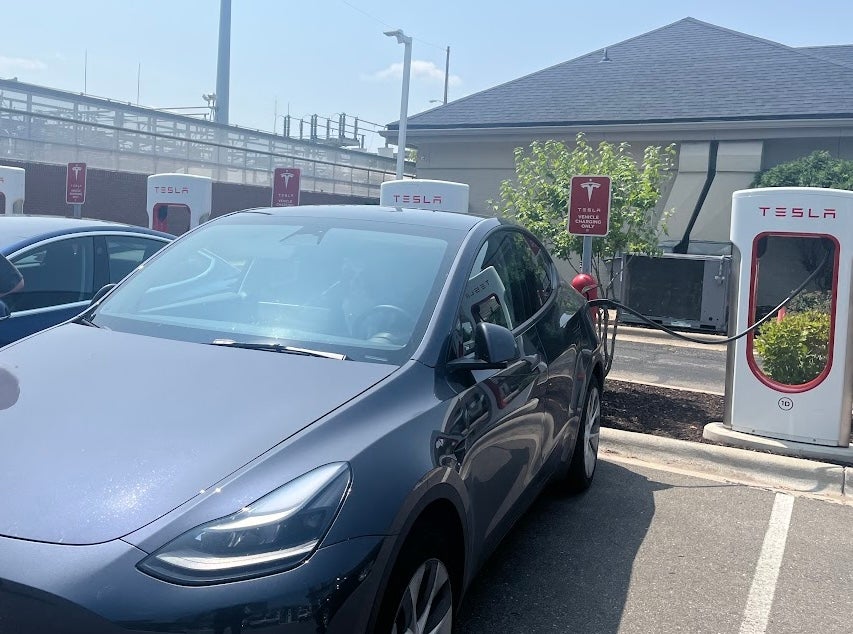
An electric car charging in Madison, Wis. Joe Tarr/WPR
When JD Smith started working at the Milwaukee-based Arch Solar about six years ago, he used to get calls from potential customers who were curious to know what it would cost to go off of the grid. They wanted to install not just solar panels but enough battery storage to power their homes all the time.
Smith’s response was usually discouraging for them.
“One in four customers would ask about batteries, and then as soon as you tell them, ‘Hey, to go off the grid, you’re really going to be paying over $50,000 to even think about it,’” Smith recalled. “Then they’d say, ‘I was only going to do this if I could go off grid.’”
Times have changed. Now people are willing to pay those costs, if only to reduce their dependency on the grid. Customers of Arch Solar — which installs solar energy and battery storage for utilities, companies and residents in the Midwest — are now often just looking to be able to power their homes for short periods if the grid fails, said Smith, who is now the company’s director of marketing and public relations.
“Now, at least half of our customers are moving forward with batteries,” Smith told WPR’s “Wisconsin Today.” “People are not taking the power grid for granted anymore. Even if they can’t go 100 percent off the grid, they can protect themselves as much as possible, and that’s happened in the last two years, really.”
Under former President Joe Biden, Congress created numerous incentives for green energy in the Inflation Reduction Act. That law offered tax credits for installing solar panels, buying electric cars or energy-efficient appliances and weatherizing your home. After President Donald Trump returned to office, he and Congress axed those incentives. But some of those industries continue to thrive.
Although Smith expects there to be some consolidation among solar installers in Wisconsin, he thinks that larger companies will be able to weather the souring mood toward green energy in Washington, D.C.
The reason is that solar and battery technologies have advanced beyond most people’s dreams and expectations from a few years ago, he said. The technological advances are happening at a time when demand is booming, largely because of energy-guzzling data centers that are being built around Wisconsin and the United States.
“Renewable energy is the fastest form of energy to get on the grid, and it’s also the cheapest per kilowatt,” said Emma Heins, principal at Advanced Energy United, where she works with policymakers, businesses and advocates to promote clean energy in Wisconsin. “We have the tools to be able to meet this moment, which is really exciting.”
In Wisconsin, at least, electric cars have not yet taken over the way they have in other countries. Heins blamed the sluggish adoption of EVs in Wisconsin in part on the slow development of public charging stations.
“It’s sort of a chicken-and-egg problem for vehicle electrification, because people are hesitant to invest in such a different kind of car. If they don’t see charging infrastructure around them, range anxiety is a huge issue,” she told “Wisconsin Today.” “From the developer side, they might be more hesitant to invest in charging stations because there are less EVs in the state than Illinois or Minnesota.”
But Heins said Wisconsin — using federal funding — has done a good job of picking up the slack from private developers in putting in charging stations.
“That is designed to really bring more visible, reliable charging stations, so people know they can get across the state and go to a Packers game and not have to worry about their range running out,” she said.
Heins said that Wisconsin also created two programs from the Inflation Reduction Act that still exist — the federal funds were awarded as a block grant before Congress and the Trump administration pulled back the incentives.
The Home Efficiency Rebates (HOMES) program offers people up to $10,000 in rebates (sometimes covering the full cost) on projects to make homes more energy efficient. That can include upgrading insulation, windows, doors, roofs or appliances.
Similarly, the Home Electrification and Appliance Rebates (HEAR) program offers low- to moderate-income families up to $14,000 in rebates for home efficiency projects.
“Wisconsin was one of the first states to implement a program” after the Inflation Reduction Act was approved, Heins said. “People can still take advantage of it. The money is projected to be around until 2031.”
Despite cuts in federal incentives, green energy is growing in Wisconsin was originally published by Wisconsin Public Radio.
If you think stories like this are important, become a member of Urban Milwaukee and help support real, independent journalism. Plus you get some cool added benefits.