

Worst Smoke On Record Leaves Wisconsin Residents Gasping For Clean Air
DNR says conditions are “unhealthy for everybody” as Canadian and Minnesota fires fuel haze and ashfall.
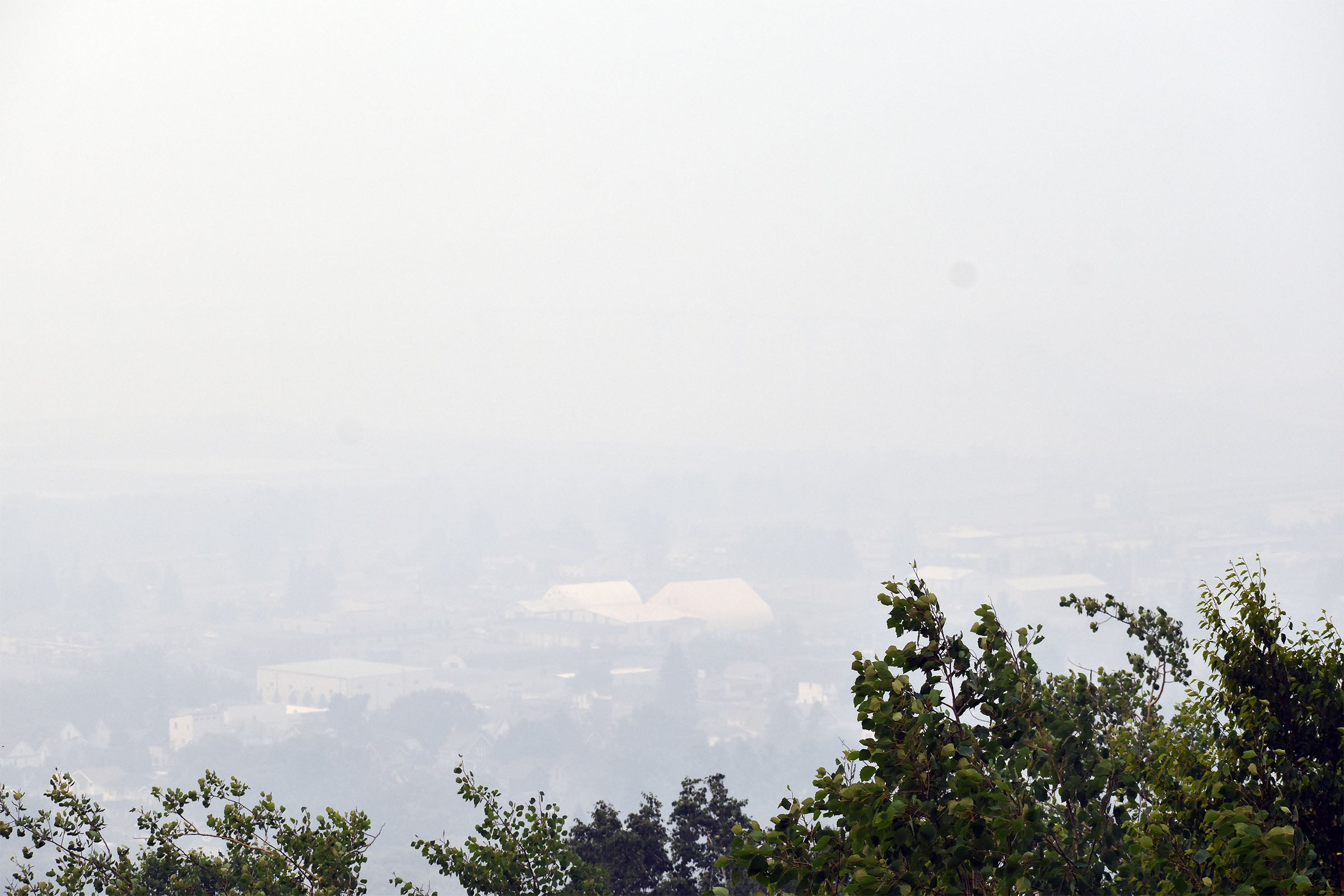
The Bong Bridge is completely obscured by smoke as of 8 a.m. Wednesday, July 15, 2026. (Danielle Kaeding/WPR)
As smoke blankets most of Wisconsin, air quality has turned hazardous in many areas of the state. Air experts with the Wisconsin Department of Natural Resources are advising everyone to stay indoors and wear masks outside.
The DNR’s air forecast for Thursday shows much of the state from Lake Superior in the north to Kenosha in the south as being in a hazardous smoke category. Air experts and doctors tell WPR the conditions are serious.
“As far as wildfire smoke is concerned, this is some of the worst air quality that we’ve measured at the DNR on record,” said Craig Czarnecki with the DNR’s Air Management Program.
Czarnecki said the smoke level is significant and people across the state should be aware of the dangerous levels.
“I know we’ve had wildfire smoke impacts the last few years,” he said. “But this is really the highest concentration of smoke that we’ve seen in any of these episodes.”
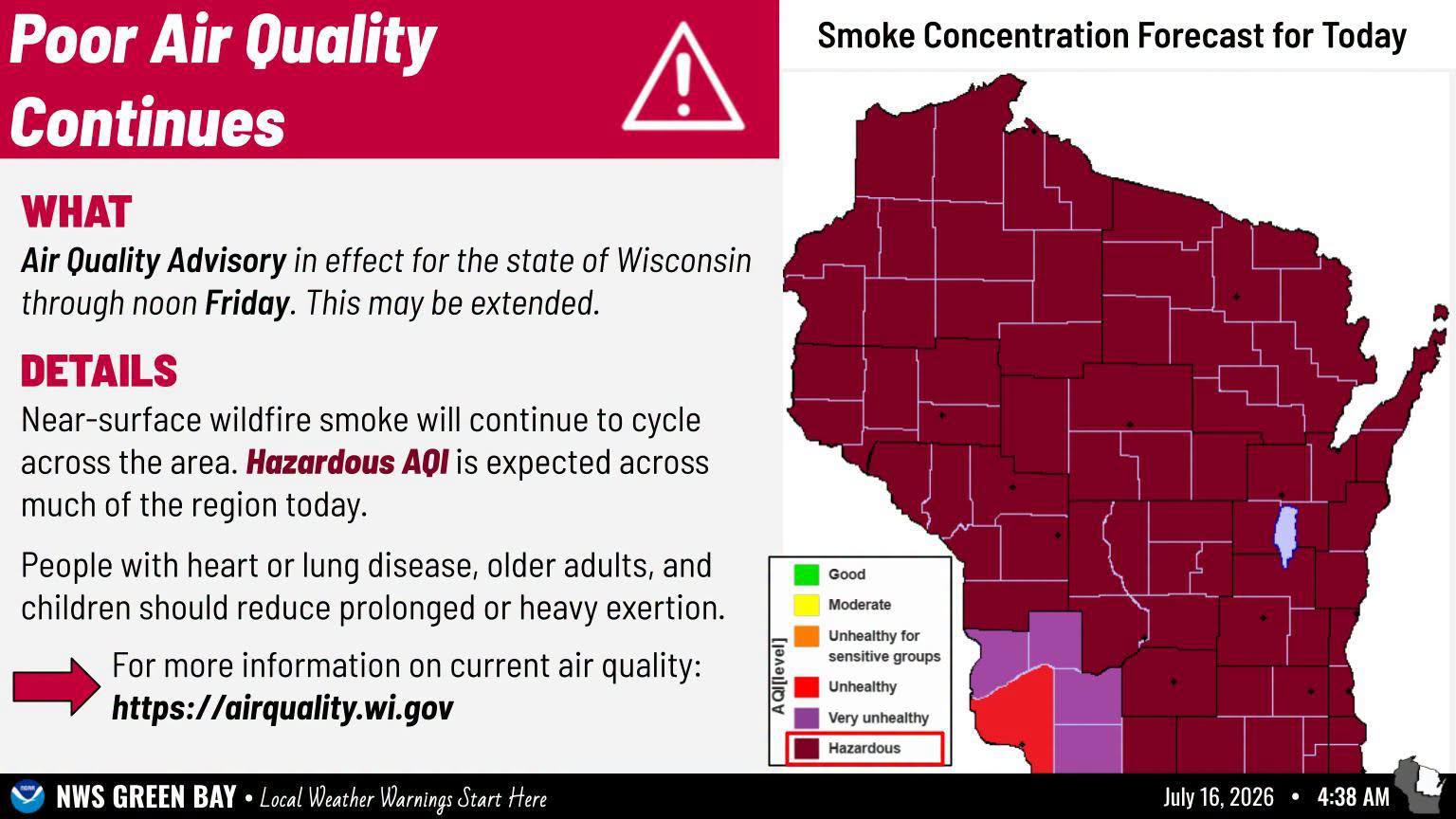
Graph courtesy of the Wisconsin Department of Natural Resources
“I don’t remember ever hitting hazardous (air quality rankings) ever,” Czarnecki added.
While the smoke will stay in place overnight, there is hope for better quality Friday, according to the DNR.
“We expect to see some clearing kind of start tomorrow,” Czarnecki said. Winds — moving from west to east across the state — are expected to pick up, he said, and hopefully alleviate some of the smoke.
“But, we can’t rule out another extension for a few areas here into the weekend,” he added.
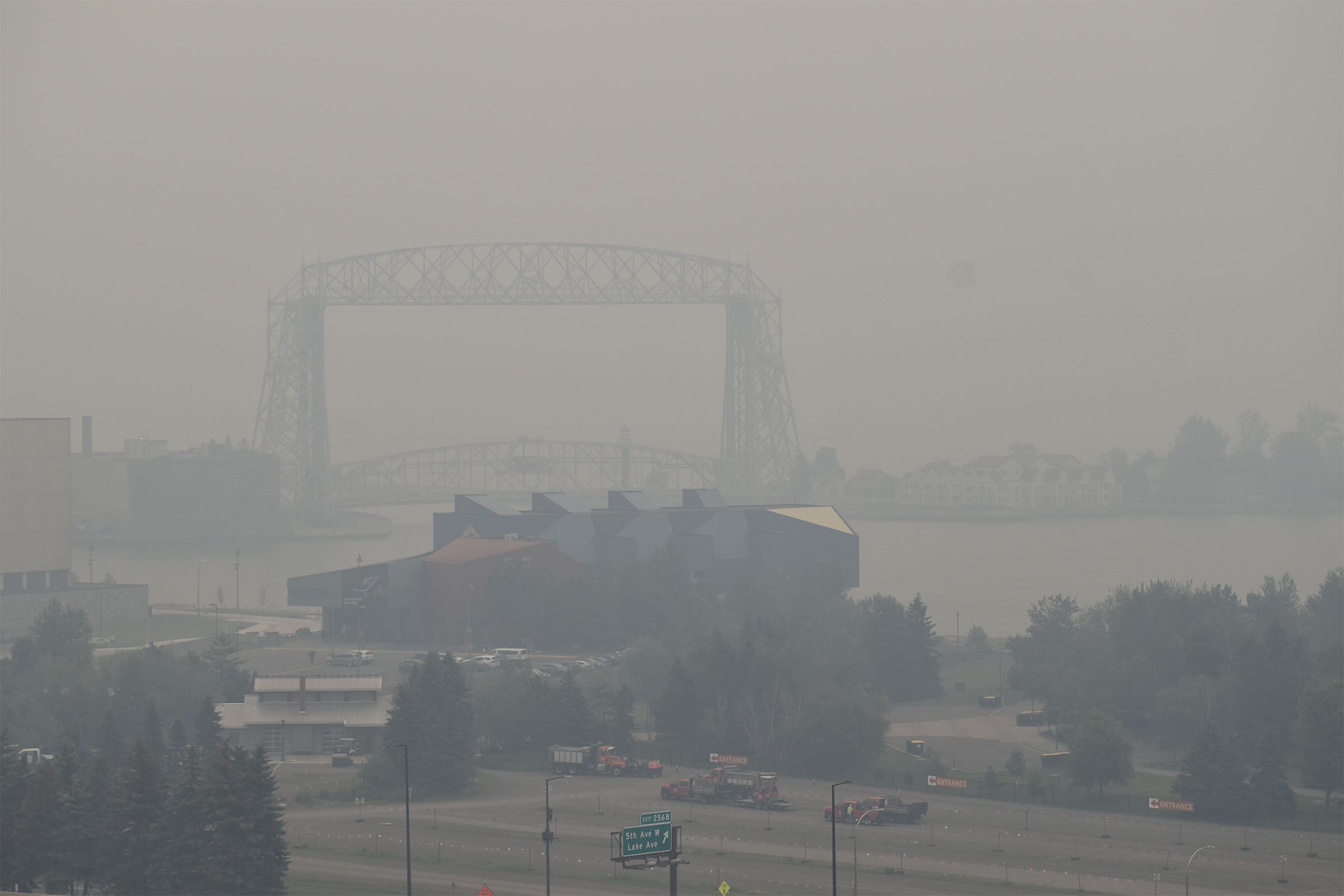
Smoke from wildfires in Canada and Minnesota have already pushed soot pollution past hazardous levels in the Duluth-Superior area Wednesday, July 15, 2026. Danielle Kaeding/WPR
Heath risks across Wisconsin
Czarnekci compared the air quality levels to a stoplight. Green is good, yellow is concerned, red is dangerous — and then there’s purple, which is very unhealthy, and where much of the state was Thursday morning.
“Then we’re talking unhealthy for everybody,” Czarnecki said. “Going inside if you have any symptoms, watching for coughing or shortness of breath.”
Some people are more susceptible to the effects of the smoke than others, according to Dr. Mark Moss, an allergist with UW Health. Those with heart or lung disease, children, older adults, pregnant people or those who exercise outdoors are at risk with even moderate air quality concerns.
“Wildfire smoke’s small particles will penetrate very deeply into the lungs,” Moss said. “They can easily penetrate into tissues, even the bloodstream and cause inflammation, irritation and in the lungs cause people to have difficulty breathing.”
Public Health Madison & Dane County say the air quality will remain poor for the next few days, and if someone begins experiencing coughing, stinging eyes or scratchy throat, to head indoors.
“The biggest concern is air hunger, where people are feeling chest tightness or shortness of breath and feel like it’s very difficult to get a deep breath,” Moss said. “They should immediately try to get indoors into a cooler, preferably air-conditioned environment.”
At noon the air quality index was 644, or “hazardous,” in Milwaukee-Ozaukee, according to AirNow.gov.
In the city of Milwaukee, the poor air quality led to the Department of Public Works suspending non-emergency field work, according to a statement from the city. Only emergency work outdoors will be performed, the statement said.
The city also suspended garbage and recycling collection services, “until further notice.” The city’s drop off centers also closed, while the city tow lot closed early Thursday afternoon.
“City officials will continue to monitor air quality conditions and determine when it’s safe to resume normal operations,” the statement said.
Barista Finn Wozniak at Best Place Coffee and Spirits in downtown Milwaukee was wearing a mask indoors while working on Thursday morning.
“This blows,” Wozniak said. “Canada, this is a call out post. Stop doing that. Stop having wildfires up there.”
Why is the smoke sticking around?
Dry conditions, mixed with heat and wind, made a perfect setting for rapid fire growth — and plenty of smoke — in Minnesota and Canada. Czarnecki explained how those conditions led to such severe smoke across Wisconsin.
“The explosion of the fire … and then the proximity also just kind of combined to make these really high concentrations in that very unhealthy to hazardous range,” he said.
Air quality monitoring networks across the state, and forecasts from DNR staff have been looking at where the smoke could stay or concentrate across Wisconsin. They’ve also been talking to Minnesota’s officials about the status of the fire.
Czarnecki said the smoke doesn’t have enough room to dissipate and spread out and that lakes and large bodies of water can actually hold smoke along their banks.
Many of the cities and towns near Lake Superior are facing serious smoke conditions that limit visibility, Czarnecki said. He pointed to Duluth, Minnesota, Superior and Ashland as areas that have seen hazardous air quality for days.
“Anecdotally, I have some friends that live up there,” Czarnecki said, adding he graduated from Ashland High School. “They said it’s just terrible. They could see ash falling in some places.”
He now works in Madison, and said when he woke up he could smell the smoke in the air.
“It’s really spread,” Czarnecki said. “It’s quite the impressive the smoke plume here that we’re dealing with.”
How to protect yourself
For anyone who must be outside, Moss with UW Health said wearing a mask is a very good idea.
“An N95 mask will be the best type of mask to filter out these very small particles,” he said. “A paper mask, which most of us are familiar with from healthcare, or a cloth mask is going to help less.”
You can get the latest information on air quality from the Wisconsin Air Quality page, signing up for email or text alerts from the DNR or downloading the airnow.gov app to your phone.
To manage smoke impacts, Moss and Public Health Madison & Dane County recommend:
- Avoid exercising outside.
- Wearing a mask.
- Limiting time outside as much as possible.
- Rescheduling outdoor events.
- Closing windows.
- Running air conditioning, on recirculation settings if possible.
- Using an air purifier, if possible.
If you don’t have air conditioning:
- Consider going to malls, libraries or other public spaces with air conditioning.
- Consider wearing an N95 mask.
Editor’s note: WPR’s Evan Casey contributed reporting to this story.
Wisconsin DNR records worst smoke levels on record, advises staying inside was originally published by Wisconsin Public Radio.
If you think stories like this are important, become a member of Urban Milwaukee and help support real, independent journalism. Plus you get some cool added benefits.





















A very bright man, simply referred to as DJT, informed me that Canadian windmills where blowing the smoke this way and all we need to do is demolish the windmills and the problem is solved. Thank you for your attention to this matter.
twenty years ago Al Gore warned us about massive wildfires among other things in his movie an “Inconvenient Truth.” We need to bring that movie back and show it now that these Truths are becoming normal.