Midtown Walmart Redevelopment Drops ‘Data Center’ Plan
Controversial computing facility nixed as city faces deadline for 200 affordable apartments.
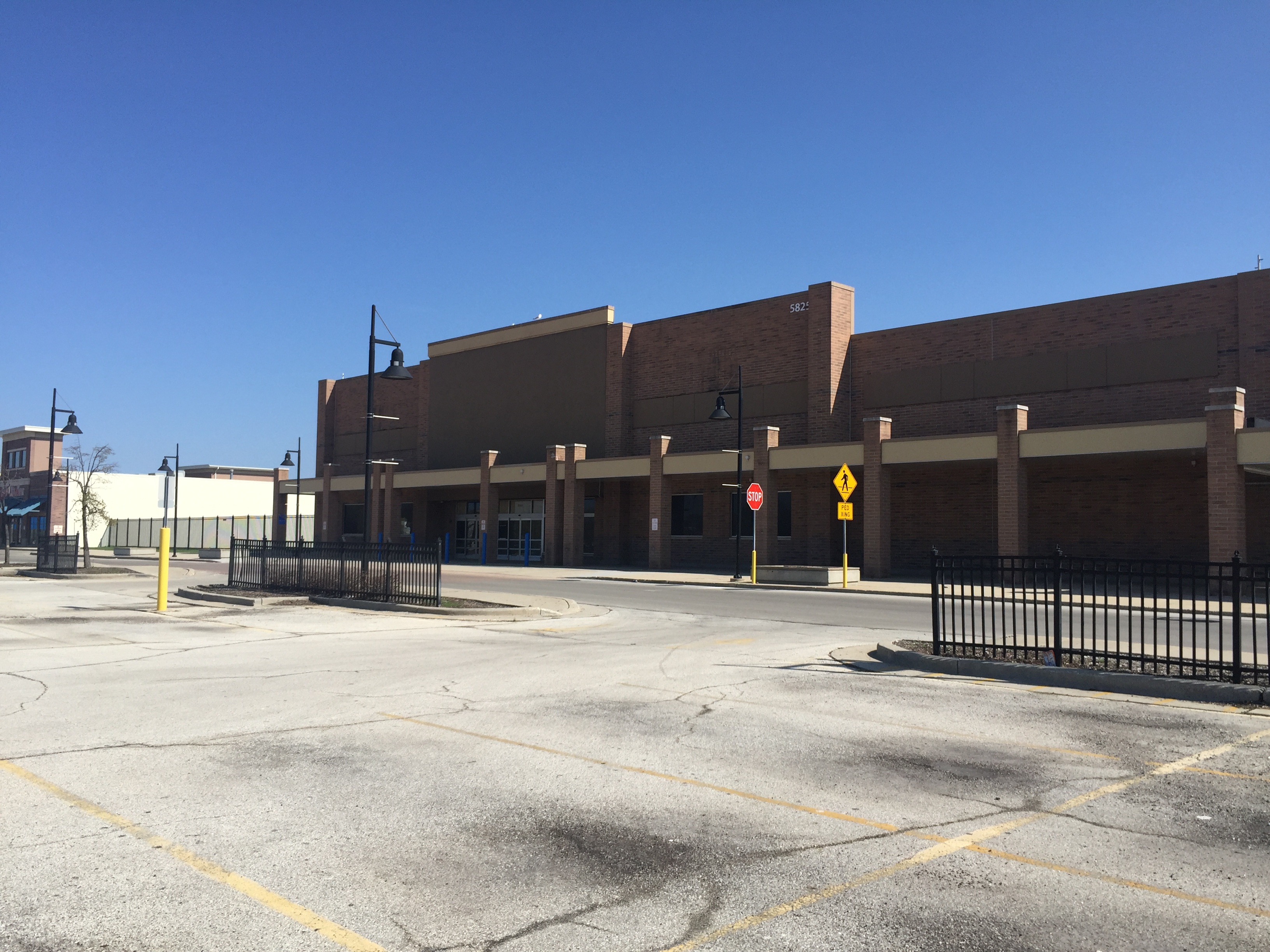
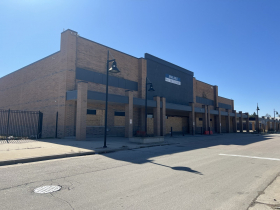
Vacant Wal-Mart at 5825 W. Hope Ave. Photo by Alison Peterson.
The proposed redevelopment of the long-vacant Midtown Center Walmart store will proceed without a controversial computer research facility that some have called a data center.
The change would allow the development of a new library, an affordable housing complex, a self-storage facility and a community-focused tenant.
Ald. Mark Chambers Jr. announced Monday that the applicant behind the redevelopment of the former big-box store at 5825 W. Hope Ave. plans to remove the proposed computing research facility from the project following a contentious public review process.
The change could clear the way for a revised plan to advance when it returns to the City Plan Commission on July 20. The commission, after a marathon June 29 meeting, delayed taking action on the proposal following more than six hours of testimony, debate and interruptions.
The redevelopment package would still include a new Milwaukee Public Library branch, approximately 200 units of affordable housing from Gorman & Co., indoor self-storage operated by Affordable Family Storage, and a city-controlled, neighborhood-serving use. But the 19,000-square-foot computing component, which developer Trent Overhue described as a small “edge site” and opponents repeatedly called a data center, is being dropped.
Overhue leads Affordable Family Storage, which has tried for several years to redevelop the property as a self-storage facility. The computing component was added late in discussions with the city after an agreement was reached to provide the front of the building for civic uses. Through Lumon Solutions, he is pursuing a larger data center facility in his home state of Missouri.
“Following extensive discussions with the property owner, developer and city staff — and after carefully considering the feedback shared during three public information sessions and the testimony presented before the City Plan Commission — the applicant has made my office aware of plans to remove the proposed computing research facility from the redevelopment,” said Chambers in a press release.
The move is a significant reversal for a proposal that, until recent weeks, appeared to have the backing of Chambers and the Department of City Development. But the computing use ignited substantial opposition after media coverage in May raised questions about whether the project was a data center and how it compared with much larger hyperscale data centers, which exceed 1 million square feet in size.
A series of misleading images and posts about the project spread quickly on multiple social media networks.
Three public information sessions were held ahead of the June 29 commission meeting. The meetings, and then the hearing itself, drew organized opposition from activists, including members of the Party for Socialism and Liberation (PSL).
“You can call it whatever you want. It’s still a data center,” said Samantha Doucas, a PSL member, during the June 29 hearing.
“They’re trying to sell us a bad deal,” said Joshua Taylor, another PSL member.
Opponents questioned the outreach process, the role of an out-of-state developer, the potential impacts of the computing use and whether a majority Black neighborhood was being asked to accept a facility that would not be proposed elsewhere. A handful of residents spoke in favor, saying the proposal would reactivate a long-vacant property and deliver needed investment.
Overhue previously said the facility was not a hyperscale data center nor an artificial intelligence campus, but a much smaller computing facility intended to serve tenants such as medical research firms with patient privacy concerns. He said the facility would occupy less than 10,000 square feet of IT space, draw about 9 to 10 megawatts of power at full buildout and use a closed-loop cooling system consuming less than 5 gallons of water per day.
Department of City Development officials recommended a series of conditions intended to address sound, water use, energy consumption, backup generators and other potential impacts. Planning Manager Tanya Fonseca told the commission the proposed conditions were more stringent than the city’s pending data center zoning framework.
But the conditions were not enough to win approval.
After hours of testimony, commissioners struggled to determine whether the project could be approved with additional safeguards. Commissioner Willie Smith moved to approve the deal with DCD’s 12 recommended conditions and several additional provisions developed during the meeting, including a possible inspection of an existing AFS computing facility in Springfield, Missouri. The motion failed to get a second.
A subsequent motion also failed. Eventually, Commissioner Tarik Moody moved to hold the matter until a future meeting but did not provide any guidance on what should change. The commission unanimously approved the delay.
That delay created a new problem for the housing component. Gorman & Co. faces a July 31 deadline to start construction on the affordable housing portion of the project or seek an extension from the Wisconsin Housing and Economic Development Authority on its low-income housing tax credit award. DCD Commissioner Lafayette Crump told the commission that an extension, if granted, would cost the developer “tens of thousands of dollars” and could imperil the whole project.
The housing portion was already approved by the commission in April. But the larger redevelopment package, including the use of the former Walmart building, still requires commission approval because the site is governed by a development incentive zone. Unlike many plan commission votes, the decision is binding and does not advance to the Common Council for final approval.
The former Walmart has been vacant since 2016. In 2023, the City Plan Commission, at the request of Chambers and DCD, rejected an earlier Affordable Family Storage proposal to convert the building entirely into self-storage. The revised 2026 plan sought to make the project more acceptable by giving the city a $1 long-term lease for the front 51,000 square feet of the building for a new library branch, allowing Gorman to develop housing on the unused parking lot, and limiting AFS’ storage use to the rear of the building.
But the late addition of the computing use threatened to derail the deal.
Chambers, who supported the broader redevelopment, expressed frustration during the June 29 hearing that the computing component had been added late in the process. In his Monday statement, he said removing it better reflects the community feedback received in recent weeks.
“As the alderman representing this community, I have always believed that meaningful public engagement must be more than a checkbox,” said Chambers. “The listening sessions and public testimony provided residents with an opportunity to voice their concerns, ask difficult questions, and share their vision for the future of Midtown. I heard those concerns clearly, and I took them seriously throughout this process.”
Chambers said the revised plan returns the focus to “what matters most” to residents: housing, a new library branch, neighborhood-serving amenities and the redevelopment of a property that has sat vacant for nearly a decade.
“While this change comes with a reduction in potential tax revenue, it is a better reflection of the vision shared by residents throughout this process,” said Chambers.
The tax revenue loss could be substantial, though Chambers’ release did not provide a figure. Computing facilities, because of their electrical and mechanical equipment, can generate significant personal property or real estate value compared with lower-intensity uses. City officials previously said the computing facility would have strengthened the tax base and helped support the broader development package.
But Chambers said he remains confident the amended project will still be transformative for Midtown, which has struggled in recent years.
“A development anchored by a Milwaukee Public Library branch, housing, and expanded storage units will reactivate a property that has sat vacant for nearly a decade, expand access to essential services, create new housing opportunities, and improve the overall quality of life for residents throughout the 2nd Aldermanic District,” said Chambers.
The project has also exposed tensions over the proposed relocation of the Capitol Library branch. The new branch would move from its current home near N. 74th Street and W. Capitol Drive to the former Walmart site near N. 60th Street and W. Capitol Drive. Chambers has said keeping the library in its current location is not viable and cited $100,000 in damage from April rainstorms. The city has sought to replace it for several years.
Ald. Sharlen P. Moore, whose district includes the current library site south of Capitol Drive, arrived late and criticized the relocation during the June 29 hearing. She said residents in her district had been left out of the process. But Crump, a constituent, said the new library would actually be closer to his home and those of many other 10th District residents. Chambers, as Urban Milwaukee has previously reported, said the deal was several years in the making. Moore was first elected in 2024. Planning funding for the library has been approved by the library board, though the library itself has yet to comment on the proposal. Capitol Drive, the south side of the retail center, is the dividing line between Chambers’ and Moore’s districts.
The July 20 meeting could now determine whether the amended deal can move ahead to preserve the housing timeline. Because the commission already held a public hearing on the matter, it is not legally required to hold another one when the proposal returns.
Chambers said his commitment remains unchanged.
“I will continue working to attract quality investment, expand housing opportunities, strengthen our tax base and revitalize Midtown Center through a process grounded in transparency, collaboration, and genuine community engagement,” he said.
Former Walmart
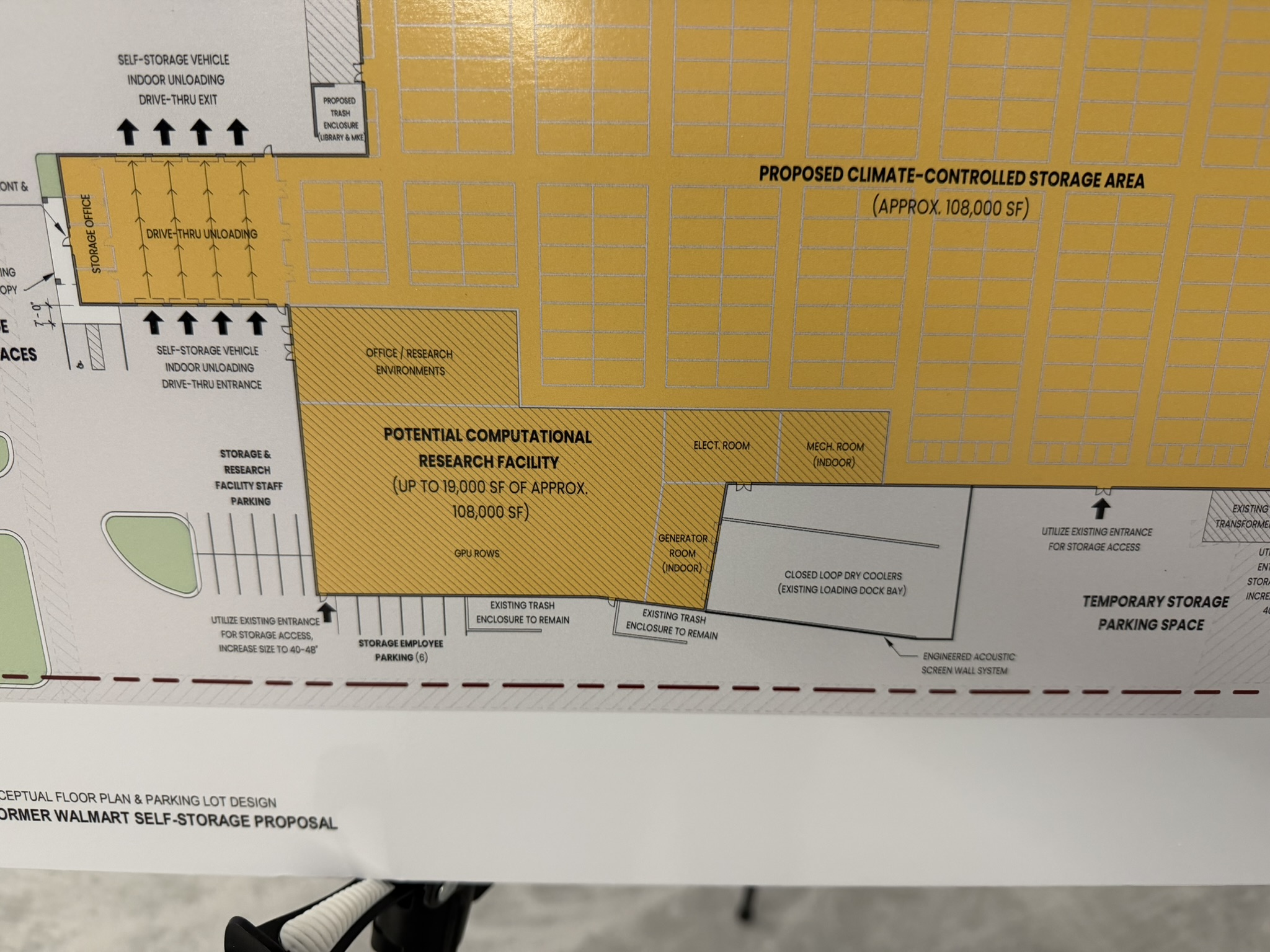
New Walmart interior layout. Photo by Jeramey Jannene.
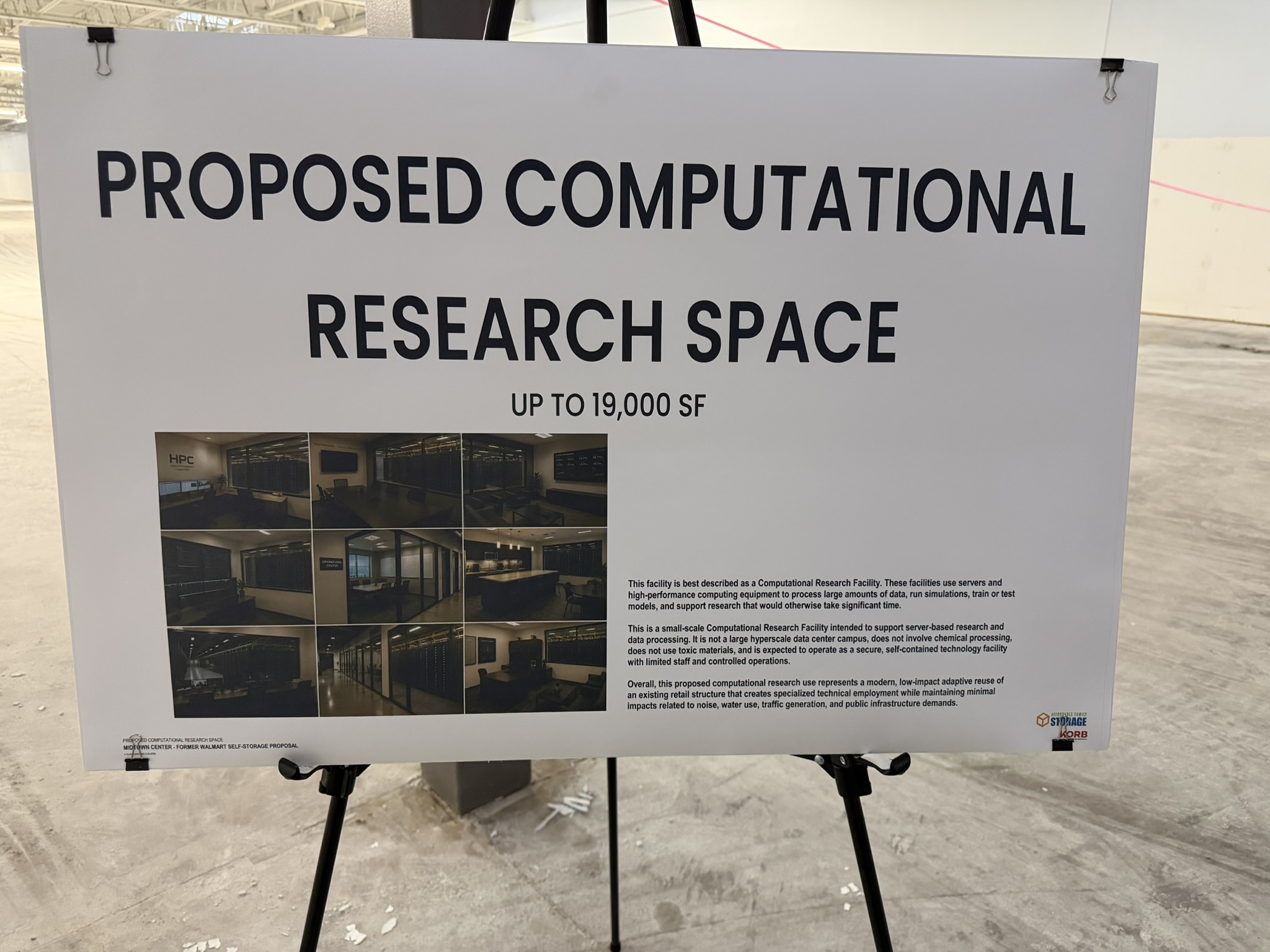
Computational research place sign. Photo by Jeramey Jannene.
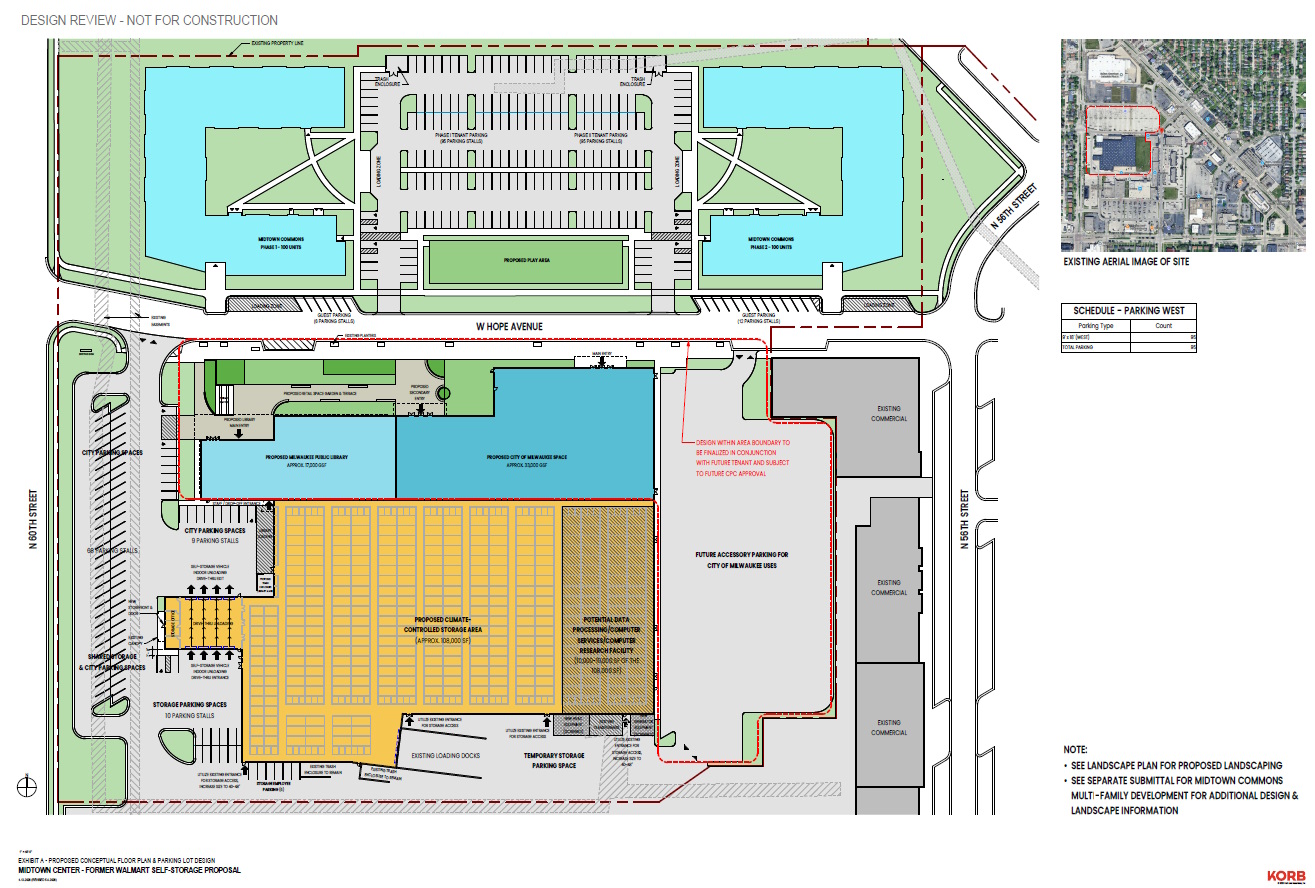
Initial Walmart site plan. Image submitted to CPC by KORB.
Existing members must be signed in to see the interactive map. Sign in.
If you think stories like this are important, become a member of Urban Milwaukee and help support real, independent journalism. Plus you get some cool added benefits.
More about the Midtown Walmart redevelopment
- Midtown Walmart Redevelopment Wins Approval After Contentious Fight - Jeramey Jannene - Jul 20th, 2026
- Midtown Walmart Redevelopment Drops ‘Data Center’ Plan - Jeramey Jannene - Jul 6th, 2026
- 6-Hour Showdown Over Midtown Walmart Ends In No Decision - Jeramey Jannene - Jun 29th, 2026
- It’s Not a Data Center, Developer Says of Midtown Walmart Project - Jeramey Jannene - Jun 10th, 2026
- Three Meetings For Public To Learn About Controversial Walmart Redevelopment - Jeramey Jannene - Jun 2nd, 2026
- Ald. Mark Chambers Attempts To Set Record Straight About Midtown ‘Data Center’ - Jeramey Jannene - May 14th, 2026
- Self Storage, Data Center Planned for Former Walmart - Jeramey Jannene - May 8th, 2026
- New Library Planned For Key Milwaukee Location - Jeramey Jannene - May 4th, 2026
- Walmart Parking Lot To Be Replaced With Affordable Housing - Jeramey Jannene - Apr 30th, 2026
- Two Milwaukee Affordable Housing Proposals Denied Funding, A Third Goes A Different Route - Jeramey Jannene - Feb 12th, 2026
Read more about Midtown Walmart redevelopment here