

6-Hour Showdown Over Midtown Walmart Ends In No Decision
Fierce debate over computing facility threatens 200-unit affordable housing deal and new library.
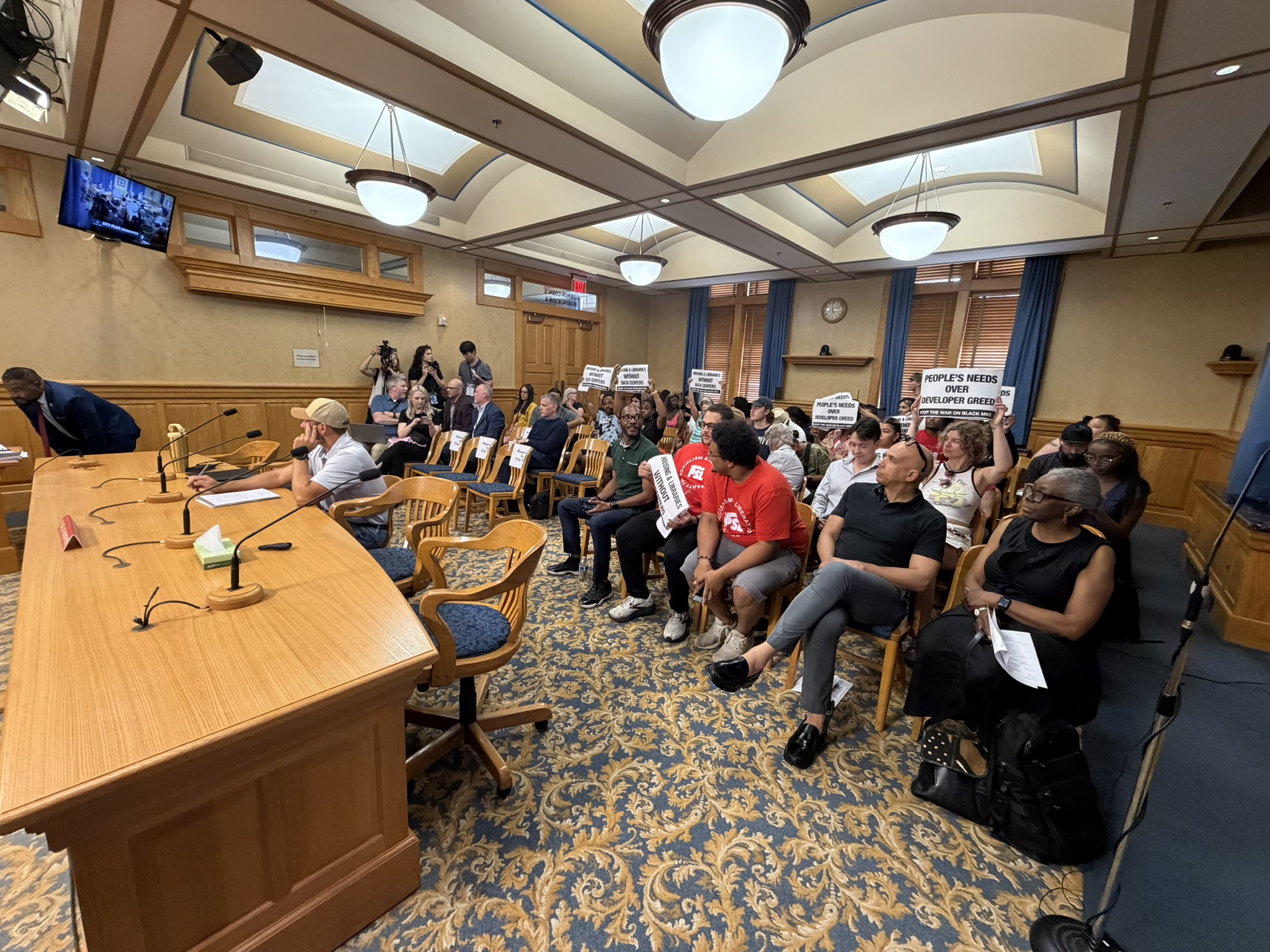
Trent Overhue sits in front of the City Plan Commission while PSL members and data center opponents hold up signs. Photo by Jeramey Jannene.
It was heated. It was long. And in the end, it might not have resolved anything.
After six and a half hours of testimony, debate and interruptions, the City Plan Commission voted to hold off authorizing a multilayered development deal that would include affordable housing, a new library, a yet-to-be-determined community tenant, indoor self-storage and a “computer research facility,” or what opponents call a “data center.”
It sets up a high-stakes July 20 plan commission meeting. The affordable housing component, and the deal with it, could fall apart if construction doesn’t start by July 31.
It’s just the last twist in the now four-year odyssey to redevelop the vacant Walmart at the Midtown Center retail complex.
The Walmart, 5825 W. Hope Ave., closed in 2016. Then, in 2023, the City Plan Commission, at the request of area Ald. Mark Chambers Jr. and the Department of City Development, rejected Affordable Family Storage‘s proposal for a self-storage facility. A reformulated plan, with support from Chambers and DCD, returned in 2026 with the city being given a $1 long-term lease for the front 51,000 square feet of the building and Gorman & Co. being given the unused parking lot to develop 200 units of housing. AFS could put its self-storage in the rear of the building.
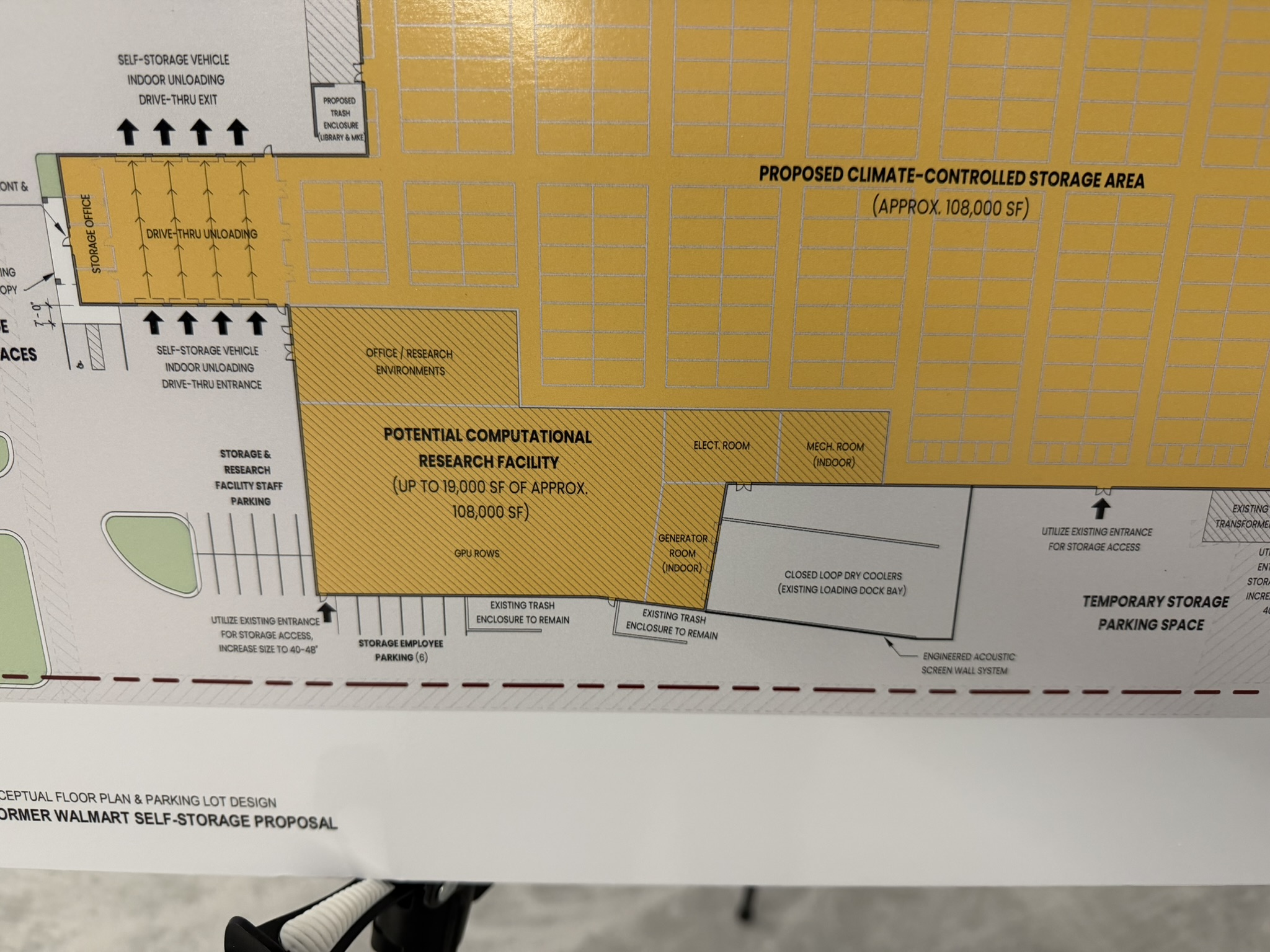
But AFS proposed adding a computing facility to the rear 19,000 square feet of the 160,000-square-foot building.
May media coverage of the computing facility, whether it was a data center or not and what that would mean compared to large AI-focused facilities, ignited a firestorm of social media activity. A May plan commission hearing was canceled. Three open house meetings were subsequently held, but they encountered substantial organized pushback.
Monday’s meeting was slated to approve or deny the proposal. In the end, it did neither.
DCD Planning Manager Tanya Fonseca spent more than half an hour detailing to the commission the various safeguard conditions DCD was proposing to put into the deal, including engineering reports on sound, water and energy usage, requirements that land be conveyed to the affordable housing developer and that the city have its lease secured to replace the Capitol Library before AFS could proceed with any of its plans.
DCD Commissioner Lafayette Crump said the revised proposal was “unquestionably better” and came with the necessary safeguards to make it valuable to the community.
“There has been a lot of misconception about these edge sites that we develop,” said Trent Overhue, co-owner of AFS.
Overhue, in a prior interview, said the proposal isn’t a data center, but a facility to serve tenants, likely medical research firms with patient privacy concerns, running specialized computing workloads. He called it an “edge site” that fits within the existing power grid. “You’ll never know that we would exist,” he said on June 10.
On Monday, he probably wished he wasn’t there. Speaker after speaker in the public testimony section personally accused him of being an out-of-town millionaire from Missouri focused only on exploiting a majority Black neighborhood.
An affiliate of AFS would own and operate the facility, which he said was similar in square footage to several owned by other operators in the city. It would operate at an IT electrical load of roughly seven megawatts, with a cooling load of about two megawatts, for a total draw of nine to ten megawatts. AFS plans to expand the building’s electrical service from approximately three megawatts to seven to support that capacity. We Energies has the available power, he said.
The AI hyperscale data center campuses — like the Microsoft facility under construction in Mount Pleasant — operate at thousands of megawatts and can exceed a million square feet. The Midtown facility’s IT room would occupy less than 10,000 square feet.
The facility would rely on a closed-loop cooling system that consumes less than five gallons of water per day. Any discharge would be handled by a private operator and not put into the sewer system. Backup generators for the facility would be placed indoors at the city’s request.
Public feedback
Despite Overhue’s insistence on what the facility was and wasn’t, Chambers’ support and the conditions and support from DCD, several dozen speakers spoke in opposition to the project. The testimony reflected the international discord over the proliferation of large data centers and fast-changing nature of the industry.
Chair Stephanie Bloomingdale imposed no time limit on speakers, which resulted in some speakers going on for several minutes even as she asked them to wrap up. Others, politically aligned with the earlier speakers, complained of how long they had to wait to speak. Public testimony lasted more than three hours.
Many of the speakers were affiliated with the Party for Socialism and Liberation (PSL). Members of the party also appeared in large numbers at the open house meetings.
“You can call it whatever you want. It’s still a data center,” said Samantha Doucas.
“They’re trying to sell us a bad deal,” said Joshua Taylor.
Stacy Smiter, a real estate agent and two-time political candidate, said the commission made the right decision in rejecting a deal in 2023 and should do so again.
Many opponents focused their comments on perceived issues with outreach, concerns with AFS making a profit on the deal and alleged negative externalities related to the computing use that Overhue said wouldn’t occur and DCD said would be guarded against by the conditions it was recommending.
“I am disappointed that they thought they could bring you all something without bringing it to the community,” said Melody McCurtis, deputy director of Metcalfe Park Community Bridges. McCurtis’s emphatic testimony on the Growing MKE plan in 2024 resulted in that proposal being delayed, and she joked to the commission that she bet they didn’t expect to see her again.
Despite several speakers asking for a moratorium, Chambers said City Attorney Evan Goyke told the council, as Urban Milwaukee previously reported, that it would be unable to impose one because of changes in case law. Additionally, the proposed computing facility would be permitted under the data center regulations pending before the city. Fonseca, the planning manager, said the recommended conditions for the development are more stringent than those in the proposed data center zoning framework.
A handful of neighbors, many of whom appeared virtually, spoke in favor. Jeremy Moore said the proposal wasn’t perfect, but it had a chance to reactivate the struggling shopping center.
A Capitol Drive force field
At multiple points, concerns were raised about an invisible line on W. Capitol Drive. Immediately north of Capitol Drive is Midtown Center and the 2nd aldermanic district. To the south is the 10th district.
Residents to the south, including Steve O’Connell, said they weren’t ever consulted and demanded other infrastructure work first. Chambers, the second district alderman, said he held several town hall meetings about the proposal in recent years with his constituents.
But late in the meeting, 10th District Ald. Sharlen P. Moore arrived to attack the proposal. She said when she was elected in 2024, it was presented to her that it was a “done” deal that the Capitol Library would move from its current home at N. 74th Street and W. Capitol Drive to the new location near N. 60th Street and E. Capitol Drive.
“The communication has been horrible,” she said. “Community was left out.”
Moore said her district would become a “library desert,” and she didn’t want to lose the library.
Chambers noted that the library was moving 14 blocks and would only end up on the other side of Capitol Drive. Crump, a 10th District resident, said that even though the library was moving out of the 10th District, it would actually be closer to his home and many other 10th District homes.
A 2018 request for proposals to build a new mixed-use library resulted in no viable bids. Chambers said keeping it at the current location isn’t viable and cited $100,000 in damage from the April rainstorms.
On what condition could the deal be approved?
After hearing testimony, the commission spent more than an hour asking follow-up questions and considering which conditions could lead to approval, all while McCurtis and other opponents interrupted the commission’s discussions.
Unlike most commission actions, its vote on the Walmart proposal is binding. The issue is not a recommendation to the Common Council but rather a final vote, as it concerns conformity with a previously established development incentive zone.
Chambers recommended they approve the deal. “My responsibility as the alderman is not to make the decision based on the loudest voices in the room,” he said. He said he followed the facts and encouraged the commission to do the same. He also expressed frustration that Overhue added the computing facility to the deal late in the negotiations.
Crump stressed that the July 31 deadline for Gorman & Company to break ground on the housing in the parking lot was real and had been communicated previously, but when it was many months away and not a concern. The commission approved the housing component in April. Gorman would need to seek an extension on its low-income housing tax credit award, the housing component’s key funding source, from the Wisconsin Housing and Economic Development Authority. If granted, the extension would cost the company “tens of thousands of dollars” said Crump. The Austin Commons proposal in Bay View currently faces the same timeline issue.
“We would ask that the project be approved,” said Crump.
Commissioner Willie Smith eventually moved approval with DCD’s list of 12 conditions, plus four more generated by the commissioners. One of the provisions would have tasked DCD or an independent consultant with visiting the nearest AFS computing facility and assessing whether it complied with the conditions DCD recommended be imposed regarding the Milwaukee facility’s environmental impact. Overhue said the closest facility was in Springfield, Missouri and Crump noted that DCD didn’t have a budget for such things and wasn’t sure how to judge success or failure, but he agreed to try.
After substantial debate among Bloomingdale, Smith, Commissioner Allyson Nemec, Overhue and DCD staff, Smith’s motion failed to find a second.
Nemec and Smith tried another motion, but it was voted down.
Eventually, the interruptions from the audience, length of the meeting, heat in the room and difficulty reaching a consensus began to take their toll.
“Is there a library near a data center anywhere else in the world?” asked someone in the audience. “Probably, yes,” responded Crump quietly, but into a hot mic.
After yet another interruption, Bloomingdale briefly gave up and said “Well, I tried.”
Overhue, at one point, interjected to request a vote. “I would rather just take a roll call if you don’t want to do it,” he said. The commission demurred.
Without adding any conditions or direction to the developer or DCD, Tarik Moody moved to hold the matter to a future meeting. Jesus Gonzalez seconded it. The commission unanimously approved the motion.
There is one bright spot for those concerned about another marathon meeting: when the issue returns in July, the commission isn’t legally required to hold another hearing.
Former Walmart
New Walmart interior layout. Photo by Jeramey Jannene.
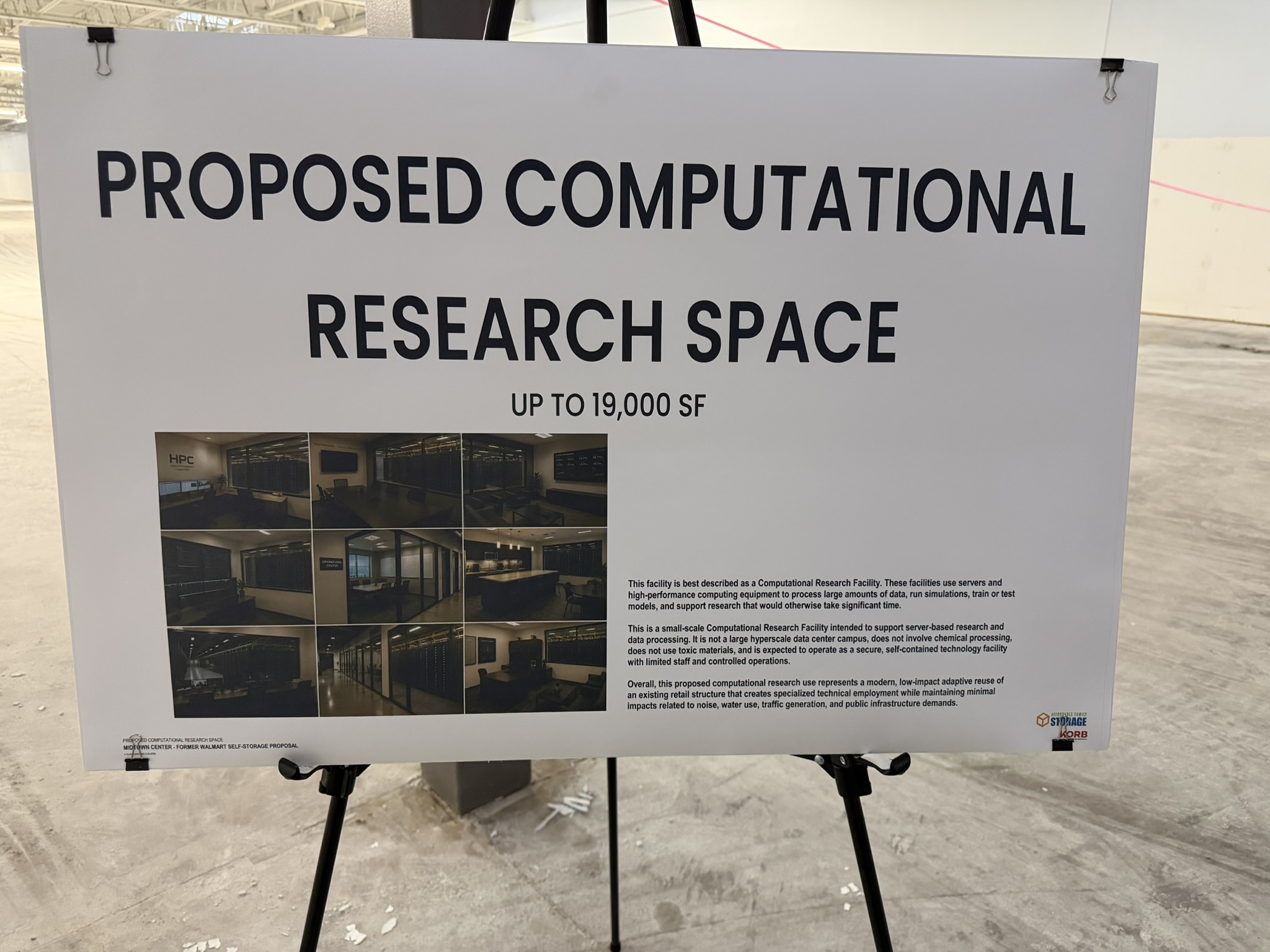
Computational research place sign. Photo by Jeramey Jannene.
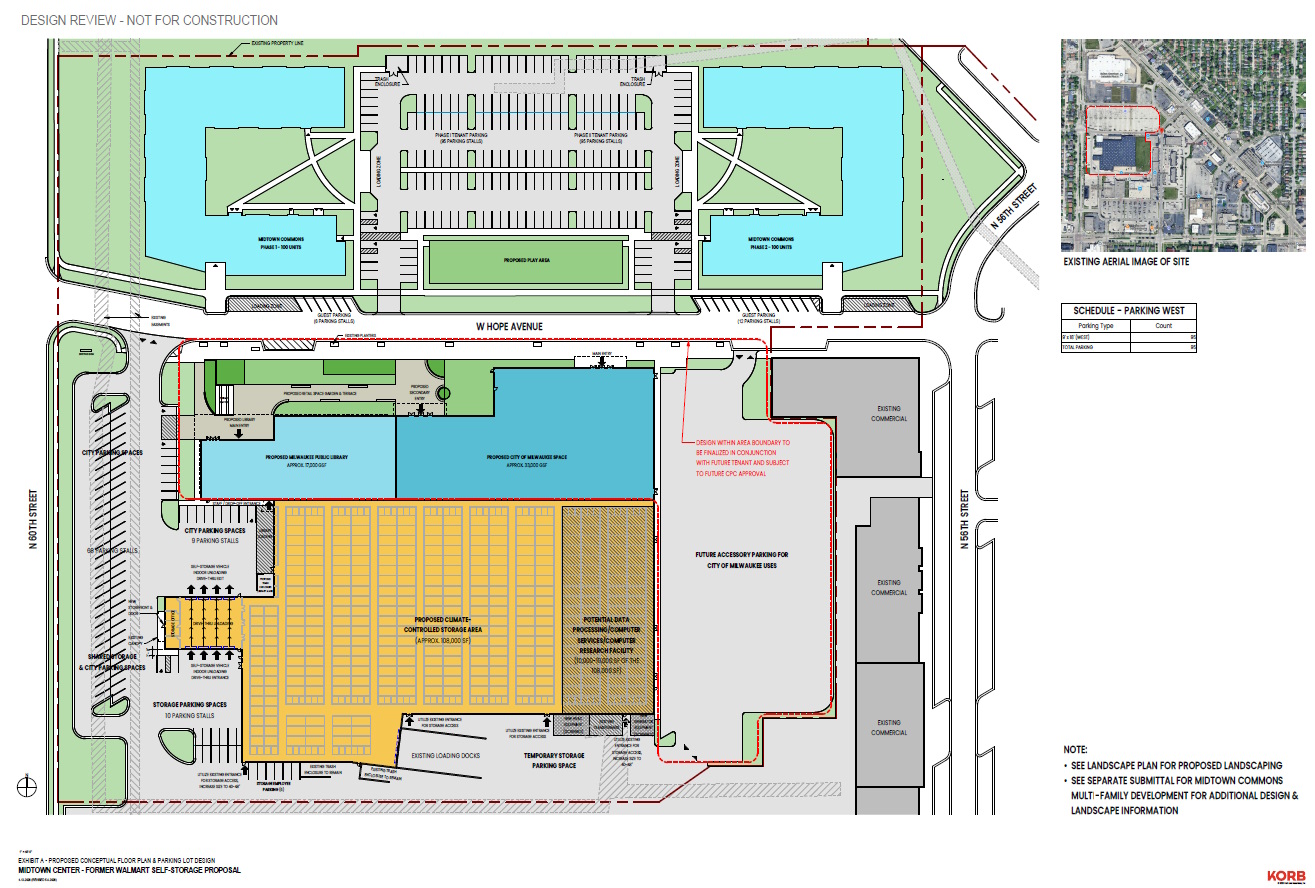
Initial Walmart site plan. Image submitted to CPC by KORB.
Legislation Link - Urban Milwaukee members see direct links to legislation mentioned in this article. Join today
Existing members must be signed in to see the interactive map. Sign in.
If you think stories like this are important, become a member of Urban Milwaukee and help support real, independent journalism. Plus you get some cool added benefits.
More about the Midtown Walmart redevelopment
- Midtown Walmart Redevelopment Wins Approval After Contentious Fight - Jeramey Jannene - Jul 20th, 2026
- Midtown Walmart Redevelopment Drops ‘Data Center’ Plan - Jeramey Jannene - Jul 6th, 2026
- 6-Hour Showdown Over Midtown Walmart Ends In No Decision - Jeramey Jannene - Jun 29th, 2026
- It’s Not a Data Center, Developer Says of Midtown Walmart Project - Jeramey Jannene - Jun 10th, 2026
- Three Meetings For Public To Learn About Controversial Walmart Redevelopment - Jeramey Jannene - Jun 2nd, 2026
- Ald. Mark Chambers Attempts To Set Record Straight About Midtown ‘Data Center’ - Jeramey Jannene - May 14th, 2026
- Self Storage, Data Center Planned for Former Walmart - Jeramey Jannene - May 8th, 2026
- New Library Planned For Key Milwaukee Location - Jeramey Jannene - May 4th, 2026
- Walmart Parking Lot To Be Replaced With Affordable Housing - Jeramey Jannene - Apr 30th, 2026
- Two Milwaukee Affordable Housing Proposals Denied Funding, A Third Goes A Different Route - Jeramey Jannene - Feb 12th, 2026
Read more about Midtown Walmart redevelopment here




















Our government is incapable of governing. I’m not sure if it’s because they fear conflict or if they are afraid of losing their jobs. Either one means you’ll underperform in your role.