Democratic Governor Candidates Address Criminal Justice, Inequality
WISDOM forum provides chance for in-depth answers by candidates.
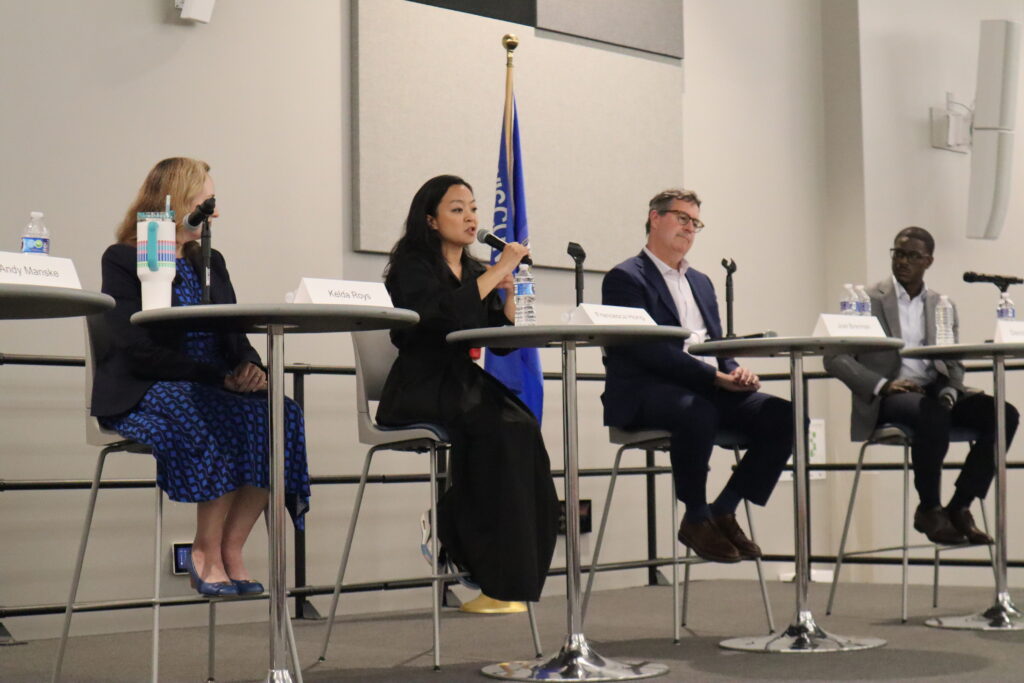
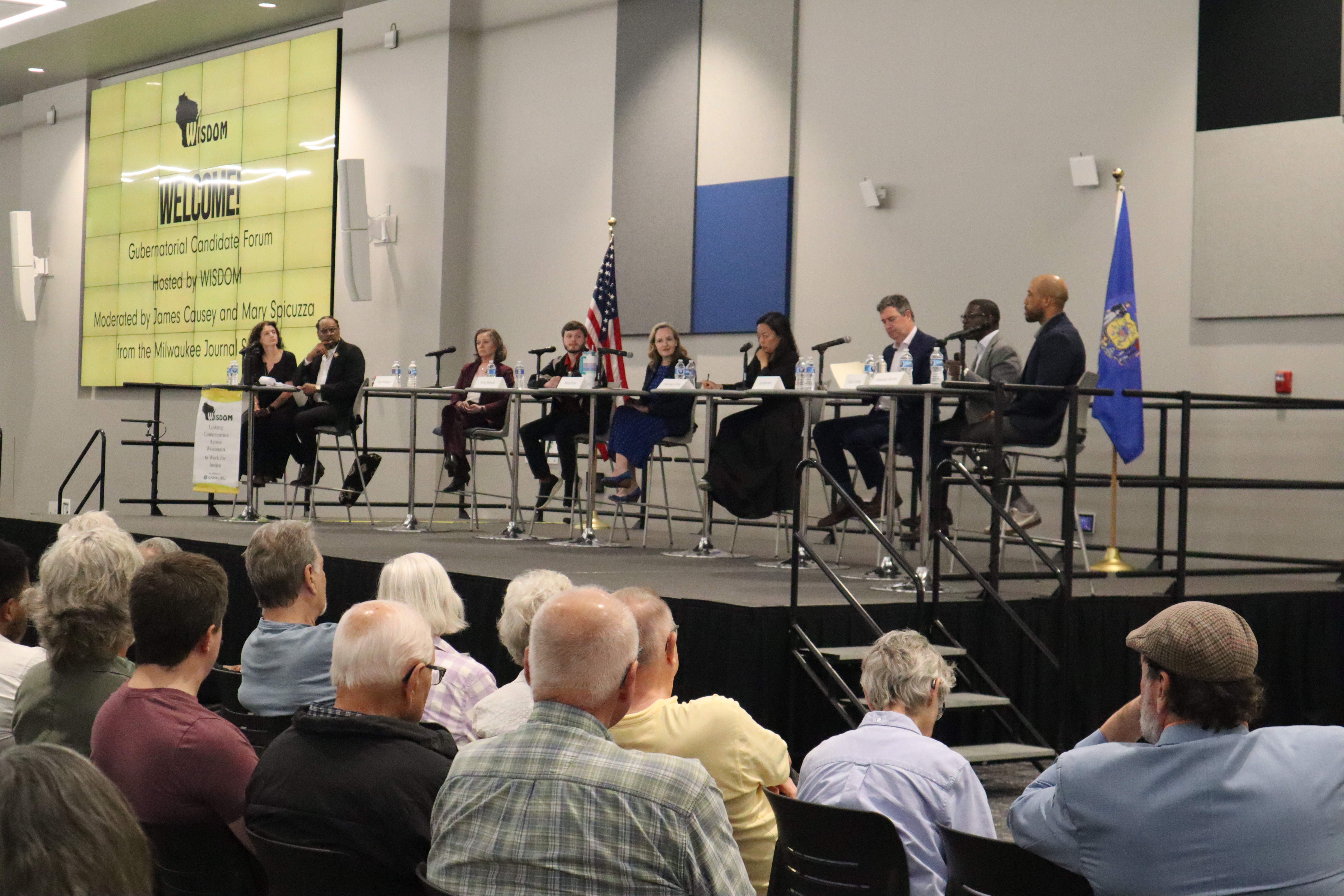
WISDOM hosts a forum with seven gubernatorial candidates. Francesca Hong speaks to the crowd as Kelda Roys, Joel Brennan and David Crowley look on. (Isiah Holmes/Wisconsin Examiner)
Seven candidates vying to become governor addressed a large audience in Pewaukee Monday night at a forum organized by WISDOM, a non-partisan organization dedicated to social justice and prison reform. Moderated by James Causey and Mary Spicuzza of the Milwaukee Journal Sentinel, the question and answer session covered policing and incarceration, healthcare, immigration and other issues.
Republican frontrunner U.S. Rep. Tom Tiffany did not attend. Andy Manske, a 26-year-old medical service technician who is running a longshot Republican campaign for governor joined Democrats Lt. Gov. Sara Rodriguez, Sen. Kelda Roys (D-Madison), Rep. Francesca Hong (D-Madison), former Department of Administration chief Joel Brennan, Milwaukee County Executive David Crowley and former Lt. Gov. Mandela Barnes.
Below are each candidate’s answers to a handful of key questions from the moderators.
How would you reduce incarceration while improving public safety?
Manske answered the question by drawing on his personal relationships with people who struggled with addiction and incarceration. He said he believes that people need not only a path out of prison, but support so they can become healthy and productive citizens. This is especially true for people leaving jail or prison and people living on the street without housing, he said. He added that he supports building a location in Madison where the best professionals could gather “and those who want help can get that help.”
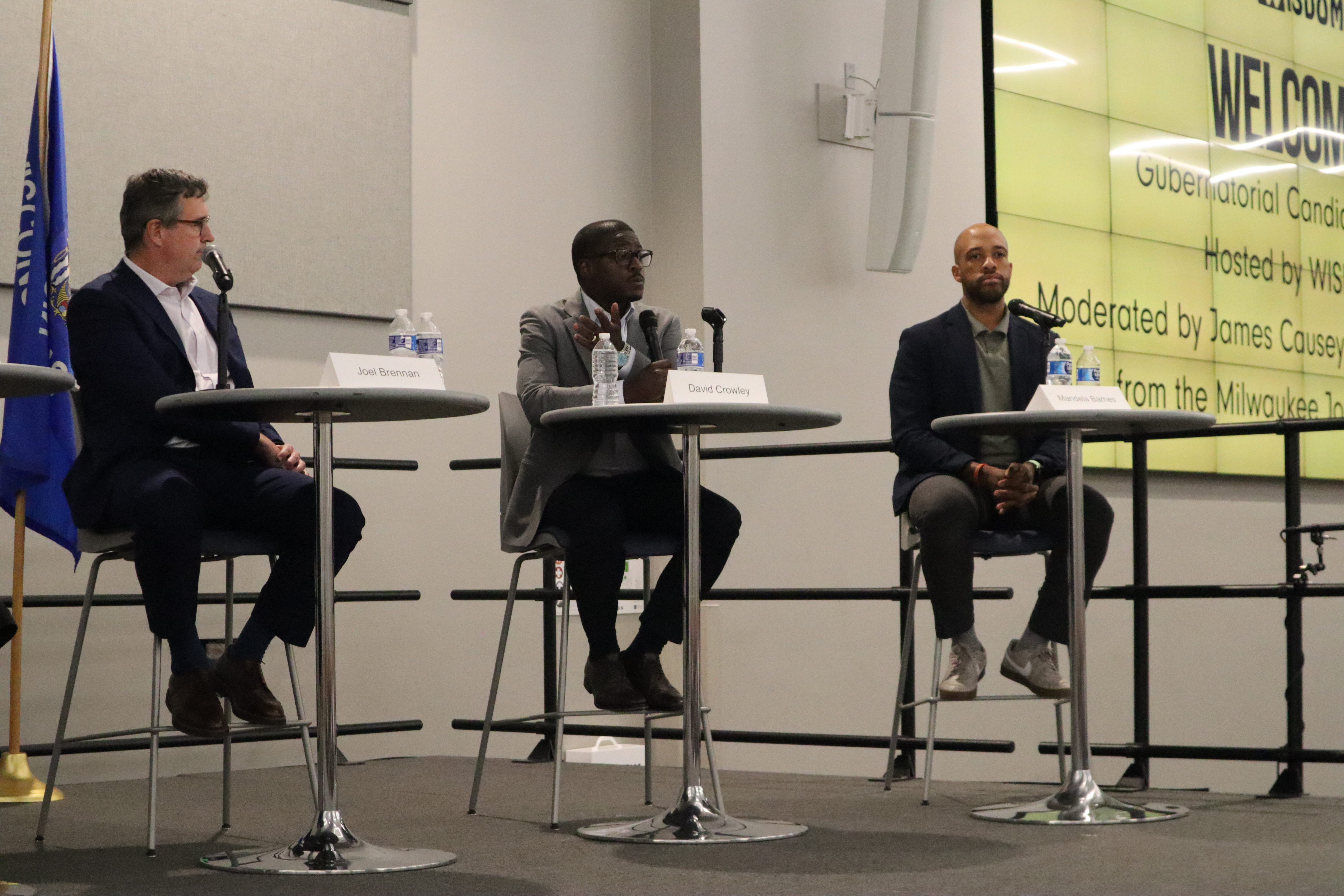
Joel Brennan (left), David Crowley (center) and Mandela Barnes (right). (Photo by Isiah Holmes/Wisconsin Examiner)
Roys said she favors following evidence-based practices and expanding treatment and diversions. “This is not rocket science,” she said, adding that it’s possible to reduce the number of people Wisconsin incarcerates while also saving money and human lives. Addiction and mental health should be treated as medical issues, not with incarceration, Roys said. She connected these medical struggles to her proposal to open up the state employee health insurance plan to all Wisconsinites to get the same health insurance that she enjoys as a state employee. Roys also endorsed ending crimeless revocation, which has increased Wisconsin’s prison and jail population by reincarcerating nonviolent offenders for minor violations of their conditions of release and implementing restorative justice practices.
“Everybody in our state deserves to live a life of dignity, including people who are incarcerated right now,” said Hong. She said that the overcrowded conditions in prisons across the state — especially for incarcerated women — are “abhorrent.” Hong said that some communities are creating local programs the state should support and fund, including efforts to provide affordable housing, community centers and mental health resources. “For too long our local governments have been starved of resources due to Robin Vos and the Republicans freezing and not funding our local governments,” said Hong. Many of the problems communities face could be best addressed through increased state support for local organizations that are already doing the work on the ground, she said.
Brennan said that about one-third of all state employees work for the Department of Corrections, making it the largest state agency. “We have about three times as many people incarcerated in Wisconsin as they do in the state of Minnesota,” Brennan said, adding that Wisconsin’s neighboring state spends $100 per capita less than Wisconsin on incarceration. He suggested that the state could make a profound positive impact by investing $600 million “on the front-end,” dismantling the school-to-prison pipeline by increasing prevention and education and providing opportunities for job training and re-integration for people leaving prison.
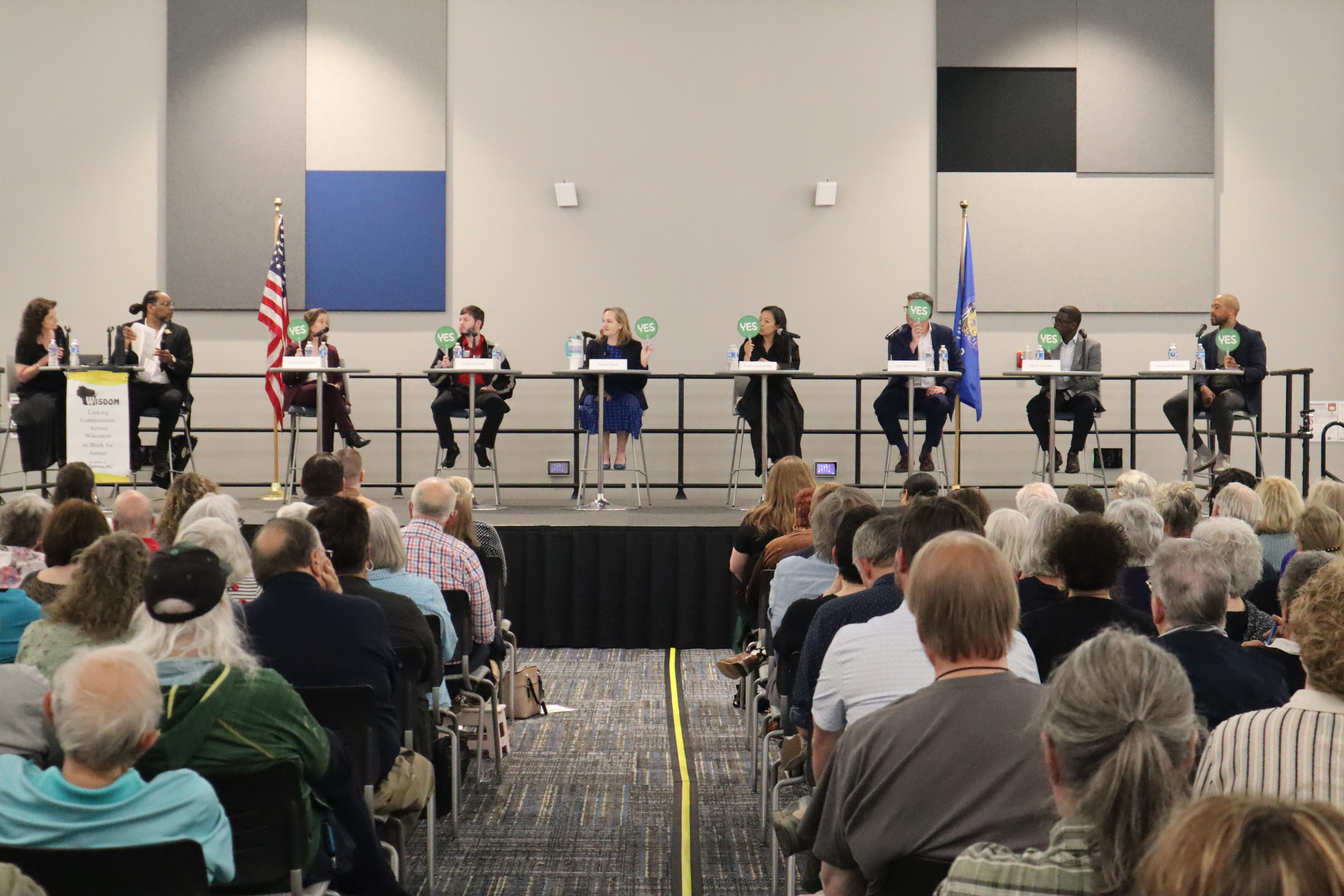
During one round of questions, participants were given “yes” and “no” paddles to hold up in answer to questions. (Photo by Isiah Holmes/Wisconsin Examiner)
Crowley said one of his first jobs after high school was working at Project: Return with formerly incarcerated people, helping them find housing. Under his leadership, Milwaukee County has taken on responsibility for running the Community Reintegration Center, formerly called the House of Corrections. He said that government’s focus needs to be directed at “how we invest upstream” to address the root causes of crime. Supporting mental health care, continuing the commutation process started by Evers, decriminalizing cannabis, creating a pathway for expungements and expanding drug courts are among the measures he said he supports.
Barnes highlighted lack of opportunity as a contributor to Wisconsin’s high incarceration rate. He said he has known people who’ve made bad decisions because they felt the consequences of their actions were no worse than their living conditions. “That’s something we need to reckon with,” said Barnes. “Right now, we’re doing things totally wrong. We’re spending so much money and the cost is not just in dollars and cents, the cost is in lives.” During his time as a state lawmaker, Barnes visited many prisons around the state and was the ranking Democrat on the Legislature’s Corrections Committee. He recalled talking to a boy who’d spent time in Lincoln Hills who said that when he was released, “that he knew for a fact that he was going back in because he did not know what else to do.” Barnes said that people need to be rehabilitated and provided opportunity, not just warehoused.
Rodriguez connected Wisconsin’s incarceration rate to its “shameful” record of failing to invest in public health. “And so what ends up happening is that people do not get the services that they need,” she said. When she chaired the governor’s healthcare workforce task force, she said, she learned that Wisconsin could double the number of therapists it provides “and it would still not be enough.” She stressed the disproportionate rates of incarceration of of Black and brown Wisconsinites despite similar rates of drug use and addiction. Like Brennan, Rodriguez pointed to Minnesota’s record reducing incarceration without triggering an increase in crime. Rodriguez said that Wisconsin could look at how other states have tackled the issue. “I am not about re-inventing the wheel,” she said, adding that Wisconsin needs to adopt the best practices from other states.
How would you use the pardon and clemency powers as governor?
Roys stressed that community safety is “the most important aspect” of decisions about releasing people from prison. Gov. Tony Evers should have used his power to reduce prison sentences and pardon Wisconsinites “much more” aggressively. She also said that the governor has significant power to shape how the Department of Corrections operates, and to help provide meaningful pathways to reintegration of incarcerated people. Yet the state continues to incarcerate people who have served such long sentences they have grown old and have aged out of crime. “I actually think that we have a constitutional problem here in Wisconsin,” said Roys. “How long you go away depends on when you committed the crime and when you were sentenced.” The power to pardon should be used “because justice is not always served,” she added.
Hong also said that the governor should wield executive power more assertively . The conditions of Wisconsin’s prisons could be considered “a state of emergency,” Hong said. “There are executive orders that should have been placed during the Evers administration that I was disappointed not to see happen,” she said. She felt Evers could have been more responsive to families, formerly incarcerated people, and advocates who are “organizing and demanding justice,” adding that those folks deserve a place at the table when discussing pardons and clemency powers. “It should be the folks who are closest to the problem who are closest to the power,” she said. By listening to these voices, she suggested, Wisconsin can move away from being among the states with the highest Black incarceration rates and where women’s prisons are desperately overcrowded. “This is about dignity,” she said.
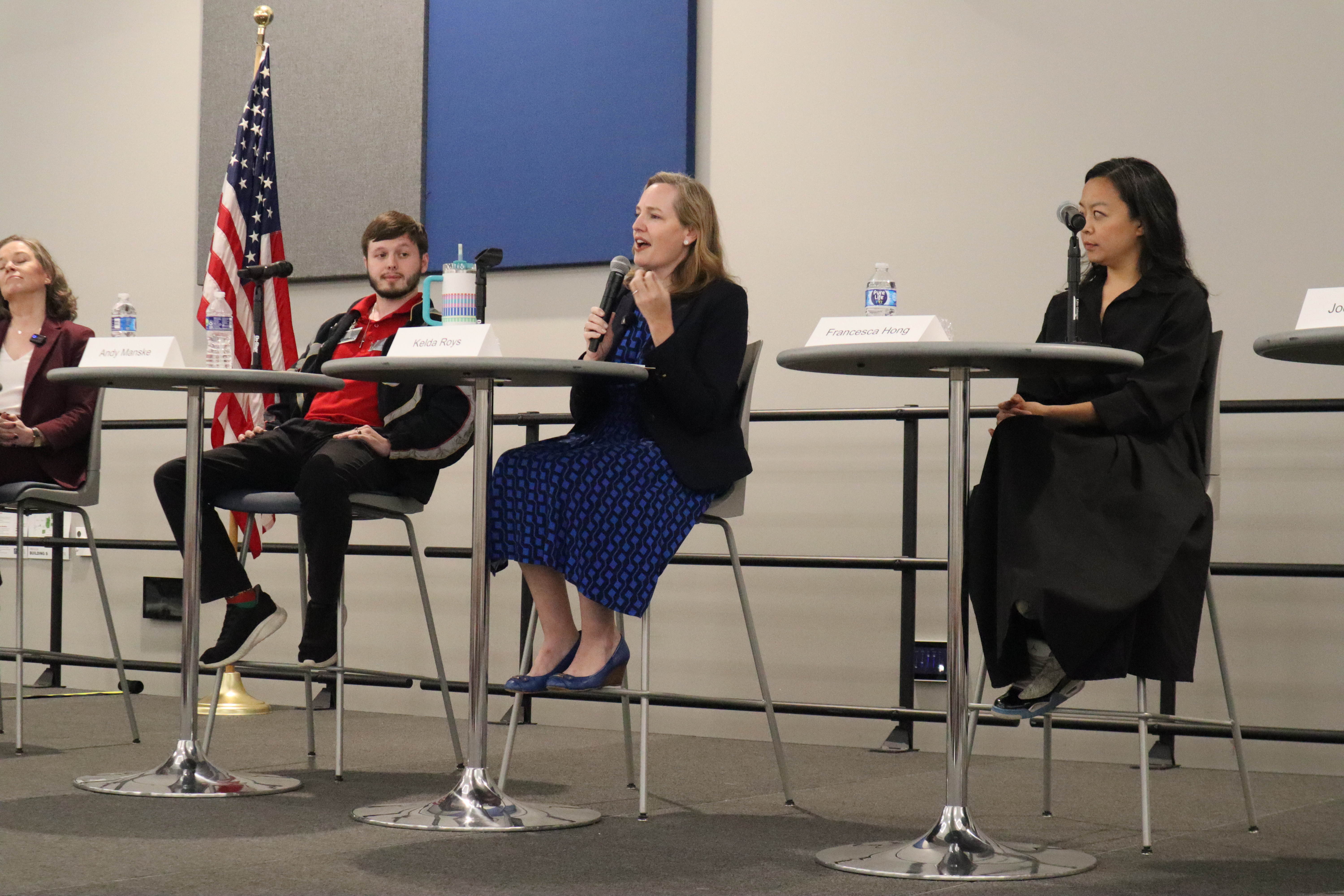
Andy Manske (left), Kelda Roys (center), and Francesca Hong (right). (Photo by Isiah Holmes/Wisconsin Examiner)
Brennan said that Evers’ was dedicated to using his pardon powers to right wrongs. “The pardon process was one where he was emotionally invested in the stories,” Brennan said. He promised to continue that commitment. He expressed optimism that the end of Republican gerrymandering will help create a state where justice and vengeance are not blended together. “We have had a generation in Wisconsin that in some ways we have lost because of that confusion,” he said, adding that pardon and clemency powers need to be used judiciously and that the governor cannot rely solely on those powers to achieve criminal justice reform.
Crowley promoted the idea that anyone and everyone should be able to apply to get their record expunged once they’ve served their time. Pardons need to be reviewed on a case-by-case basis, especially since everyone’s situation is different, he said. He highlighted that his former deputy chief of staff was a four-time felon. “Yes, I hired a four-time felon,“ he said, adding that one of the charges was for child abuse. But what that charge obscures, he said, is that his employee was convicted of child abuse after getting into a fight as an 18-year-old with someone who was 17. “And even though the victim said ‘this is not what we want to do to his life,’ the judge still threw the book at him.” This is why every case needs to be reviewed carefully, and that assumptions should be avoided, Crowley said.
Barnes said that politically polarized positions on pardons and clemency have contributed to problems in Wisconsin. He reiterated that people who find themselves on the wrong side of the law have been blocked from opportunity, which led them to prison in the first place. Non-violent offenders and people suffering from mental illness or addiction and other unique situations are all treated the same under the current system, which needs to change, he said.
Rodriguez said that she would continue the pardon, commutations and clemency process Evers began. Each case should be viewed individually, she said, but public safety has to be the first consideration, followed by justice, fairness in sentencing, and finally a demonstrated commitment to integrate back into the community. Rodriguez and Crowley both said that cannabis needs to be legalized and that convictions based on outdated laws, including cannabis convictions, need to be expunged.
Manske agreed that cannabis should be legalized “with rules and guidelines,” and cannabis convictions should be expunged. He added that the justice system should treat the powerful no differently than those who are not wealthy or well connected.
How would you make immigrant communities feel safe and reduce labor shortages?
Hong said that no one should have to live in fear in their own communities and described the pain of immigrant workers who are afraid of being arrested by federal agents if they show up for their jobs. Ensuring that people know their rights is important, she said, so they can fight back against wage theft and workplace maltreatment, while also navigating life under the threat of deportation.
Brennan said he recently toured a Manitowoc foundry where the CEO spoke to employees in Spanish and discussed a recent chilling of the labor market. “For the first time in many months, he found no Spanish speakers at all,” said Brennan. The federal immigration crackdown has harmed the dairy industry and agriculture generally as well as manufacturing and the service industries in Wisconsin, he said. Brennan described it as a joint responsibility to ensure Wisconsin is the state “we thought we were.” He said that means making sure that state resources are not being used for immigration enforcement, ending agreements between local law enforcement and immigration enforcement, and creating a welcoming state where people are treated with respect and can contribute their cultures.
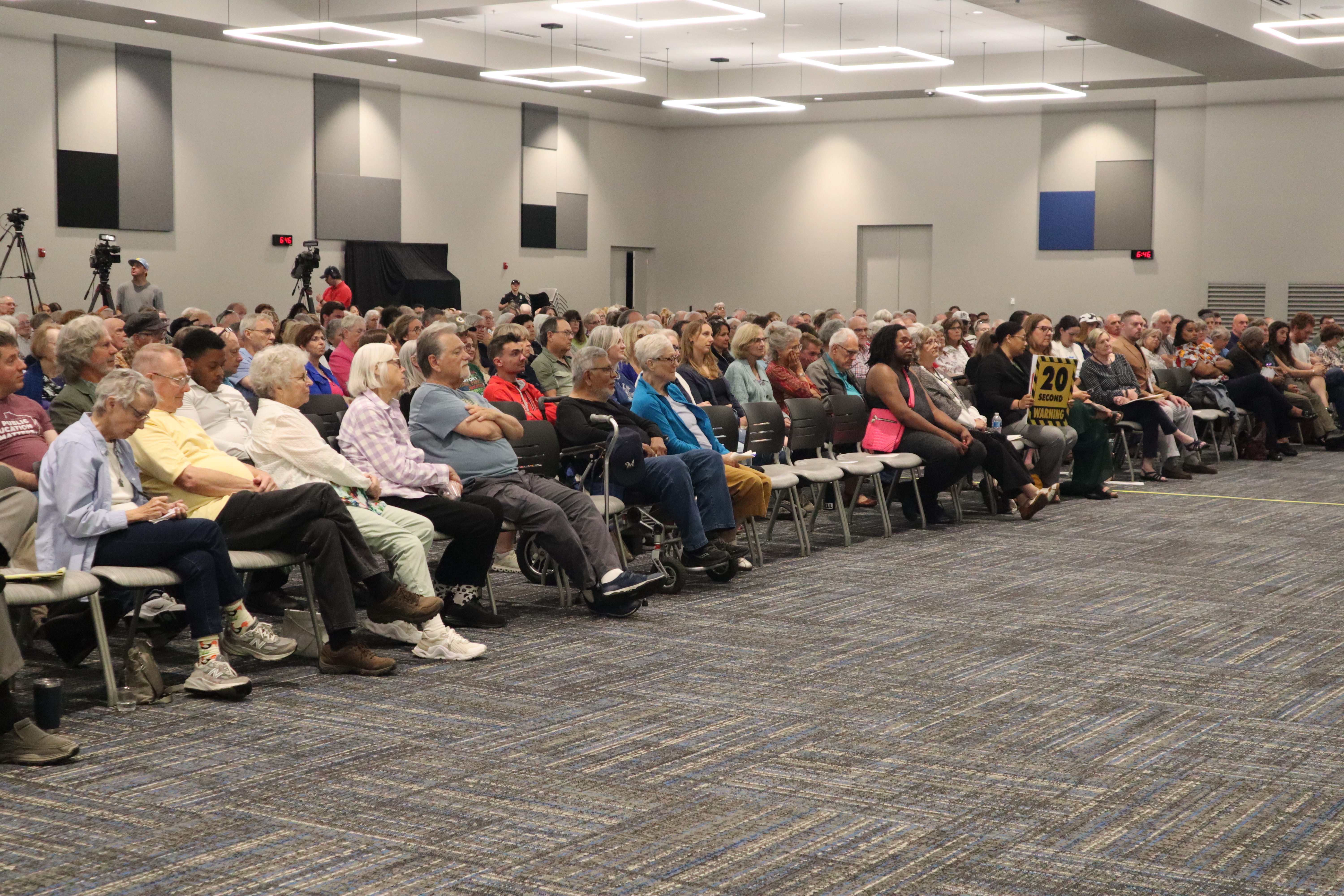
A large crowd turned out to listen to the candidates and speak with them one on one before and after the forum. (Photo by Isiah Holmes/Wisconsin Examiner)
Crowley said he has been dealing with the federal immigration crackdown directly in Milwaukee, adding that his county has the state’s largest Latino and Muslim populations statewide. Both the state and local governments and the community itself need to step up to protect neighbors, he said. Milwaukee County has created an online resource hub for immigrants and concerned residents. Crowley stated his position that local law enforcement should not become a tool of a federal immigration agenda.
Barnes said that Wisconsin grew because people, including immigrants, chose to move here. Being able to access the middle class has become more difficult over time, causing people to point fingers at each other and to blame immigrants, he said. He called scapegoating immigrants unfair, describing immigrant workers as essential to the state’s economy. Fundamentally, Barnes said, there is a broken immigration system that needs to be fixed at the federal level.
Rodriguez recalled when her young child first asked her if Donald Trump won, and whether the president would send his father — a naturalized citizen — back to Mexico. “And it broke my heart that that man’s words had gotten into my child’s head,” she said. She added that her husband now walks around with his passport card after Trump was elected for a second time. “We have to make sure that immigrants feel safe in Wisconsin,” she said.
Manske said he doesn’t like seeing immigration enforcement going into communities and hurting people. He said two classes of “oligarchic Republicans and corporate Democrats” look at immigrants almost as a “slave caste.” Manske said that it’s heartbreaking that immigrants are facing threats and repression. He added that he wants to see a working legal immigration system, but that communities shouldn’t be lied to and told “they’re safe when they’re not safe.”
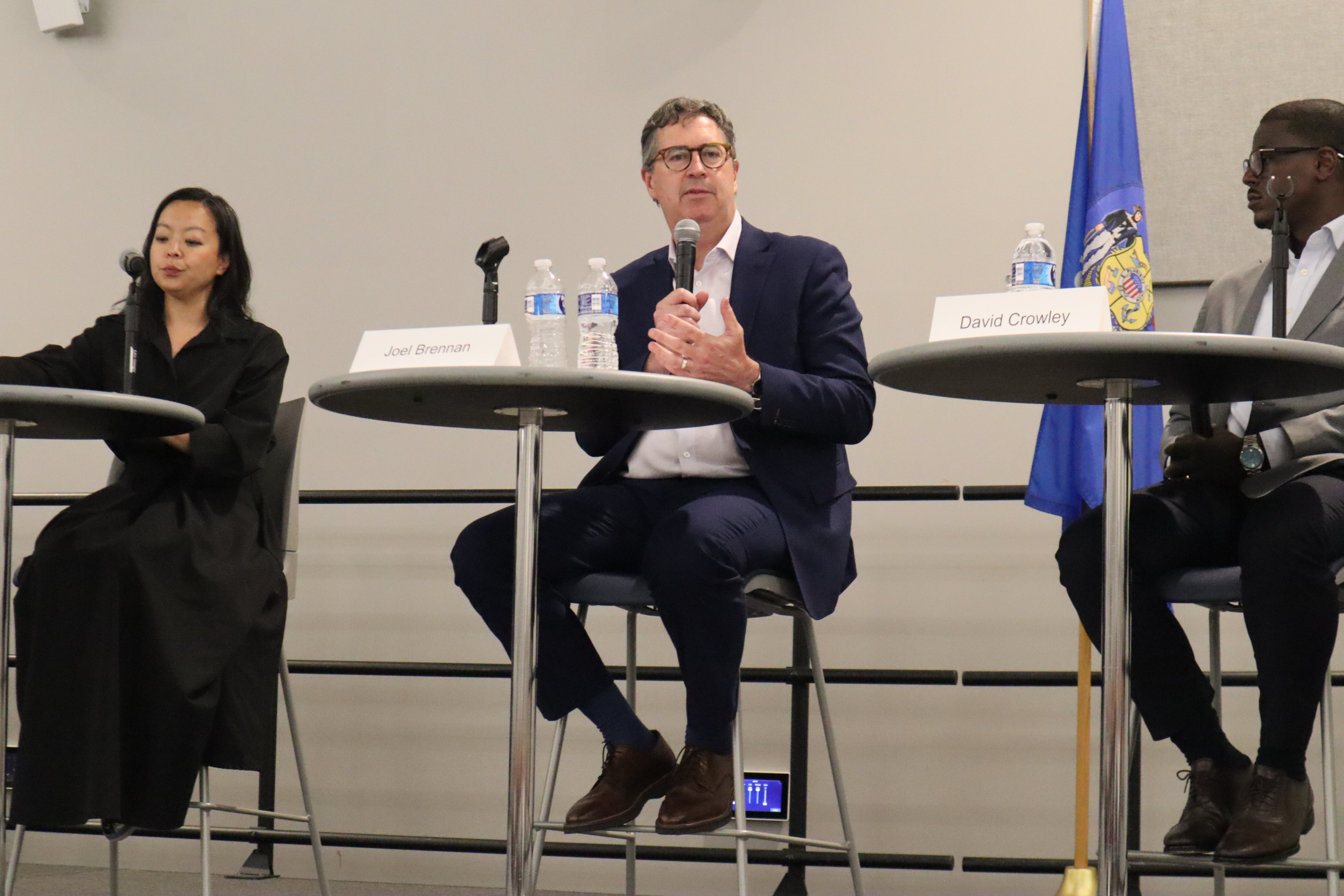
Francesca Hong (left), Joel Brennan (center), and David Crowley (right). (Photo by Isiah Holmes/Wisconsin Examiner)
Roys said that Immigration and Customs Enforcement (ICE) needs to be abolished, a position she has articulated over the last decade. “I foresaw how it could be used as a paramilitary force,” said Roys. America can have secure borders, a functional immigration system and public safety “without dehumanizing people,” she added. “What is happening now is an abomination,” she said. She highlighted her record of supporting legislation to limit or prohibit state and local cooperation with ICE, and to allow ICE agents to be sued and prosecuted for breaking laws. Roys also added that she supports raising the minimum wage, providing universal childcare, and providing driver’s license for immigrants as ways to support workers.
All of the candidates were asked specifically whether they support 287(g) agreements between local law enforcement and ICE. They all said they would not support the agreements except for Manske, who is skeptical that state law can trump federal law in this circumstance.
What would you do to significantly reduce childhood lead poisoning?
Crowley said he believes the discussion of lead poisoning plays into the political divide in Wisconsin. “We don’t just talk about clean drinking water,” he said. “We pit lead laterals against PFAS contamination in rural communities … when what we need to be focusing on is “how do we just talk about getting people access to clean water?” He said he wants to empower the Department of Natural Resources to hold polluters accountable, and work to overcome the daunting barriers to replacing lead laterals across the state, a task challenged by a lack of plumbers and tradespeople trained to do the replacements.
Barnes said that, although federal funds to address lead are drying up, the state still has a responsibility and an opportunity to step in. He described going into communities and talking to people who got good, union-paying jobs to replace lead laterals, and how the loss of those jobs is another serious problem. Barnes said that besides lead pipes, the state also needs to hold landlords accountable for having lead paint on their properties.
Rodriguez also pointed to cuts and changes at the federal level, which have frustrated efforts to replace lead laterals. She feels instead of relying on the federal government, neighboring states should collaborate to tackle the lead crisis.
(Photo by Isiah Holmes/Wisconsin Examiner)
As a Republican, Manske said, he doesn’t mind the idea of spending money on issues like this. He doesn’t want Wisconsin communities to deal with a water crisis like Flint Michigan, which seems to never end. Manske said he doesn’t like hearing about people being sick and not being able to pay for the bill. “At the end of the day, whatever it takes,” he said, stressing that investing in people is important.
Roys said that corporate money in politics is the reason clean water isn’t coming out of every tap in the state. She recounted working to hold corporate polluters accountable for curbing disparities in infant mortality rates, which have environmental components. On the Joint Finance Committee, she fought for funding to clean up water contaminates. “We need to restore environmental law and order in the state,” she said, adding that science needs to be put back “in the driver seats at the DNR.”
“Delete existing tax exemptions for data centers and the additional subsidies,” said Hong, keeping her remarks brief and pointed. The $2.1 million the state could recoup from data centers, could be put back into infrastructure to address issues like the lead crisis, she said.
Brennan said the state could use a clean water loan fund at the local level, and could view the cleanup effort as an opportunity to create good paying jobs. Brennan recalled visiting a woman who lived in a rural PFAS-contaminated community and asking her what she wanted out of state government. Her community had been dependent on bottled water for the last five years. She turned on her tap and told him “I want to be able to use this to cook, to brush my teeth.” Brennan said, “it’s our responsibility to do better.”
What is something you disagree with your party or its leadership on?
Barnes said that “we have to tax the wealthiest in our society” and restore opportunity. The reason people can’t access the middle class is because so much wealth has been concentrated in the hands of just a few people, he said. Allowing money to influence politics has allowed the wealthiest people to control who is elected, “not the voters, not the people.” Barnes said that Democrats need to “reject this level of corporate influence,” hold the wealthiest accountable, and stop profiting from systems that oppress people.
Rodriguez said that people are forced to choose unnecessarily between moderate and progressive Democrats. In reality, there is a lot of agreement across the board, she said. She added that there’s an illusion of difference among Democrats who share the same principles but differ on the right methods to achieve the same ends.
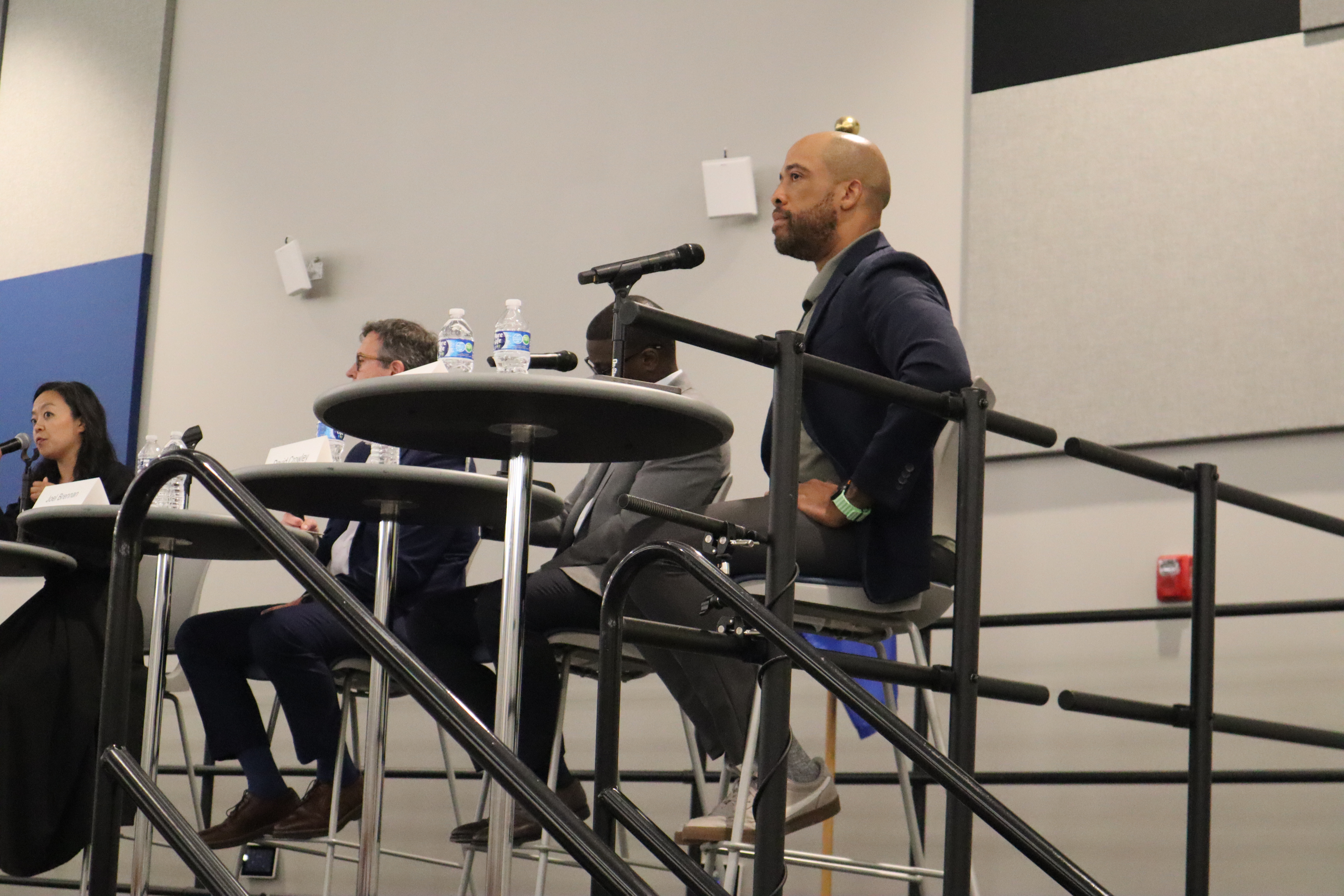
Mandela Barnes (Photo by Isiah Holmes/Wisconsin Examiner)
Manske said that other Republicans see him as an “enigma.” He believes the government should spend money to help people, he supports a high-speed train from Milwaukee to Green Bay, “if the money would allow it.” He also supports legalizing cannabis, and is pro-choice even though he is religious. Manske feels that people are unable to afford the families they may want. “The conditions need to change. People choose life if they have hope,” he said.
Roys said Wisconsinites value independent thinkers, which is why she’s well suited to take on Tom Tiffany, whom she called a “rubber stamp” for Trump. She’s gone against her party even when it hurt her, she said. “I was one of the first candidates in the country to say that I’m not going to fund my campaigns with corporate money, back in 2011,” said Roys. “You can’t tell me how many rooms I was laughed out of.” She said she believes in public financing, and pushed for fair maps when other Democrats wanted to draw maps that favored themselves. Roys also said she supported bills to put more nurses in rural communities, despite multiple vetoes from Evers. She has also pushed for ending mass incarceration, despite other Democrats not being as enthusiastic, she said.
Hong said she disagrees with some of the political strategies favored by the Democratic Party. Working class people, especially in rural communities, feel left behind, she said, and the party has a problem with “elitism.” Independents and moderate Republicans should not be seen by Democrats as more important voters than working class people, she said. She pointed to farmers who’ve been crushed by tariffs and big agriculture. Young voters also need to be valued, and issues like childcare and mass incarceration need to be taken seriously, she said. “I think I disagree with who we have been prioritizing, and I think we have an opportunity to course-correct,” she said.
Brennan said he disagreed with Evers on the provision of Trump’s Big Beautiful Bill that offered a $1,700 tax credit for contributions to school choice programs. Evers said he wouldn’t let Wisconsin opt into the tax credit, but Brennan said taking the money was better than sending it elsewhere. The money, he said, could send a kid to camp at Discovery World — which Brennan led — or could support kids who need opportunities. Brennan added that he believes that every dollar that can be used to support kids in Wisconsin should be used.
Crowley said that the Democrats are playing “the part of reaction.” All the party has done for the last 12 years is react to what the Republicans and Trump are doing, he said. Doing this allows Trump and the Republicans to “define us, for us,” he argued. No one wins a game if they’re only playing defense, he said. Crowley recalled when Trump said that private equity firms shouldn’t be buying single family homes, something he agrees with and that Democrats had fought for years to achieve. Democrats have forgotten how to be proactive and how to sell a vision of what they want for their communities, he said.
The Democratic primary will be held on August 11, followed by the general election for governor on Nov. 3.
Democratic gubernatorial hopefuls address criminal justice, inequality was originally published by Wisconsin Examiner.
Political Contributions Tracker
Displaying political contributions between people mentioned in this story. Learn more.