Tom Tiffany Stands by Criticisms of Failed Wisconsin Tax Cut Deal
Republican candidate for governor sticks to stand despite poll showing big support for deal.
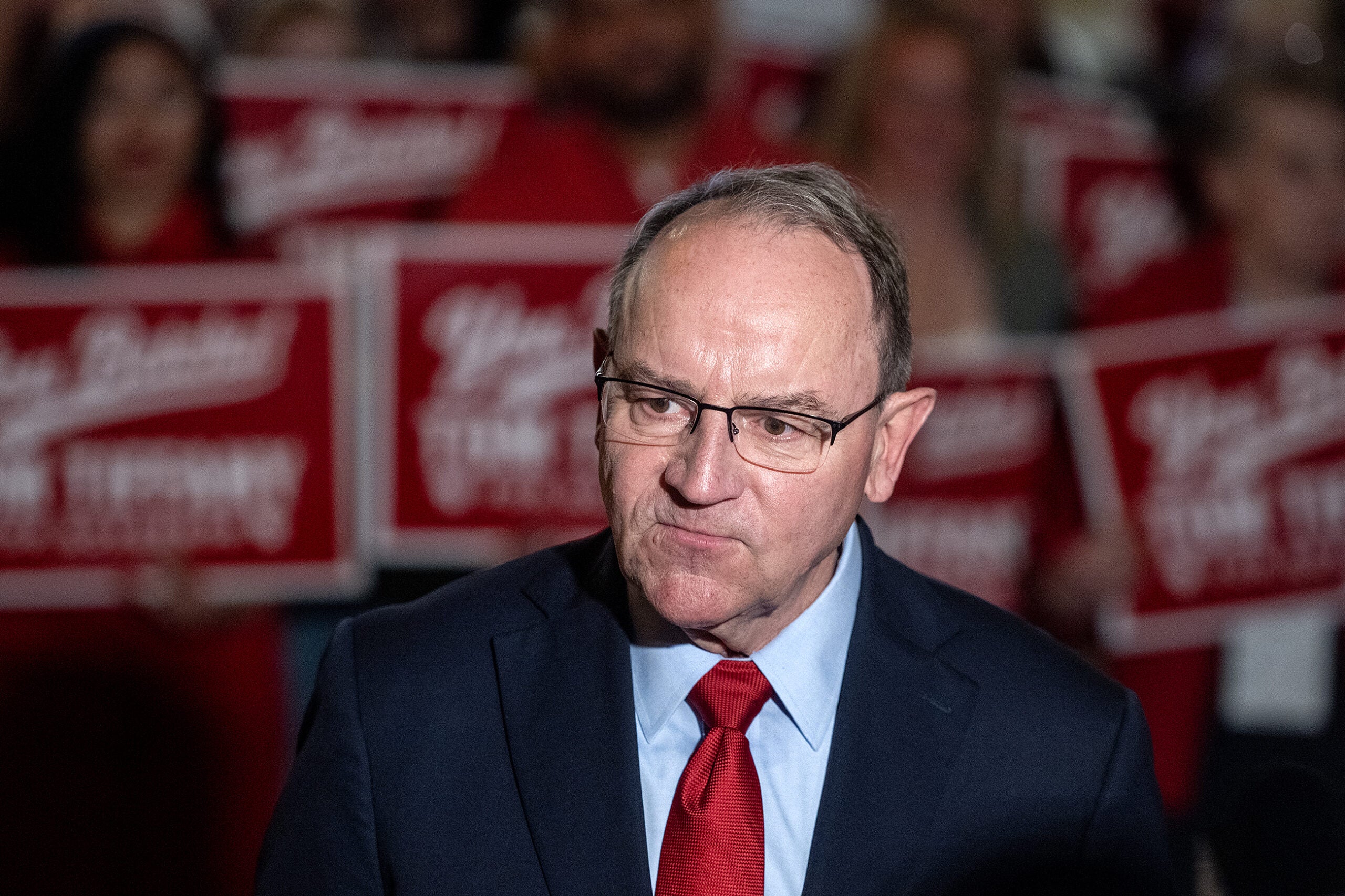
U.S. Rep. Tom Tiffany speaks to the press after being endorsed by the party for governor Saturday, May 16, 2026, during the Republican Party of Wisconsin State Convention at Kalahari Resorts & Conventions in Baraboo, Wis. Angela Major/WPR
U.S. Rep. Tom Tiffany, the leading Republican candidate for Wisconsin governor, was a vocal critic of the budget surplus deal that failed in the Legislature this month — reportedly calling at least one Republican senator to voice his concerns with the plan ahead of the vote.
Ultimately, the plan to divvy up the surplus on a combination of tax rebates, property tax relief and special education funding failed on the floor of the Senate. And at an event in Madison on Tuesday, Tiffany stood by his criticism of the bill, which was hashed out between Democratic Gov. Tony Evers and leading Republicans.
“We should return all of the surplus to the taxpayers,” Tiffany said during a luncheon hosted Tuesday by WisPolitics at the Madison Club. “We will spend it next year if we are the next governor of Wisconsin.”
Tiffany’s comments came on the same day that a Marquette University Law School poll found that four out of five Wisconsin residents supported the deal that failed in the Legislature. That number included similar margins from Republicans, Democrats and independents.
Tiffany said he was supportive of ending taxes on tipped wages and overtime — one facet of the proposal — and of sending rebate checks. He said the full details of his plan to reduce property taxes aren’t yet “penciled out in detail.”
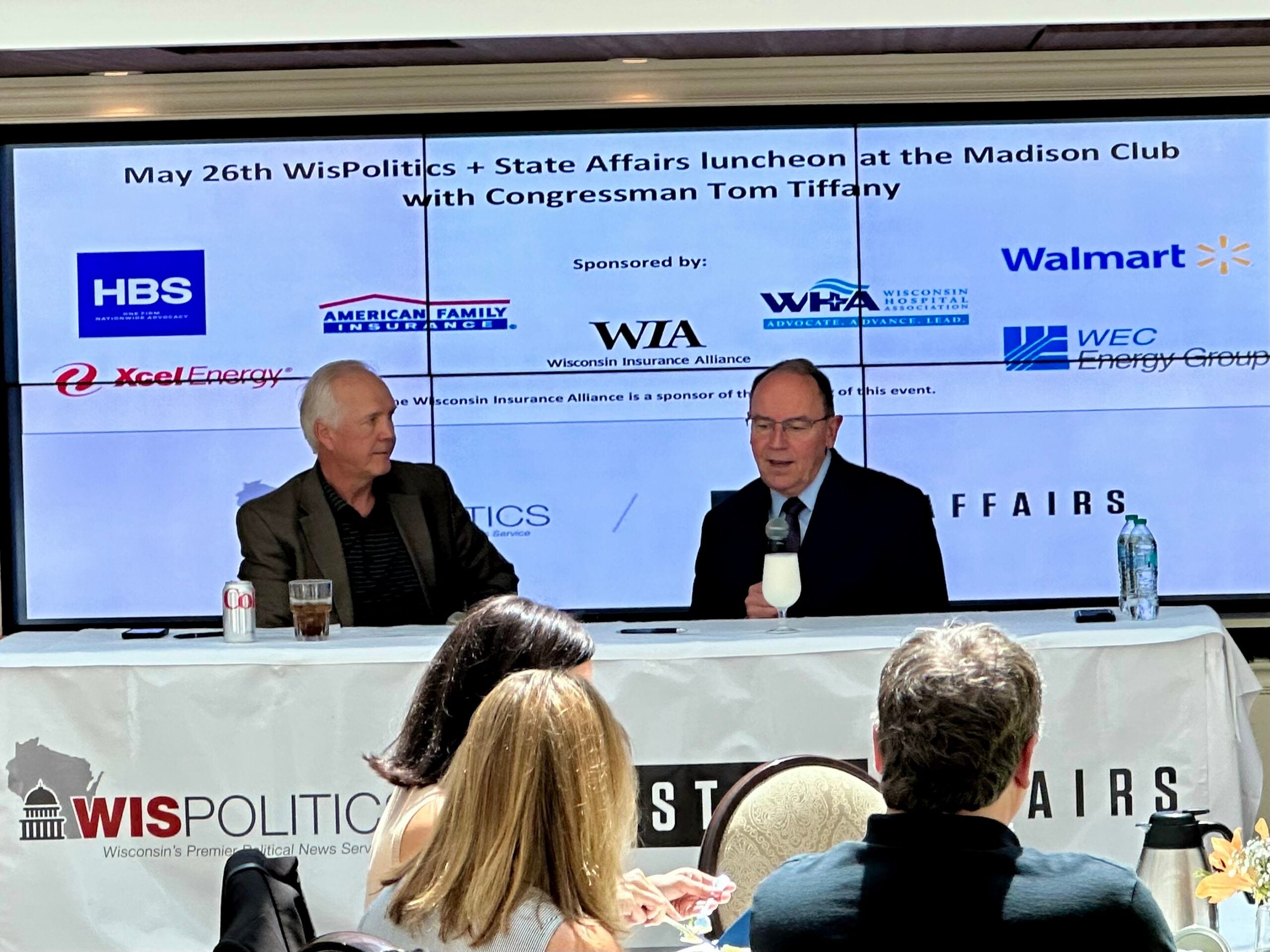
U.S. Represenative and Republican gubernatorial candidate Tom Tiffany, right, speaks during a luncheon event hosted by WisPolitics in Madison, Wis., on May 26, 2026. Anya van Wagtendonk/WPR
But he said his first step would be to repeal Gov. Tony Evers’ 400-year veto, a budget move from three years ago that increased school revenue limits for centuries. That veto, along with community referendums and a long-term underfunding of schools by the state, are considered root causes of Wisconsin’s rising property tax rates.
Tiffany dismissed a recent report that the deal would have sent Wisconsin into a multi-billion-dollar deficit as “Madison math.”
“We can return money to the taxpayers, including the surplus here, and we can also have a balanced budget. And you do it by setting priorities,” he said. “Ever since I’ve been in the Legislature, I’ve divided spending into wants and needs, and you make sure that you spend money on the needs first. And then when you run out, just like a family, then you stop spending.”
Tiffany said some of those “needs” would include education, transportation and health care. But he was coy when asked by reporters what he would consider a want.
“You’re going to find out in my next budget,” he said, referring to one of the core tasks of a governor.
Data centers, stewardship programs
Tiffany, who has represented Wisconsin’s 7th Congressional District in Washington since 2020, after about a decade in the state Legislature, touched on other issues sure to come across his desk if he wins the race for governor in November.
Tiffany said he supports the core aims of the Knowles-Nelson Stewardship Program, a bipartisan conservation program that lets the state borrow money to put land into stewardship. That program is due to expire this summer after lawmakers couldn’t reach an agreement on its future in the Senate.
But Tiffany said that the focus for now should be on spending state resources on maintaining the lands currently under conservation, instead of expanding the program.
“I think it’s really important that we maintain what we have, because we see some of our state parks and other state properties that are getting in disrepair. Let’s make sure that we take care of them first,” he said. “Let’s make sure that we’re maintaining what we have first, and then if there is something that is truly special … then give the opportunity to be able to have those purchases.”
Tiffany also said he would move to repeal a tax incentive for data centers, established in the 2023-25 state budget, “Legislature willing,” and forbid productive farmland from being used to develop data centers. He also said there should be local input on development projects, and that companies and local governments shouldn’t sign nondisclosure agreements about their development plans.
Protests outside after 2020 election remarks
Prior to the event, protesters gathered outside the Madison Club to criticize Tiffany’s support of President Donald Trump’s policies, including his signature “One Big Beautiful Bill Act.” They erected a larger-than-life puppet meant to represent Tiffany, with a sign describing him as “Trump’s puppet.”
And Rev. Greg Lewis, director of the voting rights group Souls to the Polls MKE, criticized recent comments from Tiffany supporting an ongoing probe into the 2020 election results.

Protesters erect a puppet to protest Republican gubernatorial candidate Tom Tiffany in Madison, Wis., on May 26, 2026. Anya van Wagtendonk/WPR
At a recent campaign event, Tiffany said the FBI should continue an investigation into “what happened there.” Numerous audits and investigations into Wisconsin’s results and those in other battleground states have affirmed former President Joe Biden’s win that year.
Asked on stage about those results, Tiffany said that Biden was president “from January 20 of 2021 to January 20 of 2025.”
“On January 6 of 2021, it was decided by the Congress that Joe Biden had won the presidency, and he became the president for the next four years, and I accepted that. I referred to him as President Biden,” he said.
“But I got to tell you, it was a bad time for the United States of America,” he added.
Tiffany was among the Republican members of Congress who objected to counting Biden’s electors from Pennsylvania and Arizona in 2021.
Tom Tiffany stands by criticisms of failed Wisconsin surplus deal was originally published by Wisconsin Public Radio.
If you think stories like this are important, become a member of Urban Milwaukee and help support real, independent journalism. Plus you get some cool added benefits.