WI Assembly Democratic Leader ‘Optimistic’ About Big Wins In November
Why party could score a trifecta, winning both houses of Legislature and governor's race.
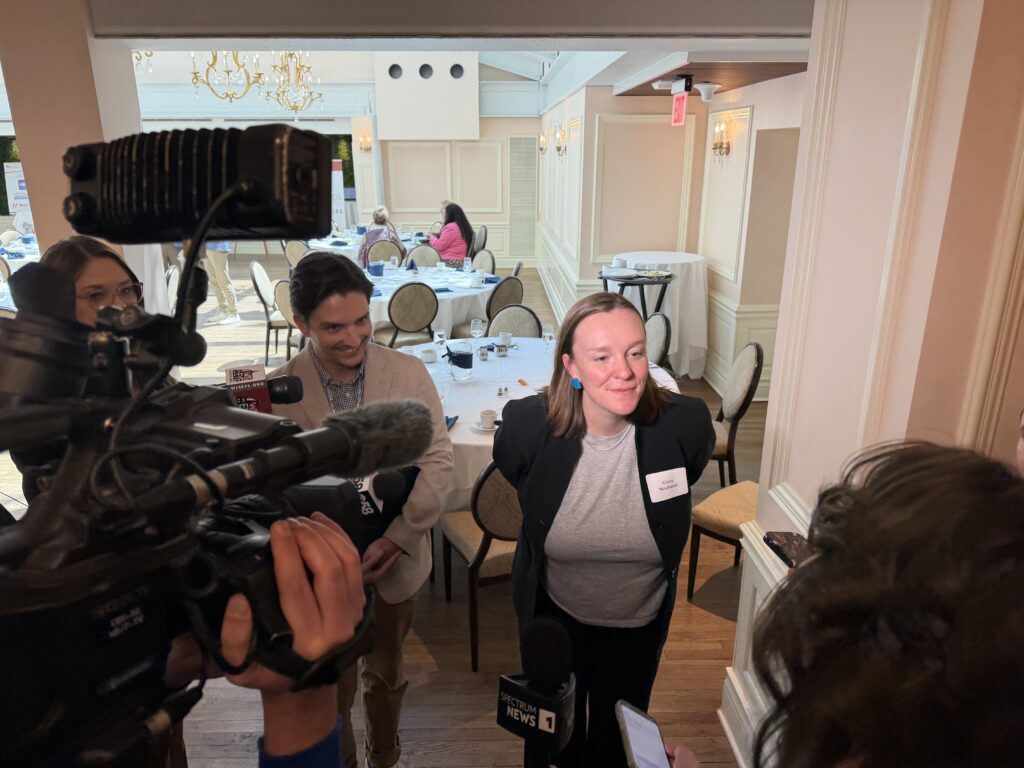
Assembly Minority Leader Greta Neubauer (D-Racine) takes questions from the press after a WisPolitics even in Madison May 14. (Henry Redman | Wisconsin Examiner)
Wisconsin Assembly Minority Leader Greta Neubauer (D-Racine) said Thursday she’s confident legislative Democrats’ opposition to the property tax and school funding deal that fell apart in the Legislature late Wednesday night won’t hurt her chances at Democrats winning majority control of both chambers for the first time in more than 15 years.
The deal, which was negotiated by Democratic Gov. Tony Evers, Assembly Speaker Robin Vos (R-Rochester) and Senate Majority Leader Devin LeMahieu (R-Oostburg), all of whom are not seeking re-election, was passed in the Assembly with some Democratic support but died in the Senate after three Republicans joined all 15 Democrats in voting against its passage.
Under the deal, the state’s school district would have received a higher reimbursement rate for special education services, state aid to schools would have been increased in an effort to lower property taxes, individual taxpayers would have received a $300 tax rebate check and state taxes on tips and overtime would have been eliminated.
Democrats largely objected to the deal’s long-term financial effect, arguing it would have left the state with a massive structural deficit ahead of next year’s budget cycle. But since the deal’s announcement Monday morning, its potential effect on the state’s midterm election politics has been at the forefront. Legislative Democrats expressed frustration that Evers was handing a lifeline to the Assembly Republican caucus. Most, but not all, of the candidates in the Democratic primary for governor opposed the bill’s use of the state budget surplus — taking away the nearly $3 billion pile of money they were anticipating to have for their own legislative plans. U.S. Rep. Tom Tiffany, the presumptive GOP nominee for governor, opposed the deal and lobbied Republicans to vote against it.
At an event hosted Thursday afternoon at the Madison Club by WisPolitics.com, Neubauer said that she believed passing the deal would have been irresponsible financially.
“Our caucus, alongside our Democratic colleagues, and many people were concerned that the deal would have put us in a very difficult financial position,” she said, noting federal cuts by the Trump administration, the higher burden placed on states for covering the costs of Medicaid and the economic uncertainty facing the country because of the war in Iran. “We did not feel it was responsible to pass a proposal that would very likely put us in a deficit in the years ahead.”
She added that the structure of the deal would not have been enough to stop the cycle of local school funding referendums that school districts across the state have had to rely on in recent years to cover costs in the face of reduced state money. With the midterm elections so close, and accusations that the Democrats only opposed the bill because it might help Republicans in November, she said that passing bad policy to help vulnerable Assembly Republicans such as Reps. Howard Marklein (R-Spring Green) and Todd Novak (R-Dodgeville) would have been irresponsible.
She also said she believes voters understand that the problems facing the state are more attributable to 16 years of Republican legislative control than one vote.
“Frankly I think their incumbents are in more trouble than our incumbents,” she said.
Neubauer cited recent polling from A Better Wisconsin Together that found Democrats ahead in five of the most competitive Assembly districts, saying she is “optimistic” about the chances at Democratic trifecta control of state government in January.
With this optimism, she said she’s looking at how to learn from the examples of states such as Michigan and Minnesota for how to manage newly won Democratic control. She said she’s working with Senate Majority Leader Dianne Hesselbein and has had conversations with the Democrats running for governor to start planning how to prioritize.
She said that lowering costs for regular people while easing the burdens facing schools and local governments would be among the first items on the agenda. Beyond those, she said that with majority control, Democrats would likely revive the Knowles-Nelson Stewardship Grant program after its expiration this summer, regulate the growth of data centers and enact “pro-democracy” measures such as a bill to begin processing absentee ballots on the Monday before an election.
To pay for these plans, she said that Democrats are looking at revenue generating actions such as legalizing recreational and medicinal cannabis, increasing the corporate tax rate and raising income taxes on millionaires and billionaires.
On the governor’s race, she said she believes it’s healthy to have a vibrant primary race, even if it’s frustrating when one side has a crowded primary while the other has consolidated around one candidate.
She said she’s spoken with all the candidates and it’s important to think about who can win in November, but it was unlikely she would endorse a candidate before the primary election in August. She added that Democratic primary voters in Wisconsin have been kept from having a say in their general election candidates in recent years.
“I do think that we have a really good field,” she said. “I’m very confident that voters are going to elect somebody to go up against Tom Tiffany and win in November.”
Wisconsin Assembly Dem leader ‘optimistic’ about trifecta control of state government next year was originally published by Wisconsin Examiner.