

Feds Suing Wisconsin Over Prediction Markets
Federal government sues to prevent state regulation of these companies.
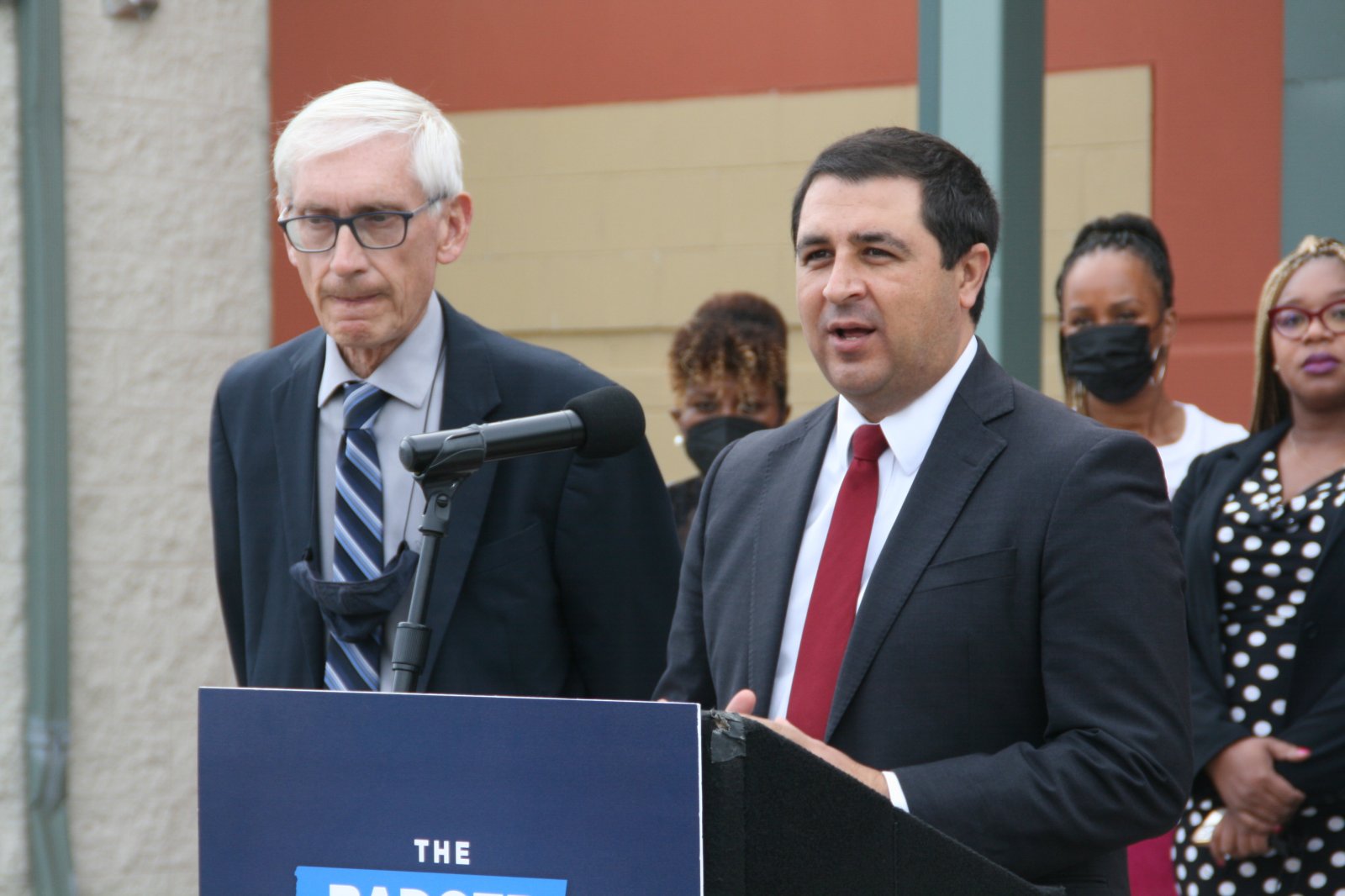
Speaking at a violence prevention press conference. File photo taken Oct. 13, 2021 by Jeramey Jannene.
The federal government is suing the state of Wisconsin over Attorney General Josh Kaul‘s attempt to stop prediction market companies from allegedly facilitating illegal sports betting in Wisconsin.
The Wisconsin Department of Justice recently filed lawsuits against the biggest players in the prediction markets: Kalshi, Polymarket, Coinbase, Robinhood and Crypto.com. These companies allow users to purchase and sell “events contracts,” which enable traders to bet on the likelihood of a given event taking place. The state DOJ alleges the “events contracts” on the outcomes are “functionally indistinguishable” from sports betting, which is illegal in Wisconsin except in certain Native American tribal gaming operations.
The federal Commodity Futures Trading Commission (CFTC) announced Tuesday it filed a lawsuit against Wisconsin in response to the state’s lawsuits filed last week. The agency, which is supposed to be led by a five-person commission and is currently led by only a single commissioner, asserts it has exclusive jurisdiction over the regulation of prediction markets. The CFTC has already filed suit against New York, Connecticut and Illinois over similar litigation aimed at prediction markets.
“States cannot circumvent the clear directive of Congress,” said Michael S. Selig, CFTC chairman and lone commissioner. “Our message to Wisconsin is the same as to New York, Arizona and others: If you interfere with the operation of federal law in regulating financial markets, we will sue you.”
Selig was appointed to the commission in December 2025. He came into the federal government in 2025, working for the Securities and Exchange Commission (SEC) under Chair Paul S. Atkins, who was appointed by President Donald Trump. At the SEC, he worked on crypto and financial technology regulation. Prior to public service, Selig worked for three years at the white-shoe international law firm Willkie Farr & Gallagher, where he worked on “the intersection of financial regulations and crypto technologies,” according to the firm.
Selig and the CFTC have found some early success in heading off states’ attempts to regulate prediction markets gambling. In Arizona, a federal court has issued a temporary restraining order against the state attorney general’s attempt to bring criminal charges against Kalshi.
The CFTC’s approach to prediction markets under Selig and the Trump administration marks an abrupt departure from the commission’s approach under former President Joe Biden‘s administration. In 2024, the CFTC attempted to ban events contracts on political elections. Kalshi sued the CFTC and won. Under Selig, the commission has formally withdrawn the proposal, as well as a policy advisory cautioning potential legal and regulatory risks to firms allowing events contracts on sporting events.
In Wisconsin, Kaul’s lawsuit against the predictions markets firms arrived less than a month after Gov. Tony Evers signed legislation legalizing online sports betting with the state’s tribal nations.
If you think stories like this are important, become a member of Urban Milwaukee and help support real, independent journalism. Plus you get some cool added benefits.






















I guess “states’ rights” are only for those states that blindly follow HWSNBN.
mkewagner, “states rights” works when GOPer is the governor of a state.