Milwaukee Has Become Proving Ground to Save Rohingya Language
Striving to save unique culture of some 4,000 former refuges from Myanmar.
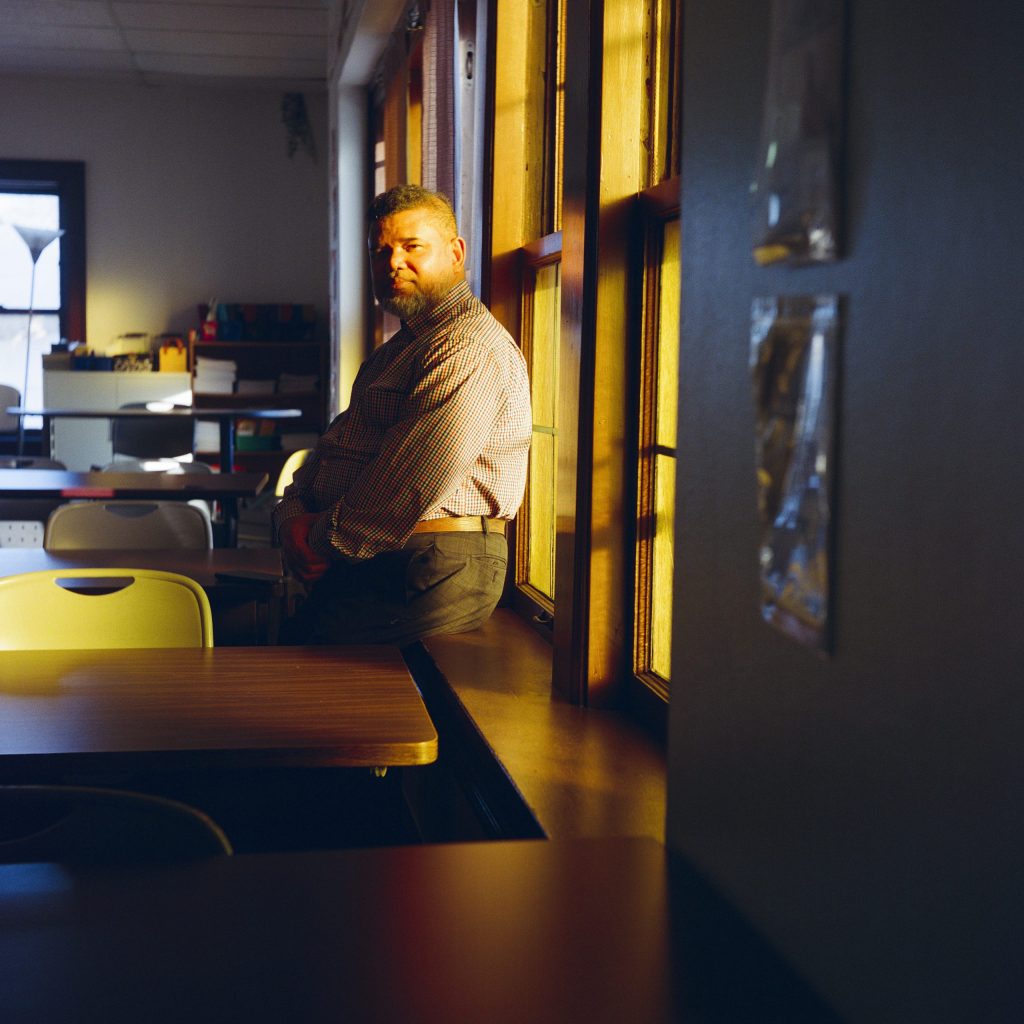
Mohamed Anwar, co-founder, president and executive director at the Burmese Rohingya Community of Wisconsin, sits for a portrait in a classroom Jan. 19, 2026, in Milwaukee. Photo by Joe Timmerman / Wisconsin Watch.
A dozen hungry teenagers filed into the basement of a converted church on Milwaukee’s South Side in mid-February to mark the first night of Ramadan around folding tables. The building belongs to the Burmese Rohingya Community of Wisconsin (BRCW), a bare-bones nonprofit serving hundreds of Rohingya refugee families who are setting down roots in the city. Brand-new carpets muffled the sounds of worshippers in the mosque one floor up.
Nearly everyone in the nonprofit’s Clarke Square community center spoke Rohingya, but not a single printed word in the language appeared on the whiteboards in the center’s classrooms where recent arrivals study English and prepare for citizenship exams. Flyers advertising a food giveaway were in English, as were posters listing prayer times and an illuminated sign over the center’s front entrance.
Printed Rohingya words could be found only in a small stack of children’s books and loose-leaf dictionaries in an office just off the prayer hall — raw materials for an experiment in cultural preservation.

A first-of-its-kind picture dictionary translating English words to a written Rohingya language is being tested at the Burmese Rohingya Community of Wisconsin, shown on Jan. 19, 2026, in Milwaukee. Photo by Joe Timmerman / Wisconsin Watch.
Hardly anyone passing through the community center can easily read a sentence in Rohingya.
Decades of state-sanctioned repression and ethnic cleansing have driven most Rohingya from their western Myanmar homeland. Several forms of written Rohingya have emerged in the diaspora, but none has reached widespread use among the scattered diaspora. Without an agreed-upon alphabet or enough people literate in Rohingya to teach it, community leaders worry the language will wither, taking with it a core part of a culture already frayed by displacement and state-sanctioned violence.
Milwaukee is now a proving ground for Rohingya literacy. If this tiny community center can build an audience for Rohingya language education — in the city likely home to the country’s largest Rohingya population — momentum could spread, boosting the language’s chances of surviving in exile.
It’s a big if.
What does it take to preserve a language that’s rarely written down? The center’s indefatigable co-founders, a Dallas-based linguist and an international network of Rohingya scholars are trying to figure it out.
From Myanmar to Milwaukee
Mohamed Anwar is always on the move. Juggling a half-dozen jobs and side gigs, the BRCW co-founder leaves a few gaps in his schedule to help refugee families navigate their new country.
He, too, came to Milwaukee as a refugee.
Anwar grew up on a knife’s edge. Since gaining independence from Britain in 1948, Myanmar’s government has chipped away at the rights of the Rohingya, a Muslim ethnic group in a majority-Buddhist nation. In 1982, when Anwar was 7, the Myanmar government stripped the Rohingya and other disfavored groups of citizenship, leaving millions stateless.
Anwar managed to secure a high school diploma and an undergraduate degree — rare accomplishments for a Rohingya student of his generation. But with prospects dimming and the threat of state-sponsored violence mounting, Anwar set aside his graduate studies and fled, paying human traffickers a steep sum to reach Malaysia.
There, he joined thousands of other stateless Rohingya scraping by on the margins. He remained in the country for over a decade, initially surviving on low-wage jobs until an immigration raid landed him in jail. United Nations outreach workers found him in custody and, recognizing his talents, brought him on as a translator.
When the State Department approved his family for resettlement in the U.S. as refugees in 2015, Anwar headed straight for Milwaukee, where a few friends had already begun putting down roots.
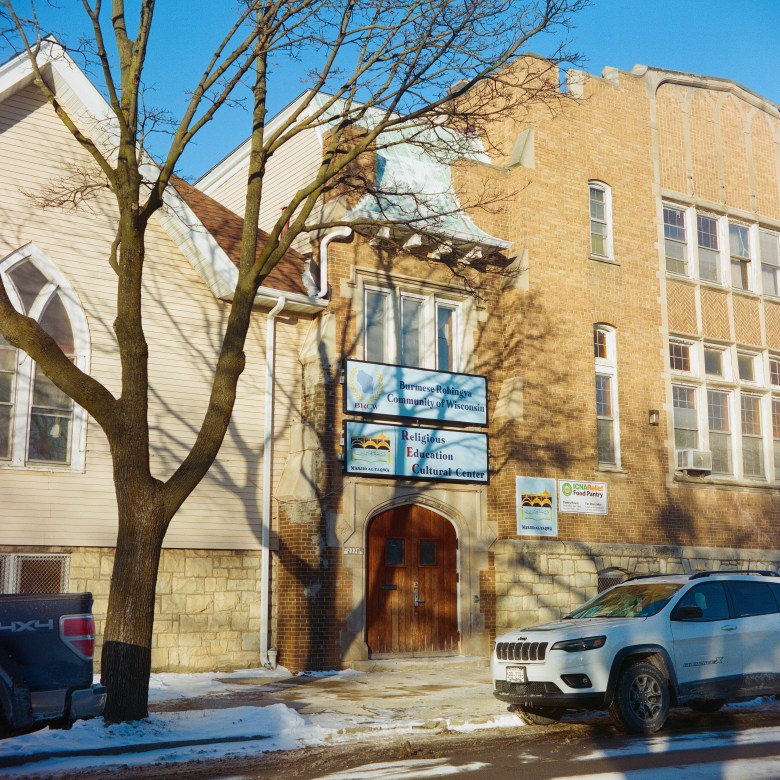
Afternoon sunlight shines on the Burmese Rohingya Community of Wisconsin on Jan. 19, 2026, in Milwaukee. Photo by Joe Timmerman / Wisconsin Watch.
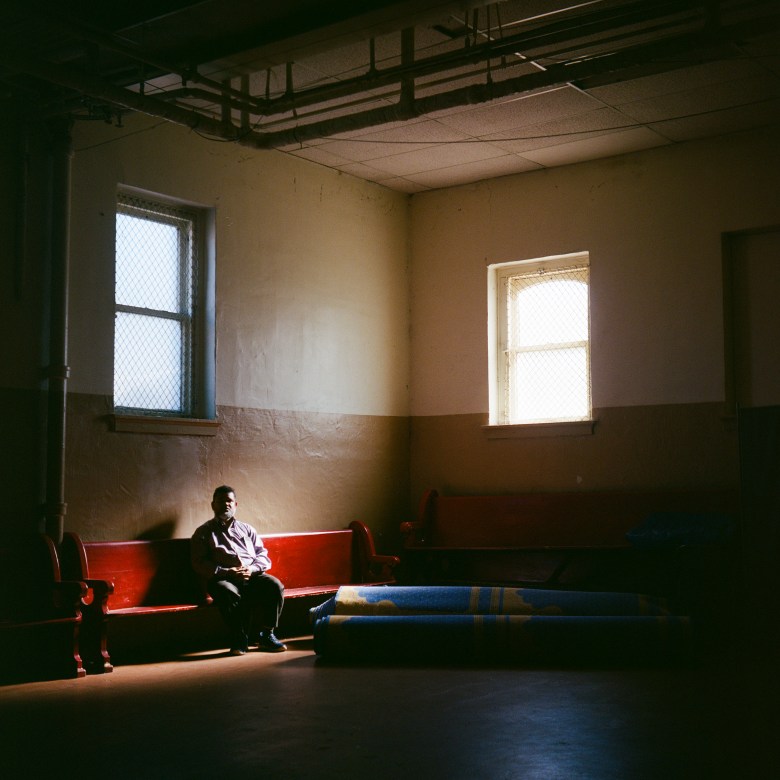
Mohamed Anwar, co-founder, president and executive director of the Burmese Rohingya Community of Wisconsin, sits for a portrait while preparing for the first day of Ramadan on Feb. 18, 2026, in Milwaukee. Photo by Joe Timmerman / Wisconsin Watch.
Even a decade ago, the city’s Rohingya community was large enough for Aurora Health Care to require interpreters. Anwar was a natural fit for the job.
Like other specialists, health care interpreters must pass a certification course. “They had no one to test me in Rohingya,” Anwar recalled. Without an agreed-upon alphabet, a written test was also off the table. He worked with his examiners to improvise a fluency test from scratch, building upon it later while recruiting and training new Rohingya interpreters for the hospital system.
Milwaukee becomes a magnet
BRCW estimates more than 4,000 Rohingya live in the Milwaukee area — an educated guess, but a difficult one to confirm. Roughly half of the more than 13,000 refugees resettled in Wisconsin since 2012 came from Myanmar, but the State Department resettlement statistics do not distinguish between Rohingya and other refugees from the country.
The city has become a magnet for Rohingya refugees who first settled elsewhere in the United States, drawn by cheaper housing, abundant jobs for immigrants with limited English, a strong support network and private Islamic schools. That pattern shows up in BRCW outreach data: 17% of phone numbers collected by 2020 had out-of-state area codes — some belonging to families whom the nonprofit helped relocate from as far away as New Hampshire.
Most Rohingya families have settled on Milwaukee’s South Side and southern suburbs, with a growing number purchasing homes within walking distance of BRCW’s community center. Anwar himself owns a few nearby properties, renting them to Rohingya newcomers finding their footing in the city.
The city’s public institutions are trying to keep pace with the community’s growth. Milwaukee Public Schools began translating notices for parents into one version of written Rohingya at least five years ago and has published a Rohingya translation of this year’s parent handbook. In mid-January, a Milwaukee Health Department official called BRCW to ask whether the agency should offer Rohingya translations using a Latin script, a script derived from Arabic and Urdu or audio recordings.
BRCW co-founder Andrew Trumbull says audio recordings are the only viable means of reaching most new arrivals, at least for now.
The nonprofit offers English classes, but many Rohingya adults have little free time between long shifts and family responsibilities. Parents often rely on their children as interpreters, but translating technical terms into Rohingya is a stretch for children who have never formally studied the language.
A volunteer effort takes shape
Trumbull sticks out in the halls of the BRCW community center. He doesn’t speak Rohingya, doesn’t pray in the center’s mosque and has no family ties to Rohingya Milwaukee, but he’s been there from the start. A decade after helping get the nonprofit off the ground, the self-described weekend warrior spends much of his scarce free time applying for grants and managing English-language communications in the cluttered office he shares with Anwar.
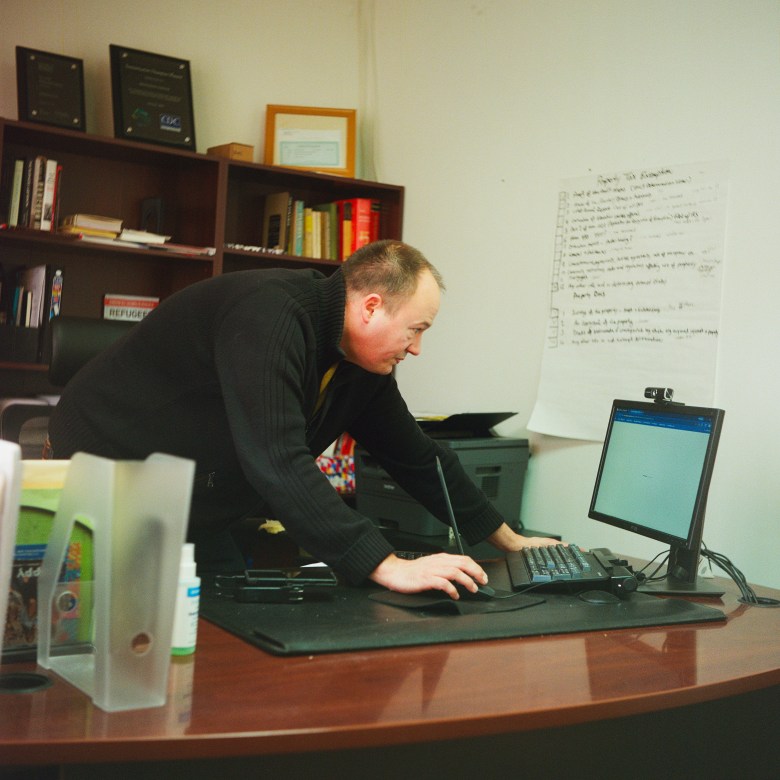
Andrew Trumbull, co-founder and administrative director at the Burmese Rohingya Community of Wisconsin, works on his computer in his office, Jan. 19, 2026, in Milwaukee. Photo by Joe Timmerman / Wisconsin Watch.
The pair met through Anwar’s brother, for whom Trumbull acted as a tutor and Milwaukee tour guide as the former settled into his new city. They soon launched BRCW, with Anwar managing community affairs and Trumbull managing relationships with government agencies and nonprofit peers — both as volunteers.Trumbull’s enthusiasm for Rohingya language preservation is partially motivated by his own feelings of cultural loss. He spent most of his childhood in Germany, but after moving to the U.S. at age 11, he refused to speak his grandparents’ language. “I wanted not to be different, so I did not speak German,” he said. While he doesn’t compare his experience to those of refugees, he’s watched similar assimilatory pressures play out among Rohingya children in Milwaukee.
“All of the Rohingya parents know that the Rohingya language is dying,” he said. “The question is what they can do about it.”
For now, a small selection of children’s books and a Rohingya-to-English dictionary offer the closest thing to a Rohingya literacy curriculum in the U.S. Trumbull hosts a digital version of the dictionary on the center’s website; the physical copies in his office are the leftovers from a pile passed out to families. Without a grant to support a more structured distribution program, Anwar and Trumbull are “field-testing” the materials by handing them out whenever they can and seeking feedback.
An episode of the Sesame Workshop International series “Playtime With Noor & Aziz,” which was introduced to refugee children after field testing in Milwaukee.
Another source of Rohingya-language learning aids: “Sesame Street.” A series of episodes starring puppet siblings Noor and Aziz — characters introduced in 2022 for refugee children in Bangladesh — also went through field-testing in Milwaukee with the help of Anwar, Trumbull and BRCW.
Searching for a written form
The written Rohingya materials on display at BRCW are the product of decades of work by Rohingya linguists.
An earlier form of written Rohingya died out roughly 200 years ago, said Dallas-based linguist Miranda Kuykendall; the reasons for its extinction remain unclear. Revival efforts took off in the 1980s, when a Rohingya academic in Bangladesh developed the Hanifi script by adapting the alphabet family used to write Arabic and Urdu.
By the turn of the century, a Rohingya engineer in Saudi Arabia introduced a Latin alphabet alternative — a more straightforward option for standard keyboards.
“Different pockets of the Rohingya population prefer different scripts for different reasons,” Kuykendall said. For Rohingya students familiar with Arabic through religious education, the Hanifi script may be more approachable, and pilot programs in Bangladesh teach the script to some refugee children. The Latin-based script is familiar to the growing Rohingya diaspora in North America, the United Kingdom and Malaysia, where the primary languages rely on the Latin alphabet.
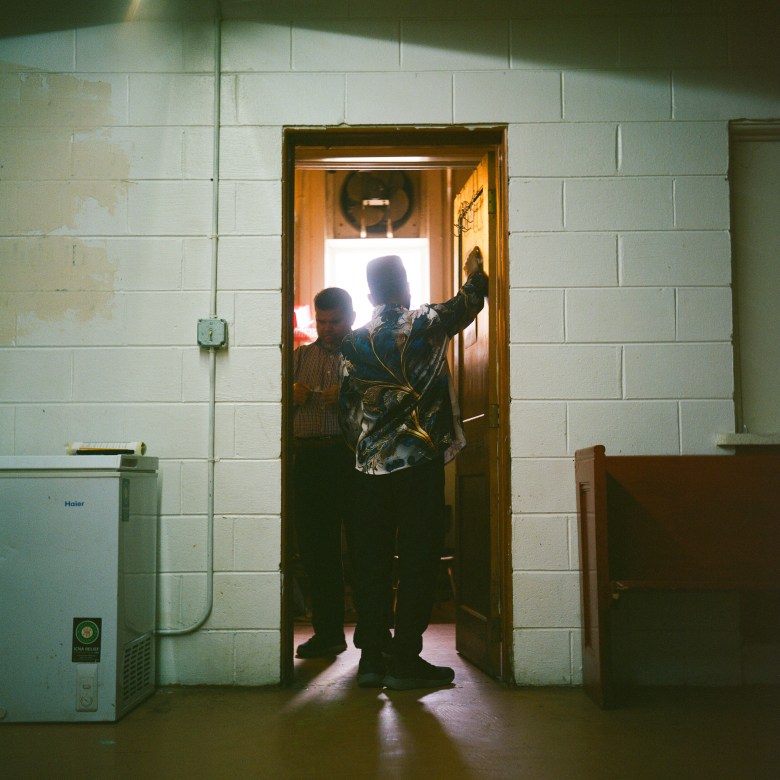
Mohamed Anwar, co-founder, president and executive director of the Burmese Rohingya Community of Wisconsin, left, prepares for the first day of Ramadan on Feb. 18, 2026, in Milwaukee. Photo by Joe Timmerman / Wisconsin Watch.
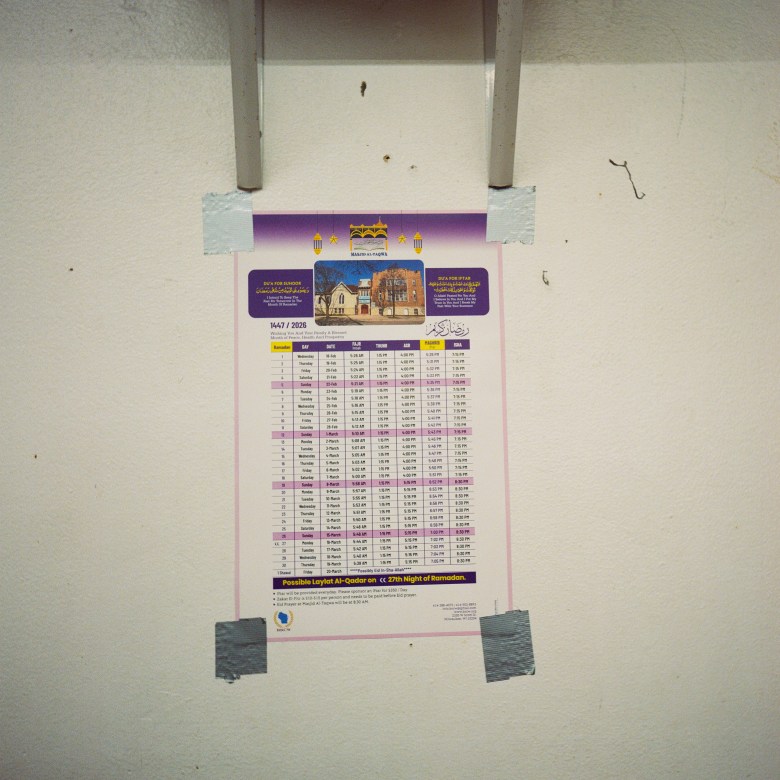
A Ramadan prayer calendar is taped on the wall at the Burmese Rohingya Community of Wisconsin on Feb. 18, 2026, in Milwaukee. Photo by Joe Timmerman / Wisconsin Watch.
Kuykendall, the Rohingya language program manager for Texas nonprofit International Literacy and Development, helped roll out the Rohingya-to-English dictionary and partnered with nonprofit publisher Books Unbound to release a picture dictionary for younger audiences. The same network of collaborators is now developing a Rohingya translation app.
Though her team included multiple Rohingya scripts in the dictionary, Kuykendall noted that children of Rohingya parents born or raised in the U.S. typically find the Latin script version of the language, also called “Rohingyalish,” far easier to pick up.
That isn’t necessarily the case for Rohingya-speaking adults — even those already literate in several other languages. “It’s difficult for me to read,” said Anwar, squinting at a page of a picture dictionary. “I never got a chance to learn.”
Kuykendall and BRCW say boosting adult literacy could be transformative for Rohingya refugee communities, with written Rohingya serving as a useful counterpart for teaching English.
But in Anwar and Trumbull’s view, children and young adults are more likely to have time for the Rohingya literacy materials now in the informal testing process in Milwaukee.
For some young people, the pitch might be practical: Learning written Rohingya could help teenagers translate technical language and complicated documents for their parents. For others, the draw could be more existential. “When they become preteens and teenagers,” Trumbull said, they might “grasp the importance of what it means to have lost their language.”
Even if the nonprofit can muster a critical mass of interested young people interested in Rohingya literacy, Trumbull noted, BRCW lacks money and bandwidth to organize formal classes.
The nonprofit seeks grants to support structured outreach, including its earlier work with “Sesame Street.” If all goes well, Anwar and Trumbull hope to offer Rohingya language lessons through BRCW’s after-school religious classes. Aside from Kuykendall’s smaller-scale work with students in Dallas, a BRCW Rohingya language class would be the first of its kind in the country.
‘I am concerned that my kids will never learn’
Those offerings would need buy-in from Rohingya parents like Umi Salmah and Mohammed Rafik, a couple raising three children in Milwaukee.
Rafik, 43, still thinks of Anwar as his teacher. Back in Myanmar, Anwar offered English lessons to young people in his home village — Rafik included.
After fleeing to Malaysia as a young man, Rafik spent early adulthood as a landscaper in Kuala Lumpur. Many of his relatives stayed behind long enough to witness a 2017 ethnic cleansing campaign that killed thousands and drove more than half of Myanmar’s remaining Rohingya into crowded refugee camps in Bangladesh, where Rohingya children are barred from attending public schools. U.S. State Department officials later described the attacks as acts of genocide.
Those who remain in Myanmar are now caught in the crossfire of the country’s civil war, and the country’s military has begun conscripting Rohingya men even while denying them citizenship.
More than a dozen members of Rafik’s immediate family drowned while en route to Bangladesh in 2024, as have hundreds of other refugees fleeing Myanmar by boat.
“Everything’s lost,” he said, clasping his hands together. “Language lost. Culture lost. People lost. Village lost.”
Rafik’s formal education ended after seventh grade. Salmah, on the other hand, completed high school in Myanmar before leaving for Malaysia, where the couple married. The military has since burned her home village.
They relocated to Milwaukee after six years in Dallas, where they initially settled after securing refugee status. Both are naturalized citizens; their children were born in the U.S.
Though the couple speaks Rohingya at home, their children “can’t speak back,” Salmah said. “Now I am concerned that my kids will never learn.”
Salmah is unusually well-positioned to teach her children to read Rohingya. She completed a degree in early childhood education at Milwaukee Area Technical College, and she has a knack for languages. Aside from English and Rohingya, Salmah can also speak and read in Burmese and Malay.
But even if she had the time to teach her children to read Rohingya — she’s currently working on a degree in phlebotomy — Salmah would first need to teach herself. Flipping to a page of a children’s book in the BRCW office, Salmah sounded out a passage letter by letter. “I have to pay so much attention to read that,” she said.
Rohingya literacy education “is not going to work at home” for most Rohingya families, Rafik said. Most parents have little to no formal education of their own, so many would need to learn to read as adults before they could teach their children.
People fluent in both Rohingya and English are often already busy providing translation services, and asking those ideal candidates to volunteer their time is a tall order. Like Salmah, any teaching candidate must also learn the Rohingya script alongside students. “I (need to) start from the beginning,” Anwar said. “From the ABCs.”
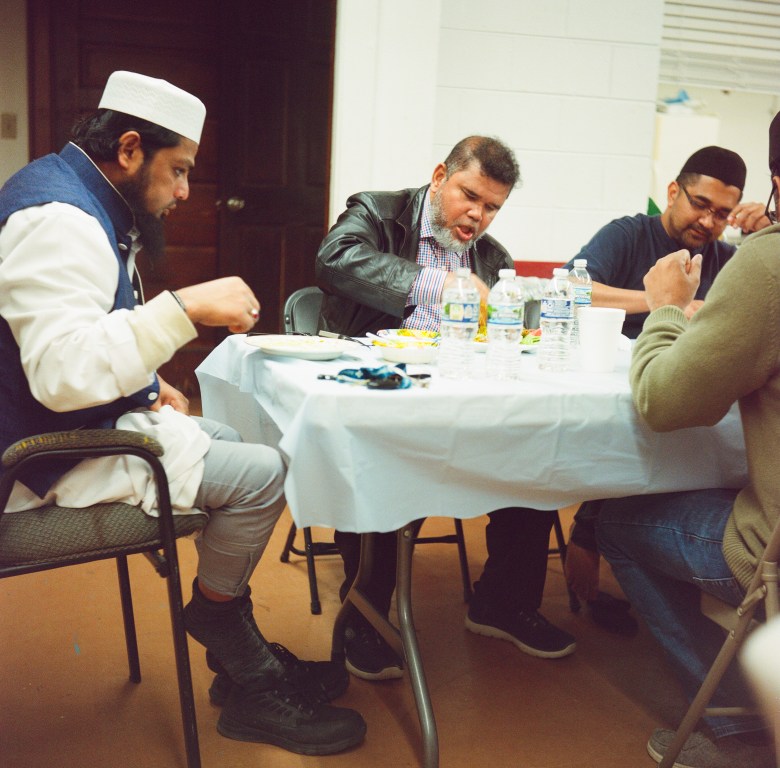
Mohamed Anwar, co-founder, president and executive director of the Burmese Rohingya Community of Wisconsin, center, eats a community meal during the first day of Ramadan on Feb. 18, 2026, in Milwaukee. Photo by Joe Timmerman / Wisconsin Watch.
Precedent in Hmong experience
If BRCW’s efforts gain traction, Milwaukee’s Rohingya community would not be the first group of refugees in the Midwest to give a struggling written language a new lease on life.
The century-old church that now houses BRCW previously belonged to a Hmong Christian congregation — the last community to pull off this feat.
Thousands of Hmong refugees settled in the upper Midwest beginning in the late 1970s, when the U.S. withdrawal from Vietnam made allies, including many Hmong working alongside American forces in Laos, targets for retaliation. Fifty years later, Hmong refugees still outnumber any other refugee group in Wisconsin. More than 60,000 Wisconsinites identified as Hmong in 2020 — the third-largest Hmong population in the country behind Minnesota and California.
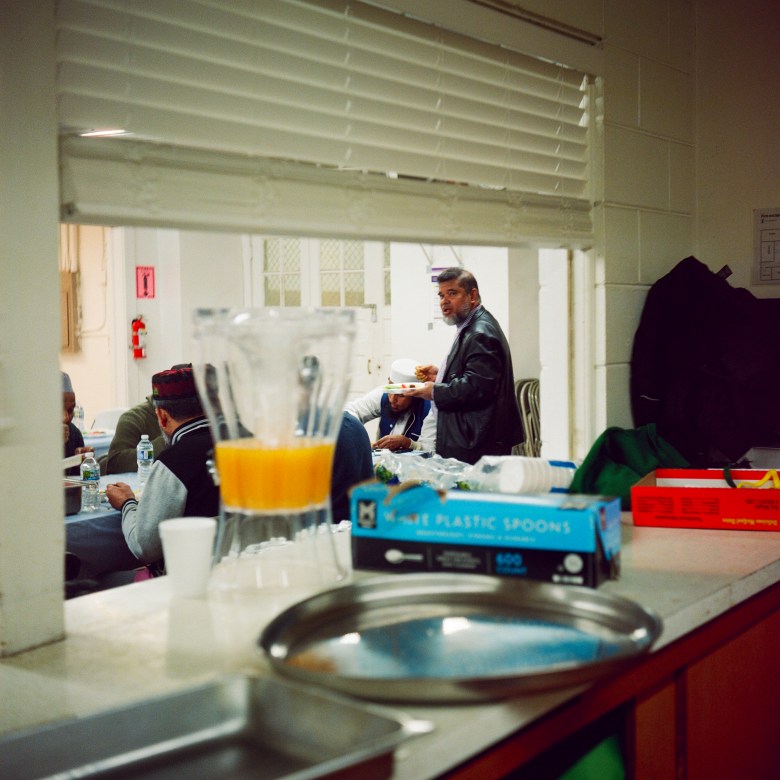
Mohamed Anwar, co-founder, president and executive director of the Burmese Rohingya Community of Wisconsin, right, eats a community meal during the first day of Ramadan on Feb. 18, 2026, in Milwaukee. Photo by Joe Timmerman / Wisconsin Watch.
Like more recent Rohingya arrivals, Hmong refugees arrived in the U.S. without a widely used written language. Christian missionaries in Laos developed a version of Hmong in the Latin script in the 1950s, but that system “did not stick,” said Bee Vang-Moua, the director of the Hmong language program at the University of Minnesota.
The mass displacement of thousands of Hmong in the 1970s became a catalyst for Hmong literacy’s rise, Vang-Moua explained. Hmong refugees in the U.S. and in refugee camps in Thailand initially communicated by recording messages on cassette tapes, but that system was difficult to sustain. “It was very expensive,” she said, “so everyone that could learn (to write) tried to learn.”
The introduction of cellphones slowed the uptake of Hmong writing, but only briefly. “Social media has boosted the need to read and write Hmong,” Vang-Moua said, because online networks connected Hmong speakers in the U.S. with Hmong speakers in Southeast Asia or Europe — primarily on text-based platforms like Facebook. The Latin-based script used by American Hmong speakers is now replacing versions of written Hmong developed independently in China and Vietnam, she added, because of the cultural influence of the diaspora in the U.S.
The emergence of Hmong language immersion schools further boosted the written language, Vang-Moua added. Milwaukee’s Hmong American Peace Academy, the first of its kind in Wisconsin, opened in 2004 with 200 students; Appleton’s Hmong American Immersion School opened last year.
Meanwhile, some Hmong groups have begun using the script to preserve community elders’ oral traditions in written form.
Given the unpredictable trajectory of Hmong literacy, Vang-Moua noted that the project underway in Milwaukee’s Rohingya community still has time to find its footing. “I’ve often wondered how it all felt” in the early stages of Hmong language education,” she said. “Here we are, talking about the same things, just with a different community.”
Can the effort last?
A Rohingya charter school is a distant goal for Anwar and Trumbull. An after-school Rohingya class would serve as a trial run, and it could give teenagers a chance to test using written Rohingya in their everyday lives.
But BRCW must also contend with parents’ priorities. Rafik and Salmah, for instance, say Rohingya language education can’t distract from other classes, including religious education.
They aren’t alone. Mohamed Ibrahim, owner of a Rohingya restaurant and grocery store on Milwaukee’s South Side, sees a practical use for written Rohingya. Though he is Rohingya by ancestry, he grew up speaking Burmese in Yangon, Myanmar’s former capital. Rohingya-language educational materials could help him communicate more easily with his Rohingya-speaking customers, Ibrahim said, but he doesn’t have time to study it.
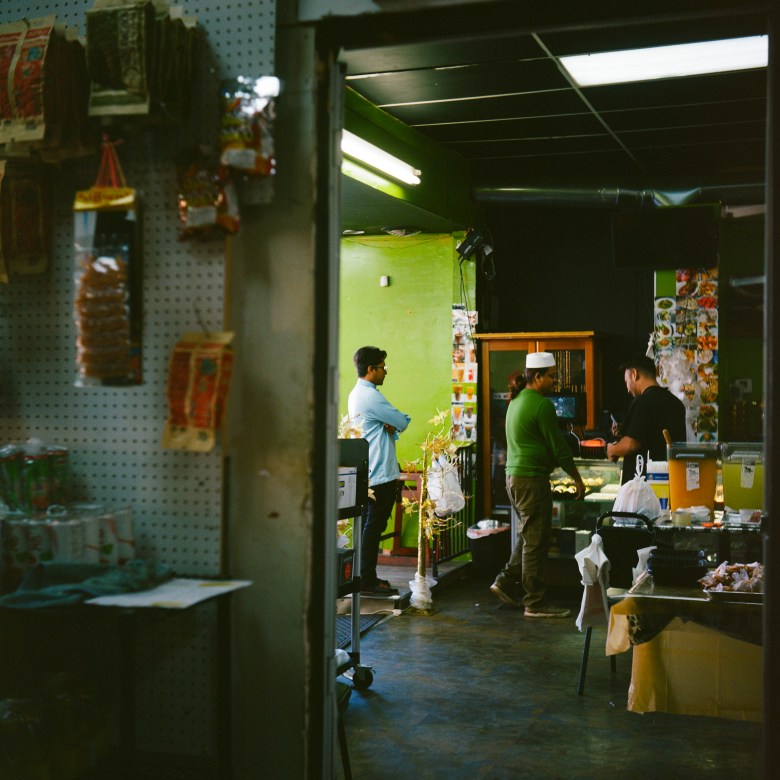
Mohamed Ibrahim, owner of Khan Aseya Restaurant, known as “Mom’s Kitchen,” center, serves takeout meals during the first day of Ramadan on Feb. 18, 2026, in Milwaukee. Photo by Joe Timmerman / Wisconsin Watch.
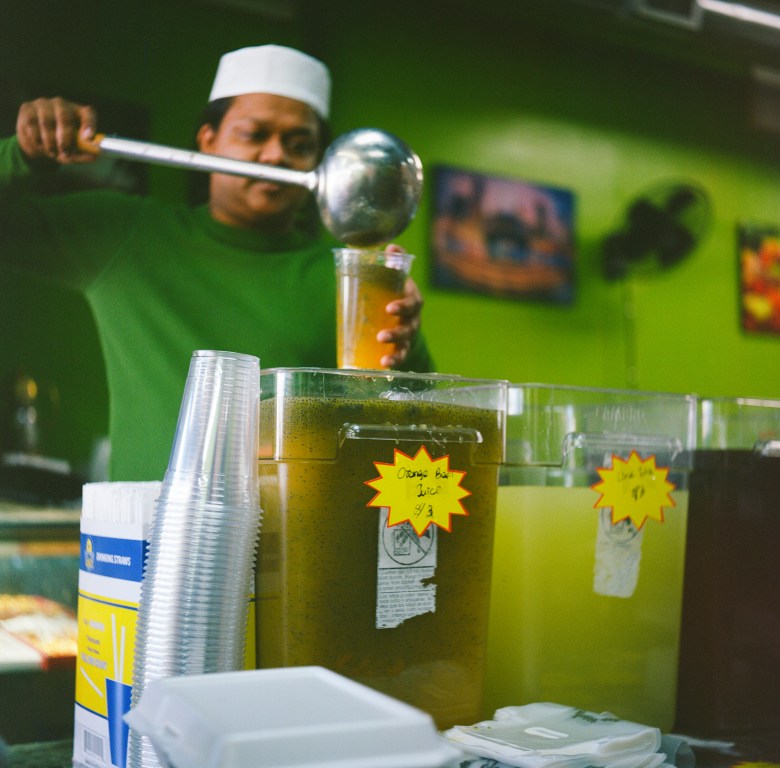
Mohamed Ibrahim, owner of Khan Aseya Restaurant, known as “Mom’s Kitchen,” serves takeout meals during the first day of Ramadan on Feb. 18, 2026, in Milwaukee. Photo by Joe Timmerman / Wisconsin Watch.
Afternoon sunlight shines on the Burmese Rohingya Community of Wisconsin on Jan. 19, 2026, in Milwaukee. Photo by Joe Timmerman / Wisconsin Watch.
Ibrahim has similar reservations about adding Rohingya language lessons to his children’s routines. “They live in the United States now,” he said. “We have to support our kids in English.”
Meanwhile, Rohingya Milwaukee faces a new set of hurdles.
The Trump administration’s January 2025 decision to largely end refugee resettlement halted Salmah’s efforts to bring several family members from refugee camps in Bangladesh to Milwaukee. Last year, Anwar sent voice notes to the nonprofit’s WhatsApp group reminding refugees of their rights during run-ins with federal immigration authorities. And last year, U.S. Citizenship and Immigration Services began reopening the cases of thousands of refugees admitted under the Biden administration, including many in Milwaukee’s Rohingya community.
Under the circumstances, Anwar and Trumbull aren’t bullish on their project’s short-term prospects. “But when you make things, sometimes they don’t go away,” Trumbull said.
This story is part of Public Square, an occasional photography series highlighting how Wisconsin residents connect with their communities. To suggest someone in your community for us to feature, email Joe Timmerman at jtimmerman@wisconsinwatch.org.
This article first appeared on Wisconsin Watch and is republished here under a Creative Commons Attribution-NoDerivatives 4.0 International License.