70 School Districts Have Referendums on April Ballots
Three districts in Wisconsin talk about why they need financial help.
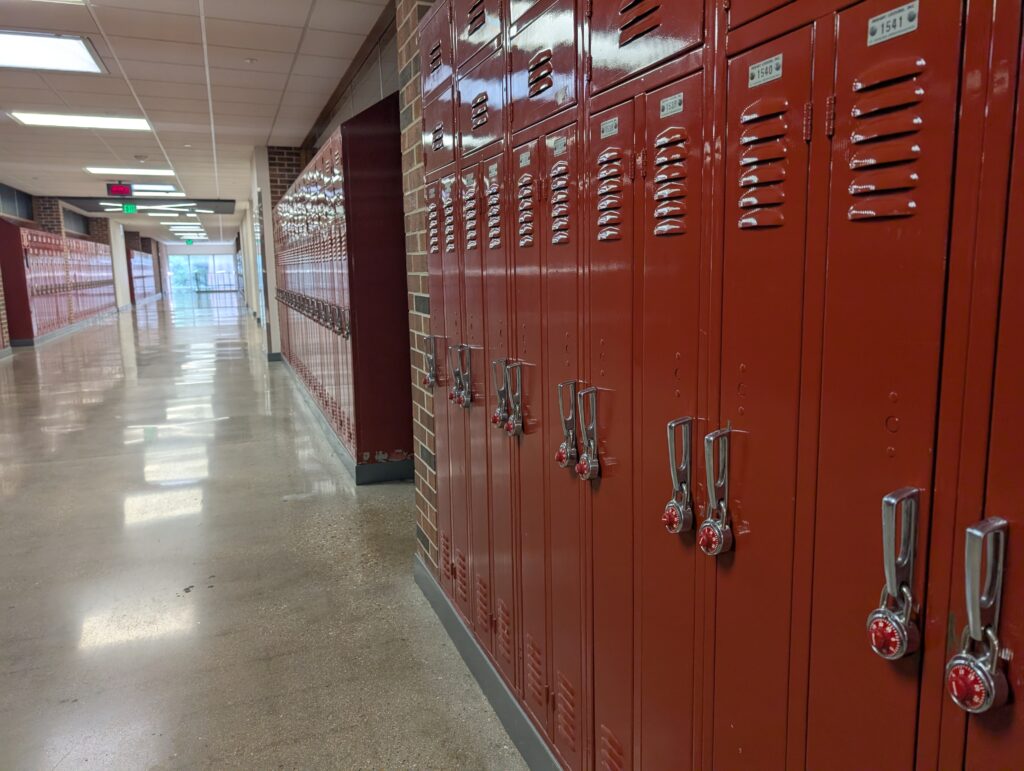
The requests this spring include 60 operational referendum requests, totaling over $1 billion in requests, and 14 for capital expenses. A hallway in La Follette High School in Madison. (Baylor Spears/Wisconsin Examiner)
More than 70 school referendum questions will appear on ballots across the state in April, continuing the trend of school districts going to voters to ask permission to raise property taxes to keep up with costs.
The requests this spring include 60 operational referendum requests, totaling over $1 billion in requests, and 14 for capital expenses. Two school districts, Sauk Prairie and Howard-Suamico, have a capital and an operating request on the ballot.
The requests come as state leaders debate the best way to provide property tax relief to Wisconsinites, as a group of teachers, students and community members have turned to the court system to find relief and as districts grapple with the consequences of referendum outcomes.
Ahead of Election Day on April 7, the Wisconsin Examiner checked in with three school districts seeking to raise property taxes to help with costs. The stakes are high in local communities as passage or rejection will determine which school programs are offered, whether staff get pay raises and whether school consolidation may be on the table.
Dodgeville tries for operational referendum for a third time
Dodgeville School District is one of four school districts in southeastern Wisconsin that have not passed an operational referendum, though not for lack of trying.
The district is asking voters in the spring to weigh in on a $7.5 million request that would provide $2.5 million annually for operational expenses over the next three years.
The district had a failed referendum in November 2024 and another failed request in April 2025. Its new request is a slimmed down version of the last one.
A Wisconsin Policy Forum report from April 2025 found that “retry” efforts have increased as districts have become more willing over time to retry operating referenda that failed. According to the report, from 2000 to 2017, about half of failed operational referendum requests were not retried within two years, but since 2018, more than three-quarters of operating referendum failures were retried.
District administrator Ryan Bohnsack told the Examiner the district needs additional funds to keep up with costs. He said the district has been making cuts where it can, including by delaying technology upgrades, day-to-day maintenance and curriculum upgrades, but that can only go so far.
“We’ve gotten to the point where we know we don’t have the funds to keep operating,” Bohnsack said, adding that the district’s fund balance is below its operational balance and it will need to start borrowing money to pay its bills.
Bohnsack said rising costs, including for staff pay, declining enrollment and stagnant state aid have all played a role in the district’s financial situation.
Randell Thompson, the treasurer for the Dodgeville School Board, emphasized that the district’s need for an operational referendum is not unique.
“If you look across the 421 school districts in Wisconsin, the vast majority have needed to go to an operating referendum at some level,” Thompson said. “Part of the state funding formula is to get local taxpayers to have a say in how much of the school budget they want to cover.”
According to 2023 census data, Wisconsin has fallen to 26th in the nation in per pupil K-12 education spending and is spending 10% below the national average. The state was ranked 11th in 2002, and at the time spent 11% above the national average.
In the most recent state budget, lawmakers invested state funds in special education, though recent estimates find the amount of money set aside will not be enough to reimburse school districts at the promised 42% rate. The Legislature also declined to provide additional state aid to schools — blaming Gov. Tony Evers’ 400-year veto that extended districts’ authority to bring in an additional $325 per pupil, which districts will only be able to take advantage of through raising property taxes.
A lawsuit recently filed in Eau Claire County Circuit Court is challenging the state’s school funding formula, arguing that it is unconstitutional as it does not meet the state’s constitutional obligation to provide educational opportunities to all students.
State leaders are also discussing ways to provide property tax relief through special education funding, school funding and school levy tax credits, though discussions so far have not yielded any results. While Gov. Tony Evers wants to provide additional funding to school general aids, Republican lawmakers have proposed investing in the school levy tax credit, which provides property tax relief but doesn’t provide direct dollars to school districts.
The last time Dodgeville had an operational referendum was in 2012, which was just a one-year ask. The district has passed two capital referendum requests since then.
Bohnstack said this means that an operational referendum is a “new concept” to many residents in the area, but that “given the strategy at the state level now… we’re now kind of at the mercy of the local control being able to support the school through the operational day to day expenses.”
The school district lays out the distribution for the referendum on its website. A little over $1 million annually, or 43% of the referendum, would be used for staff costs, $525,591 or 21% would be for the district’s fund balance and the rest would go towards technology costs, curriculum, facilities, playground safety updates at the elementary school and classroom supplies.
In addition to inflationary costs, Bohnstack said the district is grappling with declining enrollment, which has not helped its financial situation.
Data from the Department of Public Instruction reports that Wisconsin public schools lost 14,087 students this year. Wisconsin school funding is a complicated per-pupil formula that is tied to student enrollment, meaning that districts receive less state funding if they have a drop in the number of students.
“The challenge I have is I could lose 100 kids in my school district, but not be able to eliminate a single teaching position, because those kids are spread out over 12, 13 different age groups, and if I was originally of class sizes in the thirties, and I now have class sizes in the twenties, I still need a teacher either way,” Bohnstack said.
The state’s funding system also leaves districts with few options, he said.
“They don’t fund special education in a way that you can budget for it,” Bohstack said. “I also see this stalemate right now all because of this 400-year [veto], $325, and to me, who pays the price right now because they won’t work together, is the educators, the kids caught in the middle and the schools and the communities,” Bohnstack said, adding that lawmakers should make use of the $4.6 billion state budget surplus to fund Wisconsin schools.
Over the weekend, Democratic lawmakers introduced a $1.3 billion proposal that would provide over $445 million towards general school aid for the 2026–27 school year and provide schools with a special education reimbursement at 60% sum sufficient, meaning schools would be guaranteed that rate. It’s unlikely that the package will advance in the Republican-led Legislature.
Bohnstack isn’t holding his breath for action.
“Hope is not a strategy. I have no hope that they will do anything… Let’s solve our own problems, and in the end, if they do well, we adjust,” Bohnstack said.
Without the referendum, Bohnstack said the district is looking at freezing staff salaries. He said the district is already preparing to go to referendum in November if voters reject their spring request, though it would likely mean a larger request.
“There were certain positions that we cut that we cut deeper than what we needed to, and we need to ensure we have the programming in place to recruit and retain teachers, so there are some staffing positions that we need to rebuild,” Bohnstack said. He added that the technology and curriculum in the district needs to be updated.
Thompson said that a later referendum likely won’t be “any easier for people from a tax standpoint, I suspect,” but the district has to “be realistic about it and plan for what happens if it doesn’t pass.”
And still, the passage of the referendum wouldn’t be the end of Dodgeville’s referendum conversations. Its nonrecurring request would end in 2029 and could put it back at the financial point where it is now.
“Either the Legislature changes the formula, or we’re going to be coming back for a referendum in three years,” Bohnstack said. “We’re not going to be able to cut our way out of this challenge that we’re currently in.”
Lake Country’s referendum to determine consolidation or dissolution conversation
Chad Schraufnagel, the district administrator of the Lake Country School District, said his district has no choice but to go to referendum. The district, which is one of seven public school districts that feed to Arrowhead Union High School District, is going for its third “retry” attempt.
One operational request in 2024 failed, though a capital referendum passed that same year. A second operational request failed in April 2025
Schraufnagel said that without a referendum to help with operational costs, the district is looking at dissolving.
The Lake Country request would provide the district with the ability to bring in $800,000 annually for four years through property taxes. Schraufnagel said the funds would be enough to “just give us time to try and figure out a strategic way to consolidate and move forward.”
“If we don’t get the referendum, our district [is] going to dissolve,” Schraufnagel said. “It’s going to be hard for us to keep the doors open beyond ’26-27.”
The last school district in Wisconsin to dissolve was the Ondossagon School District in 1990. It was absorbed into the Ashland, Drummond and Washburn districts.
Schraufnagel said he explains the difference to residents this way: “Consolidation, it’s a three-year, three- to four-year process, heavily involved, and it takes a lot of time to do it correctly and strategically, given all of the tax implications, contract implications, costs and things like that, but with consolidation, you have local control… Dissolution the state of Wisconsin is going to tell you how it’s going to go, and you have no more local control.”
Schraufnagel said the factors that led to the district’s financial difficulties are threefold: state aid not keeping up with inflation, overstaffing and the cost related to an unemployment benefit that could’ve been cut many years ago.
“Those three things really were the financial nightmare for the district,” Shraufnagel said. “We could have as a district, I think, survived a combination of the two, but you cannot survive all three together.”
Schraufnagel said the district has worked to make over $1.6 million in cuts including by increasing class sizes, cutting post-employment benefits and eliminating programming such as band and Spanish courses.
“Those were very significant costs on the district that really were in control of the district… Now our problem is we’ve done all those things, but now it’s a matter of the state funding not keeping up,” Schraufnagel said.
Schraufnagel said the previous requests were likely rejected for a number of reasons, including a large operational request for the Arrowhead Union High School District that was on the same ballot and was also rejected. He said that the district has also worked to be direct with residents on the issues at hand and why the district needs the referendum.
Kelly Hoesly, a mother of three Lake Country School District students, is leading the “ Vote Yes” advocacy group in the district. She said the group is taking a new approach to informing community members about the referendum including watching social media and hosting events at local bars to provide answers to questions. She spoke with the Examiner one day after an event where she handed out about 130 “Vote Yes” signs to residents.
Hoesly said she made the decision to send her children to the district because “it just felt like home” and reminded her of “my elementary school that I had growing up,” and she said she is hopeful the referendum will help prop up the district so it can make decisions about its future without its “back against a wall.”
“This referendum is about maintaining that quality of education that our students have today and supporting that,” Hoesly said. “I’m encouraged by how our community’s been engaging this time around. People are asking questions, they’re attending the meetings, they’re having conversations even with different viewpoints. It shows people care. I’m hopeful.”
The effort has not been without its challenges. Hoesly said there is a misunderstanding among some about what could happen if the referendum doesn’t pass.
“There’s this appetite in our area to consolidate, and when talking about consolidation, everyone thinks it’s easy,” Hoesly said.
This legislative session, Republican lawmakers, who have pointed out declining enrollment as the main reason for the funding issues plaguing schools — rather than state aid lagging inflation — have proposed that school districts look at consolidation as a solution to the funding woes that are pushing them to go to referendum. They’ve said the state’s 421 school districts constitute an “unsustainable” number of districts.
During a public hearing in November on a package of bills meant to encourage school consolidation, Rep. Amanda Nedweski (R-Pleasant Prairie) said many districts have gone to referendum to “backfill” the loss of state aid due to declining enrollment, but that there “is no referendum that can be passed or law that can be signed to single-handedly reverse decades of birth rate declines to alleviate the stresses of declining enrollment in our schools. It’s clear that a more long-term solution is needed to address these demographic challenges because the status quo is not sustainable.”
The bills were framed as an option for schools, not mandatory. It is unclear whether the bills, which have passed the Assembly, will become law. They still need to pass the Senate before they can go to Evers to be signed or vetoed.
Hoesly said that she has concerns given the complicated nature of school consolidation and the need for a referendum approving any consolidation.
“In order for two districts to consolidate with one another, both voting communities have to go to the polls in a referendum vote and vote to approve it, and if one does and one doesn’t, then what?” Hoesly said. “If the communities don’t approve it, you are back at square one.”
Schraufnagel told the Examiner that he didn’t think consolidation would not solve the school funding issue.
“If 87% of all districts, those that are K-12, are going to operational referendum, what is consolidation going to do? It’s going to delay you needing to go to an operational referendum for maybe two or three years. The funding has not changed,” Schraufnagel said.
After consolidation, Trevor-Wilmot Consolidated Grade School District still goes to referendum
School consolidation did not end funding concerns for Trevor-Wilmot Consolidated Grade School District, though it did help stave off financial crisis for about a decade, according to District Administrator Tracy Donich.
The district was one of five school consolidations in Wisconsin between 2000 and 2022, according to WPR.
Donich said that when the districts consolidated in 2011, the move cut down on costs in some areas including as the district cut administration down to one principal and one superintendent. The state also provided incentives for school districts that opt to consolidate.
But, Donich said, costs remained the same in other areas.
“The things that don’t change are the number of students. You also have the same amount of transportation, so there are a lot of other costs that don’t go away when you consolidate, but they did what they should. That helped for a little while, and eventually that temporary funding ran out,” Donich said.
Donich said the district “started to see a deficit budget,” which led to it going to referendum in 2022. Since the referendum was approved, Donich said the district has been considering the next one.
Trevor-Wilmot Consolidated Grade School District is seeking a $6.8 million nonrecurring referendum. It would provide $1.1 million in year one and $1.9 million in years two, three and four.
Donich said the district is fortunate that the community has been supportive in the past, and they have worked to provide financial updates at school board meetings as well as set up displays at athletic events and posts on social media and the school website.
“We’re really trying to be very transparent with the community and give them all the information they need to make an informed decision,” she said.
This year’s April requests come as Wisconsin voters appear to be less friendly towards school funding referendum asks. Recent polling from Marquette University Law School found that 57% of voters said they would be inclined to vote against a referendum to increase taxes for schools in their communities.
Donich said the state’s funding formula “is definitely needing some updates… so the local taxpayers aren’t feeling that pinch quite so much.”
This year, the district’s request has increased from the previous referendum to deal with inflationary costs and a lack of state funding. Donich noted that the district has to transfer over $1 million each year from its general fund to its special education fund to keep up with the mandated costs.
“If we would not have to do that, it would really help us with having to go to referendum, possibly we wouldn’t even have to go to referendum if they had kept up even with half the amount of inflation,” Donich said. “We wouldn’t be in this situation at all.”
Without the referendum, Donich said the district will look to cut costs by delaying technology upgrades and having classrooms cleaned less frequently.
“We need to find a way that’s sustainable to help our school system thrive and not being able to rely on the factors at the state level definitely encourages people to go to more referendums,” Donich said. “When we have to do a budget without having any idea what the state will be able to provide, federal funding shifts, the most reliable thing we have is our local community.”
Three Wisconsin school districts on what’s at stake for their spring referendum requests was originally published by Wisconsin Examiner.