
Why the Rise in Property Tax Anger?
It's ebbed and flowed since the 1960s, as state politicians tried different solutions.
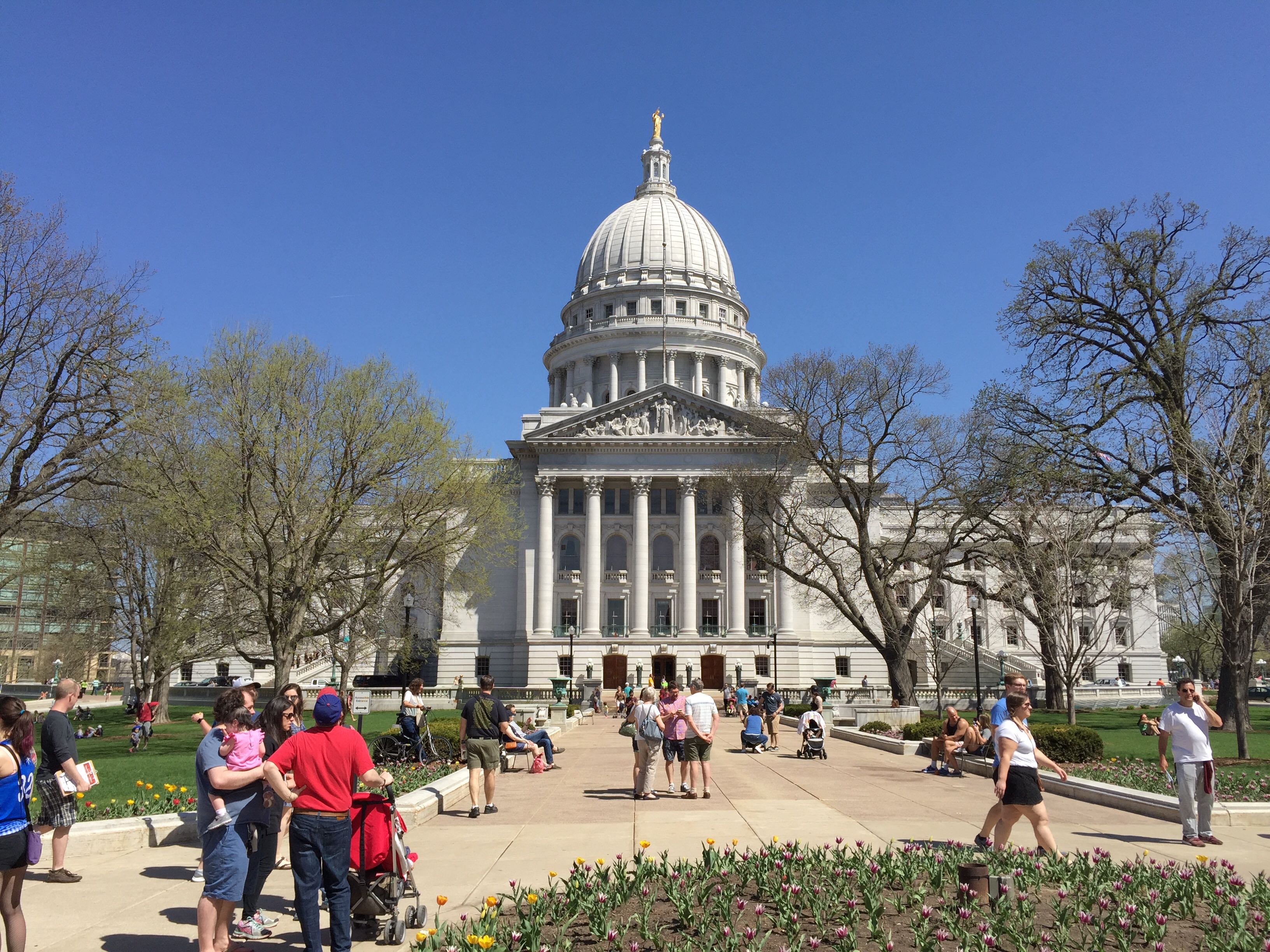
Wisconsin State Capitol. Photo by Dave Reid.
Marquette University Law School pollsters asked 818 registered voters how concerned they were about property taxes on Feb. 11-19 — two months after homeowners got property tax bills in the mail.
The results suggested widespread anger over property taxes, most of which pay for K-12 schools: 49% of those who responded said they were “very concerned” and another 29% were “somewhat concerned.”
The partisan split was just as interesting: 62% of respondents who identified as Republicans said they worry about property taxes, compared to 39% of Democrats and one-third of respondents who labeled themselves as political independents.
That split mirrors the Capitol debate. Democratic Gov. Tony Evers wants to spend the majority of state government’s $2.5 billion surplus on more state aid for K-12 schools. Republicans, who control the Legislature, say helping homeowners pay this December’s property tax bills is their priority.
It’s important to note where the anger over property taxes ranked compared to other issues. The Marquette poll found 70% of those polled last month were “very concerned about” inflation and the cost of living, while another 23% were “somewhat concerned” about those issues.
Two other issues — “jobs and the economy” and “illegal immigration and border security” — also rated as “very concerning” to 49% of those polled.
Since the 1960s, over three generations, anger over property taxes has become a priority for Capitol politicians. The Public Policy Forum reported that December bills included a 7.8% increase in levies for K-12 schools — the biggest increase since 1992.
A 50-year historical perspective on the property tax debate is part of the lawsuit filed by five public school districts, parents, teachers unions, and other education groups that seeks to have the way state government pays for schools be found unconstitutional.
“By the 1960s, as baby boomers flooded into public schools, Wisconsin’s education costs soared…[S]chool districts across the State increased local property tax levies, nearly doubling overall property tax revenues from $323 million in 1961 to $624 million in 1971,” the lawsuit says.
“Discontent about skyrocketing property taxes escalated among Wisconsin residents to the point that, in 1972, several towns voted to withhold property tax collections from their local school districts in protest,” it continues. “Ultimately, no municipality actually refused to remit tax revenue to local school districts, but at least three municipalities withheld their funding for several weeks past the statutory deadline.”
Democratic Gov. Patrick Lucey accepted the recommendations of a task force and recommended a controversial “equalization” school-aid formula.
Under it, “school districts with the greatest property value would remit a portion of their property tax revenue to the state for redistribution to school districts with less property value,” says the suit, filed by the nonprofit firm Law Forward.
Although the state Supreme Court blocked that “negative aid” provision, the governor and Legislature enacted the first spending controls on schools in the mid-1970s — controls whose legacy is the current unfair system, the lawsuit alleges.
The next season of taxpayer discontent over property taxes came in the 1990s.
“By the mid-1990s, the school finance system’s over-reliance on local property taxes was again causing political unrest,” according to the Law Forward suit.
“Between 1985 and 1993, property taxes in Wisconsin rose by an average of more than 7% annually, due largely to school districts’ increasing costs. Like in the mid-1960s, public pressure mounted for the state government to address rising property taxes.”
Responding to that anger, Republican Gov. Tommy G. Thompson and legislators approved two changes: Per-pupil “revenue limits” on school districts’ spending and a “qualified economic offer” system that allowed school districts to avoid arbitration with unions if they offered at least a 3.8% increase in salaries and benefits.
Those two limits were repealed by Democratic Gov. Jim Doyle and Democratic legislators in 2009.
Now, it’s unfair to force revenue-strapped school districts to ask voters to approve referendums that raise their property taxes because “voter appetites for and ability to pay increased property tax rates vary widely from district to district,” the lawsuit adds.
Reasons for that include “population aging, political persuasion, increasing vacation property ownership, income levels relative to property value, and tax burden.”
If there is no deal this summer on how to spend the $2.5 billion surplus, the next governor and leaders of the party that controls the Legislature in January will try to put out this generation’s fire over property taxes.
Steven Walters started covering the Capitol in 1988. Contact him at stevenscotwalters@gmail.com.


The State of Politics
-
WI Supreme Court Could Order More School Aid
 Mar 9th, 2026 by Steven Walters
-
GOP’s Rebate Checks Won’t Be in the Mail
 Mar 2nd, 2026 by Steven Walters
-
How Robin Vos Transformed Wisconsin
 Feb 23rd, 2026 by Steven Walters
















It’s a different story in St. Francis. Our school funding is good; past referendums passed here
Our property assessments are outsourced to Associates Appraisal Consultants, Inc. We would be better served if our City was responsible for property assessments.
In 2024 my property taxes increased 50% by doubling the property value. That doubled cost of my Home Owner’s Insurance $2,000.
Those factors combined led many owners to sell their homes. Meanwhile, Real Estate Agent are essentially netting a12% commission verses 6%.
I blame the Real Estate Industry including, ZILLOW and Wisconsin’s Republican *dominated Legislature for failing to regulate home sales to Investors.
Their negligence caused the housing shortage.
These rackets make it fast and easy while paying under paying much less than average value (half to rarely 2/3). While
laughing all the way to the bank. After some updating the rent cost is doubled.
Zillow lists also list home rentals. That quickly escalated rental costs. Racketeering?
*Due to Gerrymanderd Maps. WI Supreme Court declared rigged election maps Unconstitutional. VOTE November and April this year.