

Cassellius Wants to Restructure MPS
To close middle schools and have two levels: preschool to grade 6; and 7-12.
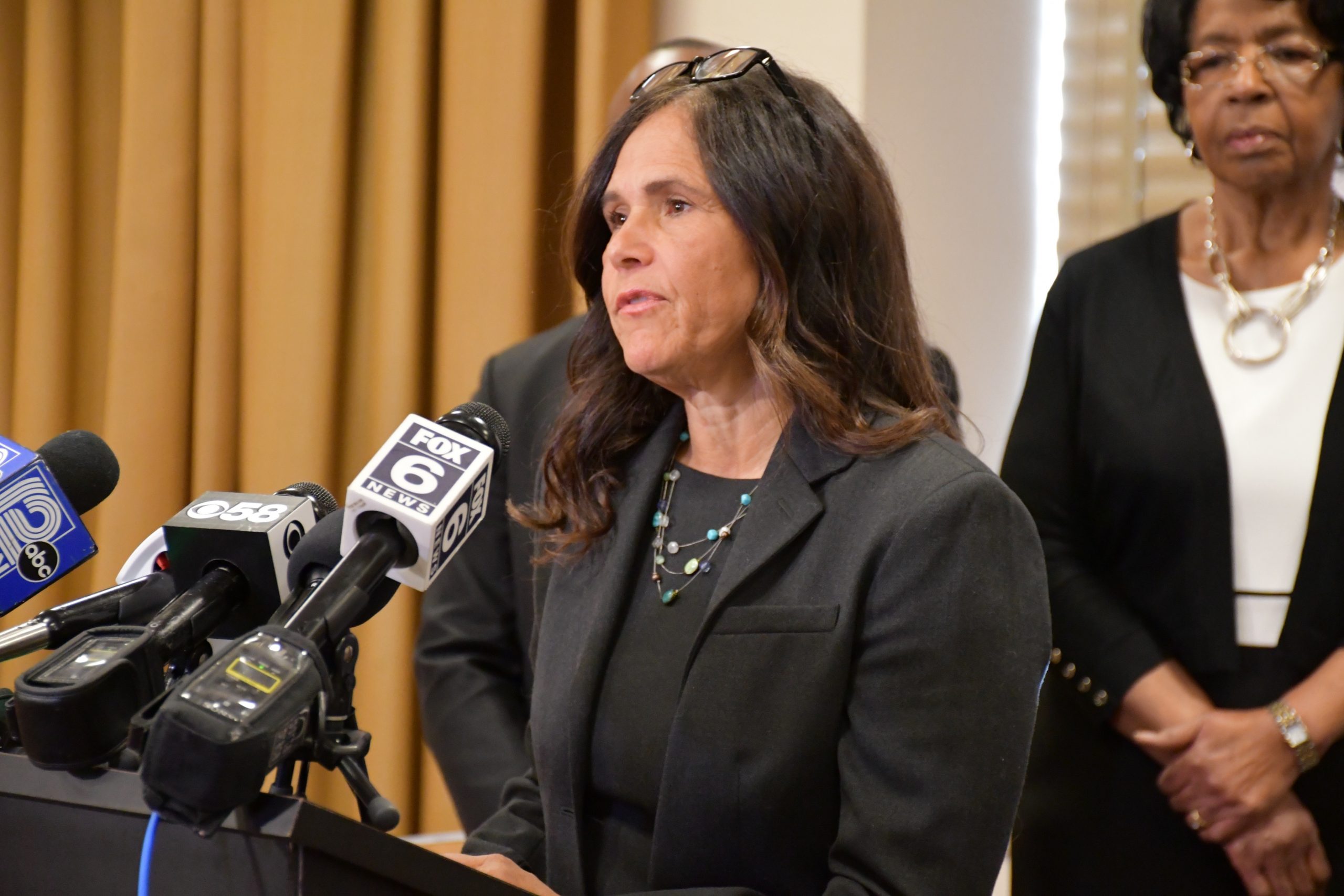
Milwaukee Public Schools Superintendent Brenda Cassellius speaks at an April 3 press conference. Photo by Jeramey Jannene.
When consultants Perkins Eastman presented their long-range facilities plan to the Milwaukee school board in early September, there was much attention on which school buildings might be closed, what programs would be merged and what programs would be restructured. But for Superintendent Brenda Cassellius, her first priority was not the buildings, it was reimagining how we educate children in Milwaukee Public Schools (MPS). In fact, she told the board and the public that, before any buildings were closed, they had to think about how they wanted to educate children.
Cassellius has let the school board and the public know she is considering recommending that many K-5 schools add 6th grade. This idea is likely to be well received by underutilized K-5 schools, giving them more long-term viability. But her ideas for changing the structure of middle and high school and perhaps moving 7th and 8th grades out of K-8 schools could face stiff opposition.
In an interview with Urban Milwaukee, Cassellius outlined her reasoning for reimagining education in Milwaukee schools and the efforts she must make to convince the public and the board that her ideas will benefit Milwaukee’s children.
“We are bleeding our students from grade 6 right now. We lose about 8% of our 6th graders,” she notes. Milwaukee has 43 stand-alone K-5 schools, including 21 that have space to add 6th grade students. That could open the way to a pilot for next school year. “Are parents willing to stay with us another year rather than move on?” She wants to see how that 6th grade modification would develop before making further recommendations.
But for Cassellius, this change is more than just an attempt to keep more students in MPS for a longer period of time and boost enrollment. She envisions a more comprehensive set of reforms to improve MPS by zeroing in on how we educate our 7th and 8th graders.
She tells Urban Milwaukee that she comes from a middle school background, as a middle school teacher and administrator. In Memphis she was the middle school superintendent and oversaw a dramatic turnaround in academic performance in middle schools, taking the majority from underperforming to meeting state standards. “I’m not against stand-alone middle schools,” she says.
But she had to rethink her support of the middle school model. When she became superintendent of Boston public schools the district was in the midst of a transition from K-8 and 9-12 schools to a K-6, 7-12 structure. And she helped facilitate that transition. To some degree, Boston’s transformation might be part of her templet to reimagine MPS.
“I believe strongly that elementary school should be elementary school, and elementary students should be exposed to elementary developmentally appropriate offerings and environment, social-emotional settings for young children, and you have specific developmentally appropriate offerings and environment for young adolescents, teenagers, and junior aged kids,” says Cassellius. “I am more of a fan of a junior high model. I think when we moved to 6-8 grade, we lost our 9th graders and we matured our 6th graders too soon.”
“They do not get appropriate emotional and academic development from a K-8 school.” she says. “Through the generations, children have changed and shifted at this age group.” She believes younger students are exposed to ideas on cell phones and the internet that previous generations never experienced, and need to be career and college ready at a younger age. Thus, students need 8th grade algebra from a mathematics teacher and content-specific teachers in other areas.
Cassellius looks at a couple of models for 7-12 schools that could work, some already existing in MPS 6-12 schools. Golda Mier has two interconnected buildings, one for the lower secondary and another for an upper secondary. She believes that even if all secondary grades are in one building, they should operate on different floors or wings if possible. Perhaps an existing middle school, especially if it is near to a high school, could be combined into one school with a high school. The junior high students would have excess to all the clubs, sports, and activities that the upper grade student have.
That might mean abandoning an entire middle school, but that could result in opening up the former middle school to an elementary school. That is what happened to the former Fritsche middle school a number of years ago. Cassellius points to the Douglas building going through a similar modification.
Cassellius point to another factor in cutting the number of educational transitions from two — primary, middle and high school — to just one. “It gives parents only one point of transition. So, they come in at K3; they go to grade 6. Grade 6 is the transition point. We anticipate that they are in 7 through 12, high school being stand alone, upper and lower campus, or you move these students into the actual facility.”
“Research shows, if students are stable in middle school, they have much greater chance to graduate high school, and they also have greater entry into college and completing. We lose too many students who come to high school unprepared if they haven’t had that transition period.”
She understands that many families have an emotional attachment to the K-8 model especially if they want to keep more than one child in the same school as long as possible. And Cassellius recognizes that these ideas can’t be forced on a skeptical public without sincere dialogue. But if the change becomes a springboard to improving MPS, that could be very persuasive for parents.
“Where you have excellent schools, parents will go. Our job is to create those excellent career pathways in our high schools.”
If you think stories like this are important, become a member of Urban Milwaukee and help support real, independent journalism. Plus you get some cool added benefits.


K-12 Education
-
Crowd Opposes MPS Staff Cuts
 Mar 11th, 2026 by Terry Falk
-
Cassellius May Use Portable Classrooms for 6th Graders
 Feb 23rd, 2026 by Terry Falk
-
Should All Students Get Free School Lunches?
 Feb 1st, 2026 by Terry Falk



















This sounds like a much better thought out plan than ones promoted and implemented by previous MPS administrations. Being an outsider, she has not been part of the “group think” of administrators who have muddles though unresolved issues that needed to be dealt with. She comes in with no allegiances to the old guard and has had enough experience to design new approaches to the district’s issues.
I think Milwaukee Public Schools Superintendent Brenda Cassellius has a fresh approach to a system that has been overwhelmed with problem and many issues that have not been addressed. She certainly has brought a fresh thought out approach on where to begin with MPS problems. I’ve enlightened myself on Cassellius background and we have someone to start the huge challenge, with her successful career. As mentioned above, “she has no allegiance to the old guard”… time for change with a directive on where to start first.
Junior high teachers and the students they teach are different from both elementary and high schools. 13- to 15-year-olds are experiencing tremendous growth physically and psychically. Having taught 7th and 8th grade, I don’t believe the building is as important as the program structure and teachers with experience and compassion to help students through puberty while teaching the curriculum.
Too many exceptional junior high teachers burn out and leave teaching because they do not get appropriate support from administrators in both K-8 and 9-12 programs. I applaud superintendent Brenda Cassellius’ focus on junior high students. Those years are critical for intellectual and emotion development. A well thought out junior high program has the potential of identifying at risk students and ultimately prevent school shootings.