

Wisconsin Puts State Dollars Into Local Food For The First Time
Feeding Wisconsin calls $10 million program a critical investment as donations fall and more residents seek help.
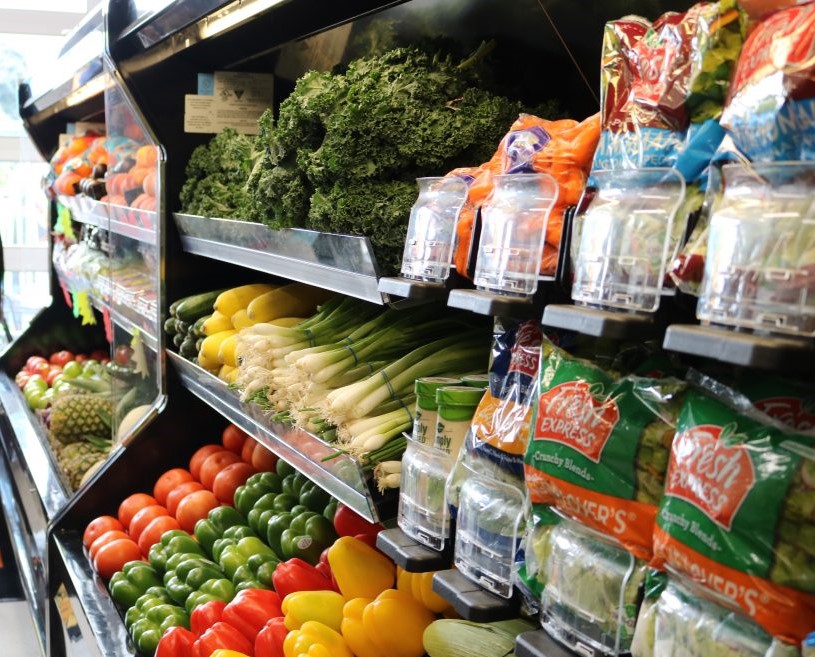
Grocery store shelves. Photo by Sophie Bolich.
New state funding will help Wisconsin hunger relief groups purchase from local farmers. It continues an effort that was disrupted last year after the abrupt end of federal support.
The Food Security and Wisconsin Products Grant Program will receive $10 million over the state’s 2025-27 biennial budget. Half of the funding was distributed last week to Feeding Wisconsin and Hunger Task Force, and will go toward purchasing foods that are at least 51 percent produced or processed in Wisconsin.
Jackie Anderson, executive director of Feeding Wisconsin, said it’s the first time Wisconsin is investing state dollars into this type of hunger-relief effort. And it comes at a critical time.
“We know, as a sector, that donations (of food and money) are decreasing,” Anderson said. “On the flip side, the need is increasing. Across our Feeding America food banks, we’re seeing about a 30 to 45 percent increase in the number of neighbors who are needing to visit pantries.”
On top of these challenges, federal funding that had previously supported getting local foods into food banks was abruptly ended last year as part of President Donald Trump’s efforts to cut federal spending.
In March, the U.S. Department of Agriculture canceled more than $400 million in contracts through the Local Foods Purchase Assistance Program. The initiative was created in 2021 in response to food supply chain disruptions during the COVID-19 pandemic, and had supported $4 million in Wisconsin food purchases through the end of 2024, according to Gov. Tony Evers’ office.
The abrupt cancellation had an immediate impact on hunger-relief groups and farmers who were counting on the contracts, according to Matt King, CEO of Hunger Task Force.
“There were a lot of small businesses and small-producer businesses that had found tremendous success in cultivating new markets, developing capacity and infrastructure and growing their small business through the markets and relationships that that program created,” King said.
Last spring, Hunger Task Force had already signed contracts to purchase around $250,000 worth of food from a dozen farmers under the program. King said his organization chose to honor those contracts in 2025 despite the end of the funding, and used private dollars to make up for the loss.
King said the funding emphasis on local food in recent years has led Hunger Task Force to invest more in the infrastructure needed to handle and store fresh local foods.
This build-up of the supply chain also provided small and mid-size farmers with more economic stability.
Tara Roberts-Turner, general manager of the Wisconsin Food Hub Cooperative based in Waupaca, said the wholesale purchases were substantial for many small producers and strengthened local food security across the state.
“You can’t just look at the immediate, ‘OK, now I’m buying a bag of carrots or I’m buying a pallet of onions,’” she said. “You have to look at the economic impact that we have by being able to be autonomous as a community, and know that we can take care of our own people.”
The Wisconsin Food Hub Cooperative had helped provide logistics and transportation under the Local Foods Purchase Assistance program. Roberts-Turners said the cooperative had to downsize their fleet of vehicles because of the loss of federal funding, but chose to keep the extra staff they hired in the hope of creating new programs.
She is optimistic that the new effort to purchase local food through state funding will be a better program because of the lessons learned.
After federal cuts, Wisconsin will fund effort to get local food into food banks was originally published by Wisconsin Public Radio.
If you think stories like this are important, become a member of Urban Milwaukee and help support real, independent journalism. Plus you get some cool added benefits.






















Perhaps it’s time all food pantries start asking for proof of need. Too many utilize this service so they have more money to drink, do drugs and gamble. I see it while I am waiting for the bus. These freeloaders who admit they can afford to buy their own food tell me I’m a fool not to utilize the food banks because then I’d have more money for “fun” things, like a weekly trip to Potawatomi. No thanks. I will keep my simple diet and let the truly needy utilize the food banks. That is, if there’s anything left after all the selfish folks who can afford to buy food wipe them out. Until food banks start asking for proof of need, I will not donate to them.I refuse to enable the entitled class more than I already am by subsidizing the fare evaders on MCTS.