

Microsoft President Supports Law to Regulate WI Data Centers
Brad Smith releases Community-First AI Infrastructure proposal.
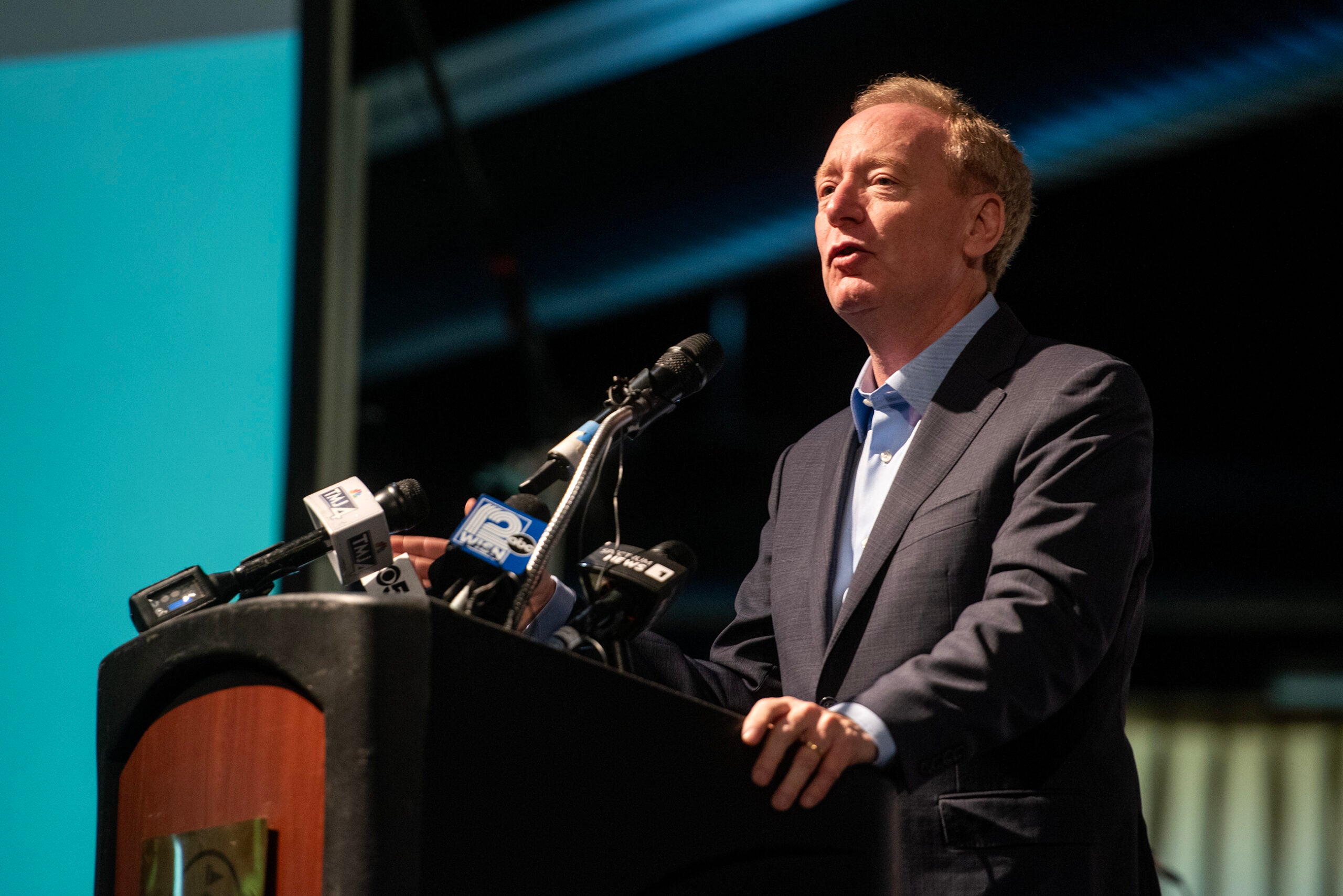
Brad Smith, Vice Chair and President of Microsoft, speaks Thursday, Sept. 18, 2025, in Racine, Wis. Angela Major/WPR
One of Microsoft’s top executives said he would support a new state law to regulate and set standards for data center developments across Wisconsin.
Brad Smith, Microsoft’s president and vice chair, also said he supports a proposal from We Energies for a “Very Large Customer” rate for data centers in the state.
“We want to pay a higher price so that our data center does not increase the price of electricity for consumers,” Smith said in an interview with WPR. “That’s the right thing to do for the state and for our business.”Tuesday morning, Smith announced a new plan from the company titled “Community-First AI Infrastructure,” which seeks to address concerns regarding data centers. The move comes as residents of some Wisconsin communities have pushed back against plans for the facilities.
During the announcement in Washington, D.C., Smith said he understands people’s concerns about rising electricity prices and the amount of water needed for data centers. The plan includes several commitments from the company, like ensuring that data centers don’t increase electric prices for nearby residents and minimizing water use.
In an interview with WPR after the announcement, Smith said he believes Wisconsinites are asking “reasonable and even good questions” about data center developments. He said the tech giant plans to “raise the bar” when it comes to the campuses.
“We have something to prove,” Smith said. “We want to prove to the people of Wisconsin that we can do this right. And we want to prove that if we can do it right, everyone can do it right, and that’s the way it should be done.”

An artificial intelligence data center is built on land once slated for development by Foxconn in Mount Pleasant on Wednesday, May 8, 2024. Angela Major/WPR
Microsoft is investing more than $7 billion in two data centers in Mount Pleasant. Smith said the first data center there is set to be operational this year. The company is also planning another data center campus in Kenosha.
However, Microsoft scrapped plans to build a data center on 244 acres in Caledonia in October, citing “community feedback.” That decision came after dozens of residents spoke out against the plans at village meetings.
Wisconsinites have been showing up to local meetings to raise concerns about the environmental impacts and the energy and water demand for data center campuses for months. Some residents have also said they’re worried the developments will impact the rural feel and look of the community.
In December, protests were held in seven communities across the state as part of an organized day of action aimed at bringing attention to the potential negative impacts of the campuses.
“It’s okay that some communities may say they don’t want them,” Smith said. “We have to respect the decision of the people of Caledonia, but for other communities, this can be a huge shot in the arm economically.”

Microsoft President Brad Smith announces a $3.3 billion investment to build an artificial intelligence data center on land once slated for development by Foxconn on Wednesday, May 8, 2024, at Gateway Technical College in Sturtevant, Wis. Angela Major/WPR
State lawmakers have begun to introduce bills in response to the data center projects. A recently introduced proposal from Republican lawmakers seeks to protect consumers from paying for electrical grid improvements for data centers.
That bill would require data centers in Wisconsin to recycle the water they use to cool computer equipment and report their yearly water usage to the state. The proposal would also require any renewable energy facility that serves as a primary power source to be located on the data center site.Another proposal, introduced by State Sen. Jodi Habush Sinykin, D-Whitefish Bay, would require that data centers receive at least 70 percent of their electricity from renewable sources.
Smith said he had read both of those measures.
“I think this is a year when we, everyone, should ask the Democrats and Republicans alike to find common ground, to pursue a common cause, agree where you can and set the bar for everyone, certainly around transparency, around water use, around the protection of consumers from data centers leading to higher electricity prices,” Smith said.
Microsoft’s data centers in Mount Pleasant will require up to 8.4 million gallons of water each year, according to data released by the city of Racine. Smith said the company is open to being more transparent around how much water data centers will use each year, as he said the company plans to reduce water use by 40 percent at facilities across the nation.
“I think a community has a right to know and we have information that we can share,” Smith said about water use.
Microsoft purchased around 240 acres for a data campus in Kenosha last year. Tuesday, Smith said the tech giant is still “working on our plans” for that development, even as residents there have already voiced opposition to the project.
When it comes to a potential AI ‘bubble’ impacting the growth of data center development in Wisconsin, Smith said he believes AI will become an “indispensable part of the economy.”
“I don’t see a concern today that they’re going to be sitting empty,” Smith said about the data center buildings.
Microsoft president says he would support a Wisconsin law to regulate data centers was originally published by Wisconsin Public Radio.
If you think stories like this are important, become a member of Urban Milwaukee and help support real, independent journalism. Plus you get some cool added benefits.