Lawmakers Seek Hospital Price Transparency
Hospitals say they should focus on insurance companies.
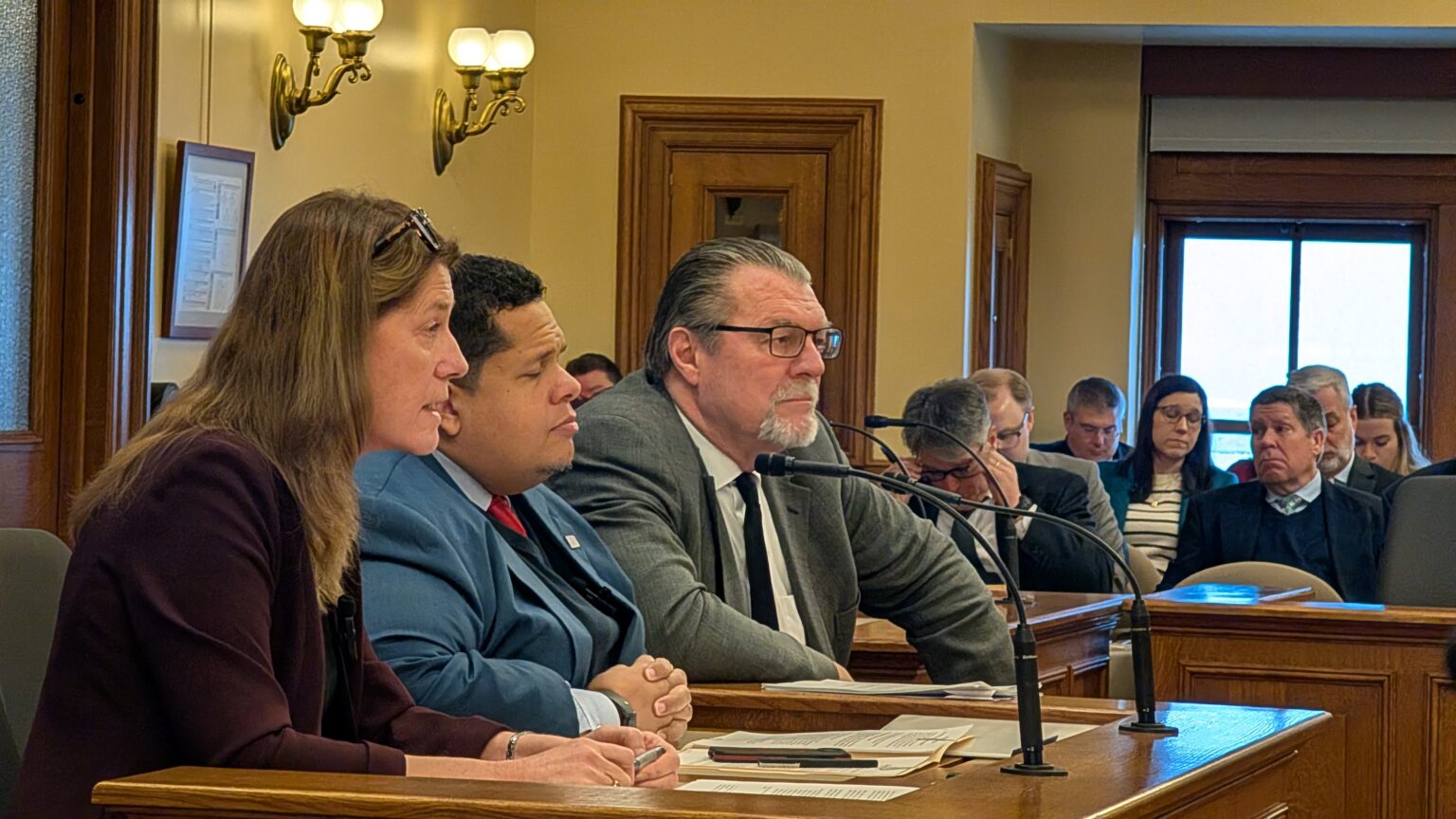
“What major purchase does anyone in this room make without knowing the cost before you make the purchase? It is inconceivable to me that we do not know what something is going to cost of that magnitude before we actually consent to the cost,” Sen. Mary Felzkowski said. (Photo by Baylor Spears/Wisconsin Examiner)
A bill to implement state-level enforcement of federal hospital price transparency requirements in Wisconsin, with the goal of bringing down the cost of health care, received pushback from hospital representatives and support from employers on Wednesday.
Sen. Julian Bradley (R-New Berlin) told the Senate Licensing, Regulatory Reform, State and Federal Affairs Committee that ensuring that the cost of services provided would help with health care affordability.
“When hospitals clearly share pricing information, patients can make informed decisions. Trust in the system grows and costs come down naturally,” Bradley said, adding that the bill would ensure Wisconsin “reaps the benefits” of changes made by the Trump administration.
During his first term, President Donald Trump’s administration implemented rules to require hospitals to post pricing information online. The effects of the changes on patients’ costs have been mixed. At the start of his second term, Trump signed an executive order intended to bolster the effort and in December, the administration proposed a new rule that aims to simplify how price data is organized and shared with people.
SB 383 would instruct the Wisconsin Department of Health Services to enforce federal price transparency requirements for hospitals.
Bradley and Rep. Robert Wittke (R-Caledonia), the bill coauthors, said it is needed to help ensure that federal policies are being followed.
“Sometimes we need to take action to make sure that it goes all the way through the state and all of our residents have access to the things that are expected through federal law,” Wittke said.
Bradley said the lawmakers aren’t trying to penalize hospitals, just ensure people have access to information.
If a hospital is found to be out of compliance under the bill, Wisconsin DHS would be able to take several actions including providing a written notice to the hospital, requesting a corrective action plan or imposing a financial penalty. DHS would also need to keep a public list of any hospitals that have violated the requirements.
Hospitals would also need to be certified as being in compliance with the requirements when seeking judgment from a court against a patient who owes a debt for services.
Lawmakers introduced a similar bill in 2023, but it failed to receive a floor vote in the Senate and advance in the Assembly.
The current version of the bill includes a provision that says that if federal laws change and are eliminated, then provisions in the bill that establish state level requirements for publishing prices will take effect.
Under those provisions, each hospital would need to make a list of “shoppable services” — ones that can be scheduled in advance such as a knee replacement — available with the standard charge for each item that would be publicly available. A hospital’s list would need to include at least 300 “shoppable services,” and if a hospital doesn’t provide that many, it must list all of its shoppable services.
The change is meant to avoid overlapping and varying requirements, though hospital representatives expressed concerns that would happen anyway.
The Wisconsin Hospital Association (WHA) opposes the bill. Christian Moran, the WHA vice president of Medicaid and payer reimbursement policy, said during the hearing that the organization’s opposition to the bill is not opposition to price transparency.
“Our opposition is to the added regulatory complexity that is created by layering on state level enforcement and state level regulations and unlimited fines on Wisconsin hospitals when robust federal regulation and enforcement already exists,” Moran said.
Moran said no Wisconsin hospitals have been fined for noncompliance since the first federal regulations went into effect.
“Personal experience, it’s somewhat inevitable: if you pass legislation on the state level that mirrors the federal level it will eventually not match up,” John Russell, president and CEO of Prairie Ridge Health, said.
Hospital representatives also expressed concerns that not enough attention was being given to the role of health insurance companies.
“The solution proposed to you in [SB] 383 is to double up on existing enforcement for hospitals while ignoring the state’s current responsibility to enforce and monitor insurance compliance,” Moran said.
Brian Stephens, CEO of the Door County Medical Center, said the state should be more focused on the “middlemen” including insurance providers, saying that bolstering the transparency of hospital costs has its limitations. He spoke to the work that his medical center has done over many years to improve transparency of prices.
“There’s a disconnect in this country between the concerted efforts of health care providers to provide reasonable and transparent prices and the costs that people are paying for health insurance. Unfortunately, hospital price transparency efforts have not put a dent in that dichotomy,” Stephens said. “Perhaps we need to be asking for more transparency from health insurance companies and other middlemen to understand the real drivers of health care costs in our country. Perhaps hospitals have just become a good punching bag for folks who need an effective sound bite. The reality is that, despite our wholehearted commitment to providing reasonable upfront prices, transparency has its limitations. What are the odds that a person waking up with pain will take the time to bring out his or her phone and search the most affordable hospital or clinic prior to seeking treatment.”
Sen. Steve Nass (R-Whitewater) said the testimony focused on the insurance companies’ role sounded like “a lot of finger-pointing.”
Several other states have adopted laws or are in the process of advancing bills to bolster price transparency including Colorado, Washington State and Ohio.
Patrick Neville, a former Republican state representative in Colorado who helped pass a similar law in his state, testified on the Wisconsin bill, saying provisions in his home state have already helped. He told the story of one patient who was charged nearly $80,000 for a hysterectomy, but didn’t have to pay the cost.
“Because we had the consumer protections in this bill in Colorado, and they weren’t compliant with price transparency. They couldn’t actually collect that $80,000,” Neville said. “That was really important and powerful for the actual consumer in this case, and so it’s actually working in Colorado.”
Neville added that the Colorado legislation did not codify the federal rules, but he wishes it had.
“Any president could get rid of those rules at any point and I think the way this bill is crafted… It’s hugely important,” Neville said. “That’s a clever way to craft it.”
Several employers testified in favor of the legislation.
Erik Sonju, president of Fitchburg-based Power System Engineering, described the unpredictable jumps in health care costs that his company has grappled with since 2018 when he started in his position. He said that 2023 was the year the “straw broke” as they dealt with a 20% increase in insurance rates and he wasn’t able to get clear answers about the rising cost.
Sen. Mary Felzkowski (R-Tomahawk) told the committee that the cost of health care is too high.
“This is common sense. What major purchase does anyone in this room make without knowing the cost before you make the purchase? It is inconceivable to me that we do not know what something is going to cost of that magnitude before we actually consent to the cost,” Felzkowski said.
Felzkowski is the lead coauthor on two of the other bills the committee took up. SB 796 would require insurers to submit information about claims to the Wisconsin Health Information Organization (WHIO), a nonprofit organization that collects health care claims data, and SB 797 would provide a $600,000 grant for the WHIO to establish an online dashboard of health care claims information and to add new payer data.
The committee also took testimony on SB 703, coauthored by Wittke and Sen. Rob Hutton (R-Brookfield), which would establish that employers who sponsor group health insurance plans have a right to data relating to the employees and dependents covered under those plans, including claims data, utilization reports and other information necessary to understand and manage health care costs.
Wittke said the bill will maintain privacy protections by requiring employers to designate a HIPAA compliance privacy officer and ensure that the Office of the Commissioner of Insurance maintains oversight. The bill also includes a provision prohibiting data from being sold to any party without the permission of the plan sponsor and the person to whom the claims data relates.
Lawmakers seek hospital price transparency, while hospitals say they should focus on insurers was originally published by the Wisconsin Examiner.
If you think stories like this are important, become a member of Urban Milwaukee and help support real, independent journalism. Plus you get some cool added benefits.