

From Solitary To Soap Prices, Lawmakers Probe Wisconsin’s Prisons
A yearlong review and emotional testimony on hygiene, menstruation and supervision power imbalances frame the latest hearing.
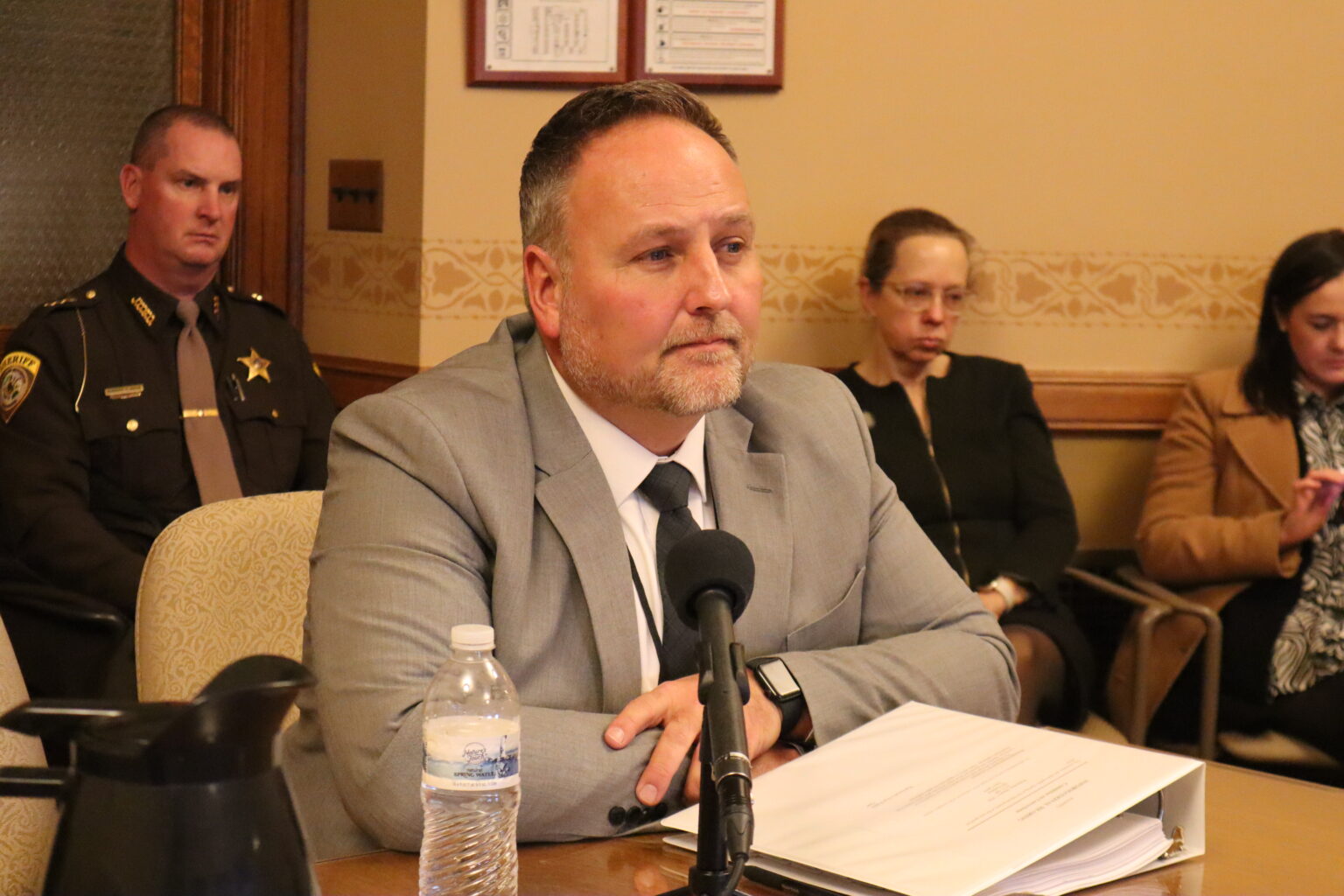
DOC Secretary Jared Hoy (Isiah Holmes/Wisconsin Examiner)
Jared Hoy, Secretary of the Department of Corrections (DOC), appeared before the Assembly Committee on Corrections Wednesday morning to discuss a third-party study of DOC facilities, policies and practices.
“The report clearly shows our agency and our staff are working hard getting a lot right, but as expected we also learned of several areas we need to make improvements on,” said Hoy, calling the report conducted by Falcon Correctional and Community Services Inc. “a critical and necessary step forward” after he succeeded former Secretary Kevin Carr in 2024.
Hoy said that the Falcon Report focused on behavioral health, correctional practices, health care, employee wellness, leadership development, agency culture, recruitment of staff and problems in the restrictive housing unit, otherwise known as solitary confinement. The review lasted nearly a year, and highlighted a number of positive changes within DOC that Hoy listed, including:
- Developing an objective custody classification system in 2023;
- Restructuring the Bureau of Health Services in 2024,
- Expanding the earned release program,
- Transitioning the Waupun Correctional Institution to having all single cells,
- Reforming restrictive housing in 2024 by enhancing training and increasing security rounds,
- Implementing new systems to track the number and frequency of security rounds,
- Retraining medication distribution and documentation,
- Performing security audits,
- Requiring supervisory meetings at Waupun at the beginning of each shift,
- Implementing a new restrictive housing policy.
It wasn’t an entirely rosy picture, however. “As noted in the report, our agency is at a period of transition,” said Hoy. “We are not alone in navigating this unique point in time following the operational disruptions of the pandemic and the related staffing shortages that followed.”
Hoy urged people to view the report in that context as he went into the areas of improvement it suggested. High vacancy rates for staff at different institutions remains an issue, although the DOC has been able to fill more security positions due to pay raises approved by the state Legislature. This has created a “new and unique concern,” Hoy said, in that many staff are new and do not have much correctional experience. Additionally, many staff members were hired during the COVID-19 pandemic, and thus have skewed perceptions of what normal DOC procedures look like. The highly restrictive, atypical protocols intended to stifle the spread of COVID-19 became the formative experience of this new generation of DOC guards and staff.
Mental health needs among DOC residents was another area of concern. Hoy noted that “44% of male persons in our care and 91% of female persons in our care have a mental health condition.” As a result of the study, DOC is working towards updating its mental health classification system, creating specific mental health units, better monitoring and collecting mental health data, and improving conditions within the restrictive housing unit, otherwise known as solitary confinement, and increasing programming and recreation.
“So while the results of this study are both informative and valuable, they represent only the starting point,” said Hoy. “The true measure of our agency’s success will be determined by how thoughtfully and effectively we act upon the recommendations that follow.” DOC is currently planning another contract with Falcon to develop a framework to review the report’s key findings, and implement its recommendations. Although many of the changes will need to cover the entire DOC, Hoy said the state agency will also look at specific institutions to “reimagine” their functions, and begin implementing changes at five “pilot sites” before expanding to other facilities.
Hoy took questions from corrections committee members. Public comment in response to the secretary’s presentation was not allowed. Lawmakers pointed out that the DOC remains overcrowded, with over 23,000 people spread across various prisons. Some highlighted the need for more uniformity among DOC policies across facilities, as well as a need for increased and centralized data analysis.
Hoy acknowledged that there are ongoing problems with placing people in appropriate facilities, such as people who should be in minimum or medium-security prisons being placed in maximum security institutions, or people with severe mental health needs not being cared for adequately. He also noted that because DOC is generally a paramilitary organization, staff are often “craving” direction and vision from their leadership. Hoy said that there is more work to be done to change the culture among DOC staff, emphasizing that “we need to treat everybody with dignity and respect, to treat people as human beings, and see that person no matter whether they have a cap and gown and they’re graduating and ready to walk out the door, or if they’re sitting at rock bottom in restrictive housing, that they are still a human being.”
Hygiene and feminine product access in prison
The Corrections Committee also heard testimony on three bills which were open to public comment. One Republican bill (AB 297) would provide pay bonuses to DOC probation and parole officers based on their ability to increase employment rates among their clients under supervision. Rep. Benjamin Franklin (R – De Pere), the bill’s author and a member of the corrections committee, said the bill would help reduce the recidivism rate. Franklin was questioned by fellow lawmakers about whether the bill would adversely affect people who have small children at home, or who need to prioritize substance abuse treatment and mental health care over finding immediate employment.
There were also questions about how probation and parole officers might abuse the incentive structure such as by creating revolving doors where clients get and lose jobs, only to be hired somewhere else, earning another bonus for their probation agent.
The bill was backed by Cicero Action, a policy advocacy group whose board of directors is chaired by Joe Lonsdale, a billionaire co-founder of the data and surveillance company Palentir. Lonsdale has called for the use of public hangings to demonstrate “masculine leadership.”
Members of the public who attended the hearing, including members of the criminal justice reform advocacy groups Dream.org, Ladies of SCI, Ex-Incarcerated People Organizing, and others testified that people on probation and parole already have lives dictated by the whims of their agents. One woman gave an example of a formerly incarcerated loved one who had to take time out of their day for a three hour bus ride to check in with a probation agent for just a few minutes. Others shared firsthand experiences of being placed in unfulfilling jobs for which they were ill suited by their probation agents, or being discouraged from applying for certain kinds of work.
Two Democratic bills (AB 736 and AB 741) focused on increasing hygiene products across DOC facilities and expanding access to menstrual products for incarcerated women. Reps. Shelia Stubbs (D-Madison), Robyn Vining (D-Wauwatosa) and Sen. LaTonya Johnson (D-Milwaukee) presented the bills to the committee.
Stubbs said that “good hygiene is both a matter of health and dignity, especially for those incarcerated.” AB 741 would require the DOC to provide culturally sensitive products ranging from shampoos to shaving cream, bar soap, natural conditioners, and other products through the commissary at no more than 125% of the price at the highest-grossing retail chain in Wisconsin, or no more than 100% of the sales price, depending on the product. Incarcerated people would also be given a $25 monthly stipend to help purchase hygiene products. The bill would also require sheriffs overseeing jails to provide a stipend and products to people held within jails.
During testimony, some formerly incarcerated people shared experiences of witnessing fellow incarcerated people fight because of bad hygiene. Family members of incarcerated people said that the costs to purchase commissary items, make phone calls and other expenses amount to unsustainable drains on their household budgets.
AB 736 would expand access to safe and appropriate menstrual products to incarcerated women. Although some prisons and jails take it upon themselves to provide such products to their residents, not all of them do so consistently nor do they provide a range of appropriate products. In some cases, women can bleed through their clothing in prisons and jails, creating embarrassing and awkward situations in which correctional staff may or may not be sympathetic to their needs.
“In this way, menstruation becomes a monthly cycle of humiliation solely borne by women simply because they are women,” said Johnson. “And that’s not fair.” Johnson called providing menstrual products to incarcerated women “a minimum standard of care in more than two dozen states,” adding that the federal prison system guarantees women access to tampons and pads in correctional facilities. “States that have implemented these policies report minimal cost and improved conditions including fewer medical complications, fewer grievances, and safer, more sanitized facility environments.”
Lawmakers, as well as members of the public, pushed the committee to consider providing menstrual cups as well as more common products like tampons, and to evaluate whether products are safe or if they come with a risk of exposing incarcerated women to toxins. Many in the committee pointed out that if public bathrooms — including those in the Capitol — provide women with menstrual products for free, then why can’t jails and prisons?
“For far too long meaningful conversations about menstruation have been avoided due to stigma, and it is my hope that as leaders in the state of Wisconsin, we can change that,” Vining said in a statement. “We need to talk about this issue now because women are one of the fastest growing populations in the U.S. And over the last 25 years, the number of women in Wisconsin’s prisons and jails has quadrupled. Our state jails and prisons, and their policies and programs, were simply not designed to safely and humanely incarcerate women.”
State corrections committee reviews prison study, hygiene bills for incarcerated people was originally published by the Wisconsin Examiner.
If you think stories like this are important, become a member of Urban Milwaukee and help support real, independent journalism. Plus you get some cool added benefits.






















How is it possible that there is NO REFERENCE to the therapy that all (the vast majority) of those incarcerated NEED REQUIRE will want if offered??? Every person in prison has been abused and some/many are currently being abused. The Medical College of Wisconsin calls the impact of ABUSE “Invisible Wounds” Yes a wound that requires care just like a broken bone or some disease. Abuse may impact the body BUT it always IMPACTS the BRAIN.