Legislators Debate Schools’ Policy on Pronoun Changes
Bill requires schools to inform parents if students change names, pronouns.
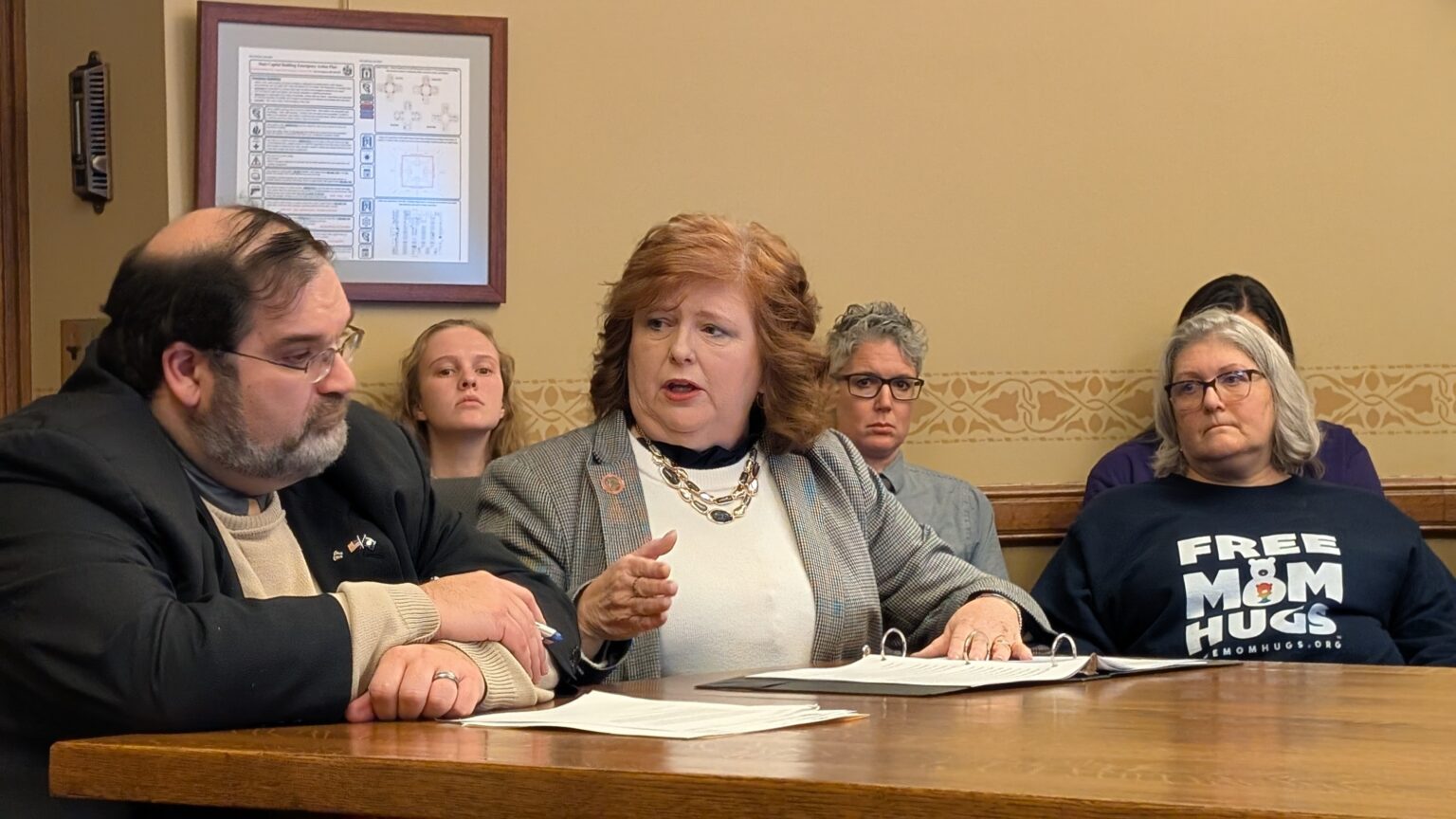
Sen. André Jacque (R-New Franken) and Rep. Barbara Dittrich (R-Oconomowoc) argued that a measure regulating the use of student names and pronouns was needed to standardize policies across the state. (Photo by Baylor Spears/Wisconsin Examiner)
A bill that would require school districts to inform parents when students want to use pronouns and names that differ from the ones given to them at birth received significant pushback Tuesday during a Senate Education Committee hearing.
The committee also took testimony on a bill to add video requirements to human growth and development curriculum as well as to opt the state into a federal school choice tax credit program.
Under SB 120, Wisconsin schools would be required to adopt a policy on name and pronoun changes by July 1, 2026. Policies would not require written authorization if school staff are using a shortened version of a student’s first or middle name.
Sen. André Jacque (R-New Franken) and Rep. Barbara Dittrich (R-Oconomowoc) argued that the measure was needed to standardize policies across the state and ensure parents are involved in conversations related to pronoun and name changes for students. Many testified in opposition to the bill, saying it would do harm to students and infringe on local decision making.
“It is deeply troubling to me that school staff are being encouraged to keep parents out of major life decisions concerning their children, while at the same time these same officials cannot give them aspirin without parental approval. Why would schools promote secrecy in such a way?” Jacque said. “Something has gone terribly wrong in our education system if officials inherently perceive parents as harmful to their own children. Parents are legally accountable for the health and welfare of their own children… Hiding from us important things that are going on in their lives is not only disrespectful to parents, it is harmful to our children.”
Jacque said the legislation would be consistent with a 2023 ruling by a Waukesha County Circuit Court judge, which found that a policy that allowed students in the Kettle Moraine School District to change their names and pronouns in school violated the rights of parents to make medical decisions for their children. The school district now has a policy that requires express parental consent for staff to use different names and pronouns.
“To me, if there’s going to be a name and pronoun change the school should be working together with parents and students to advance that together,” Dittrich said.
Sen. Chris Larson (D-Milwaukee) pushed back on the Republican bill, saying it would infringe on local communities’ ability to make decisions about policies and would harm students.
“You could sub out the words ‘parental decision making’ and say that the Legislature is going to have the best authority of what should happen — instead of parents, instead of local governments, instead of local school boards. You’re saying that you guys know better,” Larson said.
“That’s a total distortion of what the bill does,” Dittrich said.
Larson asked the bill authors to consider a situation where parents may not be accepting of a student who wants to use a different name and pronouns.
“You are expediting that situation by making it come to a head when there are parents who are less than understanding, who are brought up under a very strict and very incorrect… and you are forcing the question in a vulnerable population that is already overly targeted with transphobia with this, which is already overly targeted for bullying, which is already higher than the average rates of suicide and mental health. You are bullying them by bringing this bill forward,” Larson said.
“You are saying we should hide information and not facilitate those conversations,” Jacque replied. Dittrich added that Larson was “trampling all over parental rights.”
Paul Bartlett, a father of two transgender children, said the bill works to “prioritize the unfounded fears of conservative parents over the well-being of children.”
“Like any parent, I want my children to thrive and be happy. They are well supported against these continued legislative attacks, but many trans and nonbinary kids are not,” Bartlett said. He said that school should be a refuge for unsupported students, “not a place where teachers are obligated to out and humiliate them.”
Bartlett pointed out that lawmakers recently approved a law, known as Bradyn’s Law, that seeks to protect young people from being sexually extorted online.
“That everyone agreed on [that bill] was important because what we were doing was preventing teenagers from killing themselves basically from humiliation… and yet these bills, they do the opposite,” Bartlett said.
Bartlett noted that anti-trans laws have a negative effect on young transgender people.
According to a 2024 survey by the Trevor Project, 45% of transgender and nonbinary youth have reported that they or their family have considered moving to a different state due to anti-LGBTQ+ politics and laws, and about 90% have said that their wellbeing was negatively affected by recent politics.
The Trevor Project survey, which pulled from the experiences of over 18,000 LGBTQ+ youth, also found that 39% of LGBTQ+ young people, including 46% of transgender and nonbinary young people, had seriously considered attempting suicide.
“I just don’t understand, like, why do we keep doing this?” Bartlett said.
Abigail Swetz, executive director of FAIR Wisconsin, said bills that target transgender youth contribute to the mental health struggles they face.
The bill is part of a slate of bills that Wisconsin Republicans introduced related to transgender people, including children, last year. According to the 2025 anti-trans bills tracker, there were over 1,020 bills introduced across the country including 20 in Wisconsin.
“Inclusive policies, like making it possible for students to use an affirming name and the pronouns that best represent their identity in school in an easily accessible way — those policies are a pressure valve making it possible for [youth] to live fully and healthily,” Swetz said.
Swetz said when she previously worked as a teacher she helped support students that were preparing to share information about themselves with their family and said it was important to follow the child’s lead.
“The youth themselves are the experts in their own experience and have a better understanding than anyone about the challenges they might face when it comes to acceptance and safety at home. I have witnessed that conversation go well, and I have seen it go badly,” Swetz said. She said the bill that lawmakers were pushing “aims to traffic in distrust while a process like this, one that is directed by a well-supported young person, is actually how we can build trust between parents, children and school staff.”
Peggy Wirtz-Olsen, president of the Wisconsin Education Association Council (WEAC), said she was speaking out against the bill on behalf of the students who would be “devastated” by the bill.
“All students deserve safe and welcoming schools, not only some of them, every single one of them, and that includes our trans students,” Wirtz-Olsen said. “The simple use of preferred names and pronouns is associated with a large decrease in depressive symptoms, suicidal thoughts and even suicidal attempts. Respecting preferred names and pronouns is a proven measure to show respect, earn trust, affirm our students, so they can feel safe, and they can focus on learning.”
Requiring videos of fetal development
Lawmakers also took testimony on a bill to add requirements for schools that offer human growth and development education.
Human growth and development is optional for Wisconsin school districts, but for those that do opt in, state law includes some requirements including encouraging abstinence for students who are unmarried.
SB 371 would add requirements that explanations of pregnancy, prenatal development and childbirth include a high definition video that shows the development of the brain, heart, sex organs and other organs, a rendering of the fertilization process and fetal development as well as a presentation on each trimester of pregnancy and the physical and emotional health of the mother.
The bill would also require that instruction on parental responsibility include information on the importance of secure interpersonal relationships for infant mental health and on the value of reading to young children.
Bill coauthors Sen. Mary Felzkowski (R-Tomahawk) and Rep. Amanda Nedweski (R-Pleasant Prairie) rejected the assertion that the bill is a mandate, noting that school districts do not have to teach human growth and development.
“Today’s youth are technologically and visually inclined learners. We should lean into this to better convey this important information,” Felzkowski said. She also added that there should be bipartisan agreement around “preparing the young women of today with all the knowledge they could need to prepare for motherhood and young men for fatherhood.”
“Being able to actually see the real life process of fetal development in action will be more tangible to students than textbooks or seeing it in a still diagram or a drawing. We have a resource at our disposal to bring science into our classroom and we should use it to our advantage to give students a stronger educational experience,” Nedweski said.
Nedweski also said it “might not be obvious to some people that using an iPad as a babysitter is not healthy” and that it is “far more important for their health to read to children and to bond with them.”
Larson asked the lawmakers what type of research they had to back up the change to state law.
“There’s not one specific scientific research that we’re relating this to,” Felzkowski said. “Just Google it and numerous things will pop up, or we can have our staff do that for you.”
No one spoke against the bill.
The Wisconsin Public Health Association (WPHA) and the Wisconsin Association of Local Health Departments and Boards are registered against the bill, according to the Wisconsin Lobbying website. The organizations outlined their concerns with the Assembly version of the bill in a statement to the Wisconsin Examiner.
The organizations said they opposed the legislation in part because it doesn’t do anything to restore the educational standards that were in place under the Healthy Youth Act. The former state law, which included a more comprehensive policy that required providing age-appropriate instruction in human growth and development, was adopted in 2010 but was later repealed in 2012 during a special session under former Gov. Scott Walker, who reestablished abstinence-only education.
“Evidence-based, comprehensive instruction is essential to equip students with accurate information and skills necessary to make informed decisions about their sexual health, reducing rates of unintended pregnancies and sexually transmitted infections. It also promotes healthy relationships, consent, and emotional well-being, contributing to overall public health and safety,” the organizations said in the statement.
DPI spokesperson Chris Bucher told the Examiner in an email that the state already has similar guidelines for human development instruction in state law and said the bill is an example of infringing on local control.
“It is up to districts to determine human development curriculum for what best fits their community. This is also another unfunded mandate for districts choosing to offer human development. District budgets are already stretched thin,” Bucher said. “If the Legislature wants to mandate specific instruction, they should provide funding for curriculum.”
Federal choice tax credit program
SB 600 would instruct Gov. Tony Evers to opt Wisconsin into a federal school choice tax credit program.
Gov. Tony Evers has previously said he will not opt Wisconsin into the program, and if the bill were passed by the Senate and Assembly instructing Evers to take action, he could veto the legislation.
A provision in the federal law signed by President Donald Trump in July, which goes into effect in 2027, will provide a dollar-for-dollar tax credit of up to $1,700 to people who donate to a qualifying “scholarship granting program” to support certain educational expenses including tuition and board at private schools, tutoring and books.
However, governors in each state must decide whether to opt in and have until Jan. 1, 2027 to do so.
Felzkowski said it would be “shortsighted and self-defeating” to not opt into the tax credit, noting that other states including North Carolina, Tennessee, Nebraska, Texas, South Dakota and Iowa, are already opting in.
If Wisconsinites opt into the federal tax credit, the money will be directed to private schools outside the state if the law does not pass, Felzkowski said. “Our dollars will be going to those states… instead of our students here in the state of Wisconsin.”
Senate committee considers legislation on informing parents of name and pronoun changes was originally published by the Wisconsin Examiner.
If you think stories like this are important, become a member of Urban Milwaukee and help support real, independent journalism. Plus you get some cool added benefits.