Milwaukee Musaik Performs 20th Century Classic
Messiaen's Quartet for the End of Time anchors potent program.
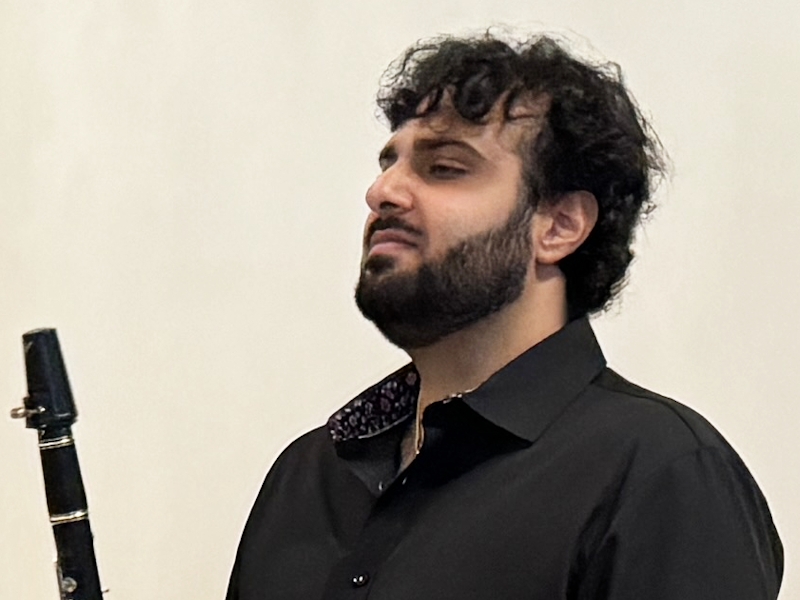
Clarinetist Jay Shankar. Photo by Michael Barndt.
From September 2025 through this January, Milwaukee has hosted the Violins of Hope – with concerts featuring a private collection of violins, violas, and cellos, all collected since the end of World War II. Many of the instruments belonged to Jews before and during the war. The objects serve as a memory of those tragic times. The many events are listed on the local Violins of Hope website.
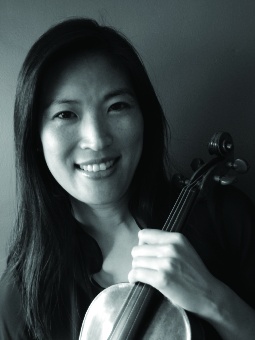
Jeanyi Kim. Photo from Kim’s website.
Milwaukee Musaik, an artist-driven opportunity for Milwaukee Symphony Orchestra artists to perform varied and intimate chamber music, will address the theme of this residency on Sunday, January 11, at the Sharon Lynne Wilson Center for the Arts.
Clarinetist Jay Shankar, violinist Jeanyi Kim, cellist Susan Babini, and pianist Yaniv Dinur will play. Shankar, Kim, and Babini hold leadership positions within the Milwaukee Symphony Orchestra. Dinur served as the Milwaukee Symphony’s resident conductor from 2016 to 2024. Although he now serves two orchestra posts outside Milwaukee, he has remained an active participant in the Milwaukee arts scene.
All four players are featured in a monumental work by French composer Olivier Messiaen (1908-1992). Messiaen was constantly on the search for music that transcended the art, driven by an intense Catholic faith, a deep respect for nature, and a willingness to break the rules of Western music to discover more powerful means of expression. His Quatuor pour la fin du Temps (Quartet for the End of Time) (1940-41) is a twentieth century classic.
Why perform an intensely Catholic work at a Violins of Hope concert? Messiaen wrote the work in a World War II prison camp to fit the players available to him. But more importantly, the Quartet is a profoundly intense composition well suited to reflection on the turbulent century the concert recalls.Messiaen sought to express his faith through creating a sense of timelessness. The result is a mesmerizing work that captures that intent. Messiaen’s use of music to conjure the mysteries of his faith, enhanced by his synesthesia (an innate vision of colors in music), his transcriptions from nature (here represented by a blackbird’s song), and his substantial research into non-Western musical forms, creates a musical style unlike any other.

Susan Babini, the MSO’s principal cellist. Photo courtesy of the MSO.
Seven movements feature individual players in intense reflection. As I remember previous performances of Quatuor pour la fin du Temps, I recall the uncanny suspension of time and the pure beauty of the instruments, particularly in solo turns. You may see angels, blue-orange specters, or blackbirds — your choice.
Three short works begin the program.
Kim and Dinur will perform a piece by Ernest Bloch (1880-1959), the Nigun from his “Baal Shem Suite” for Violin and Piano, B.47. The term nigun (improvisation) refers to a uniquely Hassidic form of devotional song, often wordless and sung to non-semantic syllables. As Jewish music expert Neil W. Levin explains, the Hassidic movement assigned to song “a new, transformative musical power capable of operating with and independently of liturgical expression,” transforming sacred song from mere beautification of prayer into “a self-contained means of spiritual elevation toward a state of oneness with the Divine essence.”
Babini and Dinur will perform Bloch’s Prayer, the opening movement to “From Jewish Life” for Cello and Piano, B.54. Bloch wrote the work in “the flavor of a fervently sung prayer, or a hymn of petition, in a traditional Ashkenazi synagogue,” Levin writes. Alternation between broad, lyrical phrases and more declamatory passages mirrors the structure of traditional Jewish prayer, which moves between sustained melodic reflection and heightened rhetorical intensity.
Shankar and Dinur will perform the Sholem Alekhem for Clarinet and Piano by Béla Kovács (1937-2021). Kovács wrote it as a salute to the “King of Klezmer,” Giora Feidman. Musicologist William E. Runyan observes that “The music is infused with traditional klezmer clarinet licks: scoops that bend the pitch, dazzling groups of facile ornaments, rhythmic asymmetries, and piercing shrieks in the high register. It’s a gripping mélange of the doleful history of the Jewish people, and their brave attempts to find a bit of joy and solace in foot-stomping music.”
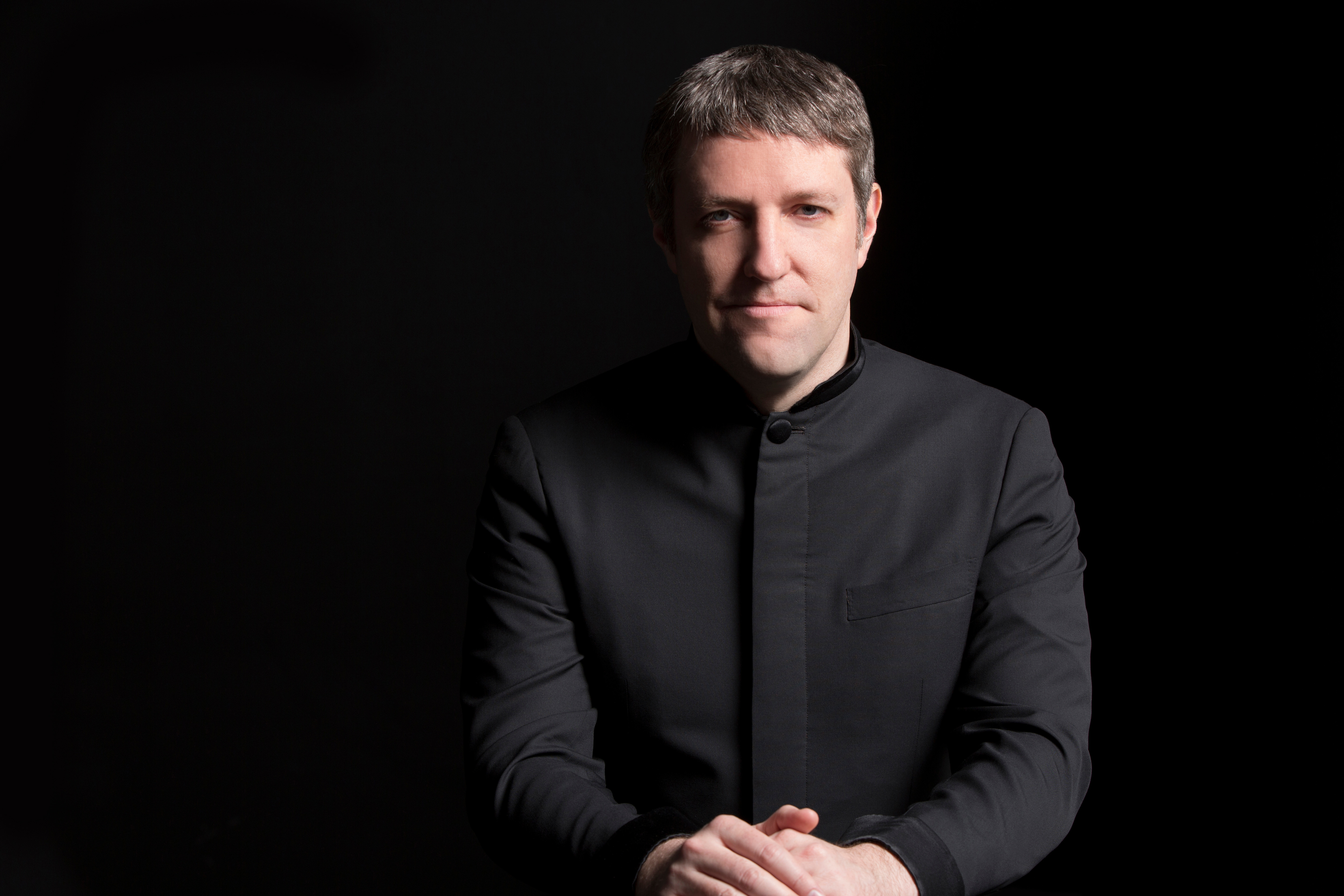
Yaniv Dinur. Photo courtesy of the Milwaukee Symphony Orchestra.
Four great players, often the focus of individual attention in these selections, offer an intense and intimate evening.
The Musaik concert scheduled for 3:30 p.m. on Sunday, January 11, has sold out. A second performance has been announced for 7:30 p.m. The Sharon Lynne Wilson Center may be found inside Brookfield’s Mitchell Park—south of Capitol Drive and west of Brookfield Road at 3270 Mitchell Park Dr. Tickets are available online.
The musicians of Milwaukee Musaik will next present “American Soundscapes: A 250th Celebration” on Monday, March 30th. This program celebrates 250 years of American classical vocal and instrumental style.

Existing members must be signed in to see the interactive map. Sign in.
If you think stories like this are important, become a member of Urban Milwaukee and help support real, independent journalism. Plus you get some cool added benefits.


Preview
-
Present Music Celebrates Hindu Festival
 Mar 16th, 2026 by Michael Barndt
-
Frankly Music Showcases Virtuoso Players
 Mar 10th, 2026 by Michael Barndt
-
Six Centuries of Secular Song
 Mar 3rd, 2026 by Michael Barndt