

Making Sense of Judge Dugan’s Conviction
Did her lawyers blow it? Was the 'safety' of ICE agents really an issue?
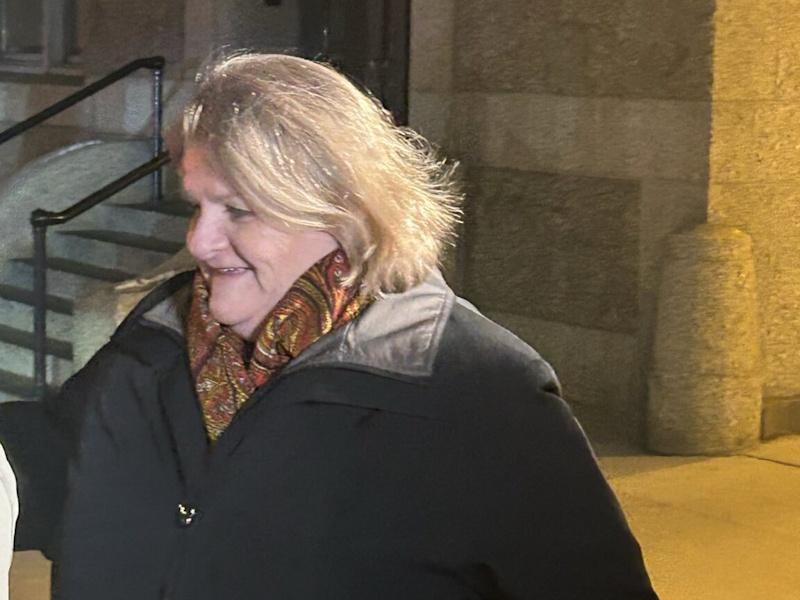
Judge Hannah Dugan leaves court in her federal trial, where she was convicted of a felony for obstructing immigration officers. (Photo by Isiah Holmes/Wisconsin Examiner)
According to the Eastern District of Wisconsin’s Interim U.S. Attorney Brad Schimel, freshly appointed to his position by President Donald Trump, the federal trial of Milwaukee Judge Hannah Dugan had nothing to do with politics. “There’s not a political aspect to it,” Schimel told reporters after Dugan’s felony conviction on charges she obstructed U.S. immigration agents as they tried to make an arrest inside the Milwaukee courthouse. “We weren’t trying to make an example out of anyone,” Schimel said. “This was necessary to hold Judge Dugan accountable because of the actions she took.”
Schimel didn’t say whether Dugan’s very public arrest and perp walk through the courthouse was also necessary, along with the social media posts by Trump’s FBI director Kash Patel and Attorney General Pam Bondi, crowing about the arrest and sharing photos of Dugan in handcuffs.
There is no doubt that the Dugan case was highly political from the start.
As a coalition of democracy and civic organizations in Wisconsin declared in a statement after the verdict, Dugan’s prosecution threatens the integrity of our justice system and “sends a troubling message about the consequences faced by judges who act to protect due process in their courtrooms.”
But Schimel is right about one thing: Dugan’s trial this week was mainly about “a single day — a single bad day — in a public courthouse.”
That narrow focus helped the prosecution win a conviction in a confusing mixed verdict. The jury found Dugan not guilty of a misdemeanor offense for concealing Eduardo Flores-Ruiz, the defendant she led out a side door while immigration agents waited near the main door of her courtroom to arrest him. At the same time, the jury found Dugan guilty of the more serious charge of obstructing the agents in their effort to make the arrest. The two charges are based on some of the same elements, and Dugan’s defense attorneys are now asking that her conviction be overturned on that basis.
An observer watching the trial from afar with no inside knowledge of the defense strategy might wonder why Dugan’s defense team didn’t enter a guilty plea on the misdemeanor charge and then strongly contest the felony obstruction charge as an outrageous overreach in a heavily politicized prosecution. That might have led to a more favorable mixed verdict, in which the jury found that Dugan was probably guilty of something, but that it did not rise to the level of a felony with a potential penalty of five years in prison.
I’m no expert, but daily reports from the trial this week gave me the strong impression that things weren’t going well for Dugan as long as witnesses and lawyers focused on a blow-by-blow account of the events of April 18. Witness testimony described an agitated Dugan, whose colleague, Judge Kristela Cervera, testified — damagingly — that she was uncomfortable with how Dugan managed the federal agents she was outraged to find hanging around outside her courtroom.
It’s not surprising that the jury agreed with the prosecution that Dugan was not cooperative and that she wanted to get Flores-Ruiz out of her courtroom in a way that made an end-run around the unprecedented meddling of federal immigration enforcement inside the courthouse. Like other judges and courthouse staff, she was upset about the disruption caused by ICE agents stalking people who showed up to court.
But, as Dean Strang, a law professor at Loyola University Chicago School of Law and a long-time Wisconsin criminal defense lawyer, told me in April just before he joined the defense team and stopped talking about the case to the press, “Whatever you think of the actual conduct the complaint alleges, there is a real question about whether there’s even arguably any federal crime here.”
The government’s behavior was “extraordinarily atypical” for a nonviolent, non-drug charge involving someone who is not a flight risk, Strang added.
The handcuffs, the public arrest at Dugan’s workplace, the media circus — none of it was normal, or justified. When Bondi and Patel began posting pictures of Dugan in handcuffs on social media to brag about it, “what is it they are trying to do?” Strang asked. His conclusion: “Humiliate and terrify, not just her but every other judge in the country.”
The Wisconsin Democracy Campaign, Voces de la Frontera, and Common Cause-Wisconsin agree with that assessment, writing in their statement reacting to the conviction that Dugan’s felony conviction threatens the integrity of our justice system as a whole, and undermines the functioning of the courts by scaring away defendants, witnesses and plaintiffs who are afraid they might be arrested if they show up to participate in legal proceedings.
But that big picture perspective was not a major feature of the defense’s closing arguments, which relied heavily on raising reasonable doubt about Dugan’s intentions and her actions during a stressful and chaotic day.
That’s frustrating because, contrary to Schimel’s assertions, the big picture, not the events of “a single bad day” is what was actually at stake in this case.
One of the most distressing aspects of the Dugan trial was the prosecution’s through-the-looking-glass invocation of the rule of law and the integrity of the courts.
The federal agents called to the stand, the prosecutors in the courtroom, and Schimel, in his summary of the case, made a big point about the “safety” of law enforcement officers.
Repeatedly, we heard that immigration agents prefer to make arrests inside courthouses because they provide a “safe” environment in which to operate.
In his comments on the verdict, Schimel emphasized that Dugan jeopardized the safety of federal officers by causing them to arrest Flores-Ruiz on the street instead of inside the courthouse: “The defendant’s actions provided an opportunity for a wanted subject to flee outside of that secure courthouse environment,” Schimel said.
This upside-down view of safety has become a regular MAGA talking point, with Republicans claiming that when citizens demand that masked agents identify themselves or make videos of ICE dragging people out of their cars, they are jeopardizing the safety of law enforcement officers — as opposed to trying to protect their neighbors’ safety in the face of violent attacks by anonymous thugs.
Churches, day care centers and peaceful suburban neighborhoods are also “safe” environments for armed, masked federal agents. But their activities there are making our communities less safe.
Assistant U.S. Attorney Kelly Brown Watzka, delivering the prosecution’s closing argument, told the jury it must draw a line against judges interfering with law enforcement, or else “there is only chaos,” and that “chaos is what the rule of law is intended to prevent.”
But chaos is what we have now, with federal agents terrorizing communities, dragging people out of courthouses and private residences, deporting them without due process and punishing those who stand in their way in an attempt to defend civil society.
The real questions raised by Dugan’s case are whether we believe the “safety” of the agents making those dubious arrests matters more than the safety of our communities, and whether we want the courts to be able to regulate the conduct in their own courthouses as a check on the government’s exercise of raw power.
Making sense of the trial and felony conviction of a Milwaukee judge who stood up to ICE was originally published by the Wisconsin Examiner.
Ruth Conniff is Editor-in-chief of the Wisconsin Examiner.
If you think stories like this are important, become a member of Urban Milwaukee and help support real, independent journalism. Plus you get some cool added benefits.
More about the Courthouse ICE Arrests
- Judge Hannah Dugan Resigns - Sarah Lehr - Jan 4th, 2026
- Hannah Dugan Seeks New Trial - Graham Kilmer - Dec 23rd, 2025
- Op Ed: Making Sense of Judge Dugan’s Conviction - Ruth Conniff - Dec 22nd, 2025
- After Dugan Verdict Comes Politics and Courthouse Uncertainty - Graham Kilmer - Dec 21st, 2025
- Wisconsin Republicans Threaten to Impeach Judge Hannah Dugan - Anya van Wagtendonk - Dec 20th, 2025
- Forward Latino Corrects Misinformation Presented During Judge Hannah Dugan Trial - Forward Latino - Dec 19th, 2025
- United States Thanks Jurors for Their Service and Urges Peaceful Response to Verdict - U.S. Department of Justice - Dec 19th, 2025
- Dugan Must Go - Wisconsin Assembly Speaker Robin Vos - Dec 19th, 2025
- A Dangerous Precedent - Press Release - Dec 19th, 2025
- Verdict Against Judge Dugan Threatens Due Process and Judicial Independence - Voces de la Frontera - Dec 19th, 2025
Read more about Courthouse ICE Arrests here
More about the Judge Hannah Dugan Trial
- Judge Hannah Dugan Resigns - Sarah Lehr - Jan 4th, 2026
- Hannah Dugan Seeks New Trial - Graham Kilmer - Dec 23rd, 2025
- Op Ed: Making Sense of Judge Dugan’s Conviction - Ruth Conniff - Dec 22nd, 2025
- After Dugan Verdict Comes Politics and Courthouse Uncertainty - Graham Kilmer - Dec 21st, 2025
- Wisconsin Republicans Threaten to Impeach Judge Hannah Dugan - Anya van Wagtendonk - Dec 20th, 2025
- Forward Latino Corrects Misinformation Presented During Judge Hannah Dugan Trial - Forward Latino - Dec 19th, 2025
- United States Thanks Jurors for Their Service and Urges Peaceful Response to Verdict - U.S. Department of Justice - Dec 19th, 2025
- Dugan Must Go - Wisconsin Assembly Speaker Robin Vos - Dec 19th, 2025
- A Dangerous Precedent - Press Release - Dec 19th, 2025
- Verdict Against Judge Dugan Threatens Due Process and Judicial Independence - Voces de la Frontera - Dec 19th, 2025
Read more about Judge Hannah Dugan Trial here


Op-Ed
-
Wisconsin’s Utility Energy Crisis
 Mar 1st, 2026 by Isaiah Ness
-
Pete Buttigieg Comes to La Crosse
 Jan 20th, 2026 by Ruth Conniff
-
Trump Administration Has Abandoned Local Governments
 Dec 28th, 2025 by Sup. Jack Eckblad

















Writing of this quality should spur many into supporting this publication.
I hope Judge Adelman makes the correct ruling as a federal judge and dismisses all charges against this State judge. Judge Dugan is the sole authority for Br 31. Shimmel (having been funded by both DOGE and MAGA money) has no credibility claiming none of Dugan’s charges or trial were political after being forced to do a Perp walk and jailed while the convicted felon we call President was given all the courtesies of scheduling his own arraignment and never saw the inside of a cell, ICE agents should not be allowed to obstruct state courts
I’ve been watching a series of documentaries about the resistance movements in occupied Europe during WWII. There have two recurring themes in the series that I believe have bearing on the Dugan trial. (1) The resistance forces were made up of ordinary people responding to the evil that was around them. (2) Each member of the resistance knew the consequences of defying the Nazis, death if they were caught.
I believe Judge Dugan responded to the evil–ICE agents invading the courthouse–knowing the consequences of defying ICE, the current administration’s gestapo.
Courage is doing what is right–not necessarily what is legal–knowing the consequences but doing it anyways.
There is no place in our courthouses for masked, quasi military forces threatening those on the administration’s hit list. Our courts must be accessible to ALL who seek justice and their day in court. ICE agents are NOT law enforcement. They are not upholding laws. Like the Gestapo during WWII, ICE agents are thugs employed by HWSNBN to enforce his “Final Solution.”