

Fellow Judge Testifies in Dugan Case
Circuit Court Judge Kristela Cervera helps support federal criminal case against Judge Hannah Dugan.
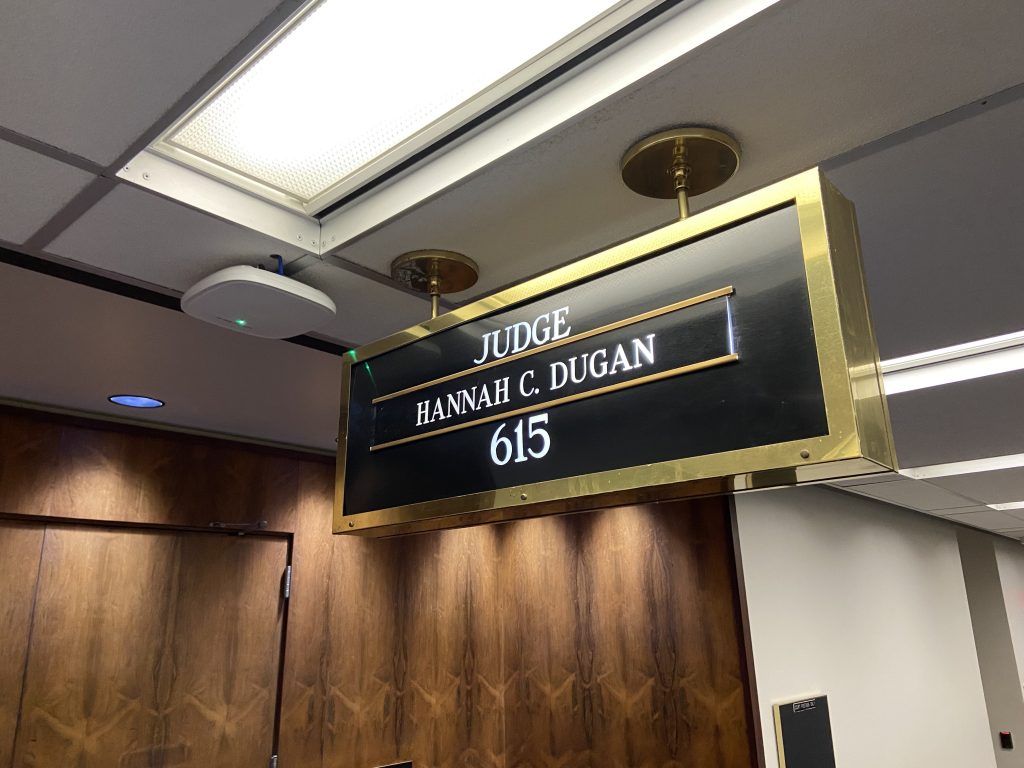
Judge Hannah Dugan’s courtroom on the sixth floor of the Milwaukee County Courthouse. Photo taken by Graham Kilmer.
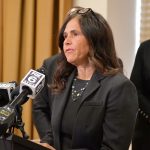
The federal government called eight witnesses Tuesday in its criminal prosecution of Milwaukee County Circuit Court Judge Hannah Dugan, including a fellow circuit court judge who suggested Dugan may have known who ICE was targeting.
Dugan is charged with obstructing an U.S. Immigration and Customs Enforcement (ICE) operation and concealing an individual from arrest on April 18. The target of the arrest operation, Eduardo Flores-Ruiz, was appearing on misdemeanor criminal charges in Dugan’s courtroom.
The federal government is attempting to prove Dugan knowingly took actions that would disrupt the ICE agents from arresting Flores-Ruiz. After ICE appeared in the hallway outside her courtroom that day, Dugan rescheduled Flores-Ruiz’s case off the record and let him out of her courtroom using a door reserved for jury members and court staff. The door also leads to the public hallway, where ICE agents were waiting.
Dugan’s defense attorneys, on the other hand, are questioning witnesses to back up their argument that Dugan was trying her best to respond to difficult circumstances, that previous ICE arrests in the courthouse left court officials concerned and confused about how to respond, and that Dugan was following a “draft policy” for responding to ICE operations in the courthouse that was being developed by her superior, Chief Judge Carl Ashley, with input from an ICE official who was a superior to the agents conducting the operation that day.
During roughly seven hours of testimony, prosecutors from the U.S. Attorney’s Office called up federal agents from the FBI, Customs and Border Protection (CBP), Immigration and Customs Enforcement (ICE), a Milwaukee County Sheriff‘s Office (MCSO) deputy, an employee of the Milwaukee County District Attorney’s Office and Circuit Court Judge Kristela Cervera.
During her testimony, Cervera offered the first suggestion that Dugan knew federal agents were there to arrest Flores-Ruiz. The federal government has attempted to Dugan knew why agents were there, and that she knowingly obstructed an arrest and concealed Flores-Ruiz with the purpose of preventing his arrest.
Cervera’s court room is located adjacent to Dugan’s in the Milwaukee County Courthouse. Dugan pulled Cervera out of her courtroom after learning ICE was in the hallway and told Cervera to leave her robes on and that they were going to check a warrant. As Dugan briskly walked toward the public hallway, Cervera testified, “I heard the name, something about Flores.”
Cervera would go on to testify that remaining in judicial robes in the public hallway was unusual, and that it made her uncomfortable. She also said Dugan’s demeanor seemed “urgent” and “irritated” and, later, when speaking to ICE, “Her irritation seemed to progress into anger.”
Throughout the trial Tuesday, federal prosecutors asked witnesses to testify to Dugan’s demeanor. CBP Officer Joseph Zuraw testified that Dugan was “visibly upset.” ICE Deportation Agent Joseph Vasconcellos said Dugan seemed “very stern and upset.”
Vasconcellos was the agent Dugan and Cervera approached to ask whether agents had a judicial warrant. When he said it was an administrative warrant, Cervera said Dugan responded, “It has to be a judicial warrant, it has to be a judicial warrant, it has to be a judicial warrant.”
Dugan then directed the agents to Chief Judge Ashley’s office. Vasconcellos did not know where the office was, so Cervera accompanied him. Ashley wasn’t there and while his receptionist called him on the phone, Cervera looked at the administrative warrant.
To get back to her courtroom, Cervera walked through Dugan’s courtroom. She saw Dugan back on the bench.
“I was irritated at that point, because I felt abandoned and because she was able to get back to her calendar after she pulled me out of my court,” Cervera said.
Later that day a state public defender came into Cervera’s courtroom and pumped his fist, apparently thinking she had acted in support of Dugan. She testified that another state public defender told her “You’re GOAT-ed now,” a reference to the “greatest of all time.”
Another state public defender, Maura Gingerich, approached Cervera that day to tell her that Flores-Ruiz had been arrested. Cervera testified that Gingerich told her, “Because we know what you guys were trying to do.”
A few days later, Cervera said Deputy Chief Judge Jane Carroll told her the FBI was investigating because Dugan sent Flores-Ruiz down the private hallway. Cervera said she was “shocked” by this. When Assistant U.S. Attorney Kelly Watzka asked her why, she answered, “Judges shouldn’t be helping defendants evade arrest.”
Cervera also said she was “mortified” by the possibility that someone thought she was involved in sending Flores-Ruiz down the restricted hallway.
In a rapid fire cross-examination, Attorney Steven Biskupic brought Cervera to say that, under “unique” circumstances she would let a defendant use a restricted hallway, and that she never told Dugan her concerns about wearing robes or confronting ICE agents.
Frohling asked her if her interaction with Vasconcellos was pleasant. Cervera said it was. Frohling asked her if she googled him afterward. She said she did. He also brought her to admit that she texted her sister, who is a defense attorney, warning her that ICE was at the courthouse because she may have clients who could be targets.
Frohling asked Cervera why she didn’t mention texting her sister when she testified before the grand jury that ultimately indicted Dugan on federal criminal charges. “It was just a text message I didn’t think anything of it,” she said.
State Public Defender Photographs ICE Agents
Federal agents involved with the operation at the courthouse testified Tuesday that courthouse security knew they were there. ICE and CBP agents said they showed security their badges and told them they were there to make an arrest.
Their presence was kicked up the chain of command. There were questions about whether they needed a courthouse escort. An MCSO sergeant decided they didn’t. CBP Agent Zuraw said Dugan’s bailiff informed him that he did not tell the judge they were there.
However, agents were not inconspicuous on the sixth floor of the courthouse. During both days of the trial now, testimony and video evidence has suggested Gingerich, a state public defender, spotted the federal agents and took photos of them.
When Vasconcellos realized photos were being taken, he texted FBI Agent Jeffrey Baker saying the operation “is gonna be a pain in the dick.”
Vasconcellos’ gruff foreboding came true when Dugan arrived in front of him and asked whether he had a judicial warrant.
Federal Agents Testify
A bulk of the testimony provided Tuesday came from federal agents involved in the Enforcement and Removal Operation (ERO) at the courthouse.
Federal prosecutors — Deputy U.S. Attorney Richard G. Frohling and Assistant U.S. Attorneys Keith Alexander and Kelly Brown Watzka — questioned agents about the routine paperwork and processes involved in initiating and carrying out the immigration arrest at the courthouse. Prosecutors repeatedly asked about the same documents or protocols, so much that the defense began objecting on grounds they were needlessly repeating the same points about routine processes. Adelman agreed, “Counsel, we’ve been over this,” he said at one point.
But given an opportunity to cross-examine, Dugan’s defense sought to draw out testimony undercutting the routine nature of their operation.
Attorneys Jason Luczak and Nicole M. Masnica variously asked agents if they were aware that previous ICE arrests had caused a public furor and generated significant publicity. FBI Special Agent Phillip Jackling testified that he was unaware of any tension at the courthouse related to ICE operations. DEA Agent Brian Ayers later testified that he was aware of media attention and that it was in response to courthouse arrests.
Three agents on the ERO team were reassigned from other federal law enforcement duties to work on immigration enforcement in the early months of the Trump Administration. Jackling, an FBI agent, was reassigned from violent gang investigations; Baker was moved out of counterterrorism operations; and Ayers was on a rotating assignment from the DEA.
The defense also asked various agents why they didn’t arrest Flores-Ruiz at various points when he walked past them in the public hallway, or in the elevator. Agents testified to not wanting to arrest Flores-Ruiz one-on-one, as the agents became split up while Vasconcellos went to the chief judges office. Vasconcellos also noted that MCSO personnel had asked ICE not to arrest Flores-Ruiz until after his case hearing concluded.
Vasconcellos was the federal agent who spoke with Chief Judge Ashley on the phone. He testified that Ashley mentioned a “draft policy” for ICE operations at the courthouse.
If you think stories like this are important, become a member of Urban Milwaukee and help support real, independent journalism. Plus you get some cool added benefits.
More about the Courthouse ICE Arrests
- Judge Hannah Dugan Resigns - Sarah Lehr - Jan 4th, 2026
- Hannah Dugan Seeks New Trial - Graham Kilmer - Dec 23rd, 2025
- Op Ed: Making Sense of Judge Dugan’s Conviction - Ruth Conniff - Dec 22nd, 2025
- After Dugan Verdict Comes Politics and Courthouse Uncertainty - Graham Kilmer - Dec 21st, 2025
- Wisconsin Republicans Threaten to Impeach Judge Hannah Dugan - Anya van Wagtendonk - Dec 20th, 2025
- Forward Latino Corrects Misinformation Presented During Judge Hannah Dugan Trial - Forward Latino - Dec 19th, 2025
- United States Thanks Jurors for Their Service and Urges Peaceful Response to Verdict - U.S. Department of Justice - Dec 19th, 2025
- Dugan Must Go - Wisconsin Assembly Speaker Robin Vos - Dec 19th, 2025
- A Dangerous Precedent - Press Release - Dec 19th, 2025
- Verdict Against Judge Dugan Threatens Due Process and Judicial Independence - Voces de la Frontera - Dec 19th, 2025
Read more about Courthouse ICE Arrests here
More about the Judge Hannah Dugan Trial
- Judge Hannah Dugan Resigns - Sarah Lehr - Jan 4th, 2026
- Hannah Dugan Seeks New Trial - Graham Kilmer - Dec 23rd, 2025
- Op Ed: Making Sense of Judge Dugan’s Conviction - Ruth Conniff - Dec 22nd, 2025
- After Dugan Verdict Comes Politics and Courthouse Uncertainty - Graham Kilmer - Dec 21st, 2025
- Wisconsin Republicans Threaten to Impeach Judge Hannah Dugan - Anya van Wagtendonk - Dec 20th, 2025
- Forward Latino Corrects Misinformation Presented During Judge Hannah Dugan Trial - Forward Latino - Dec 19th, 2025
- United States Thanks Jurors for Their Service and Urges Peaceful Response to Verdict - U.S. Department of Justice - Dec 19th, 2025
- Dugan Must Go - Wisconsin Assembly Speaker Robin Vos - Dec 19th, 2025
- A Dangerous Precedent - Press Release - Dec 19th, 2025
- Verdict Against Judge Dugan Threatens Due Process and Judicial Independence - Voces de la Frontera - Dec 19th, 2025
Read more about Judge Hannah Dugan Trial here


MKE County
-
Jury Delivers Split Verdict in Dugan Trial
 Dec 18th, 2025 by Graham Kilmer
-
Attorneys Spar Over Dugan’s Intent, Evidence in Closing Arguments
 Dec 18th, 2025 by Graham Kilmer
-
Defense Rests in Dugan ICE Trial After Brief Case and Character Testimony
Dec 18th, 2025 by Graham Kilmer















Let’s remember her name, Kristela Cervera and make certain she does not get re-elected. We have to stand up to the gestapo tactics of ICE.