

Elections Commission Denies U.S. DOJ Demand for Voter Personal Information
'The commission is explicitly forbidden by Wisconsin law' to do this.
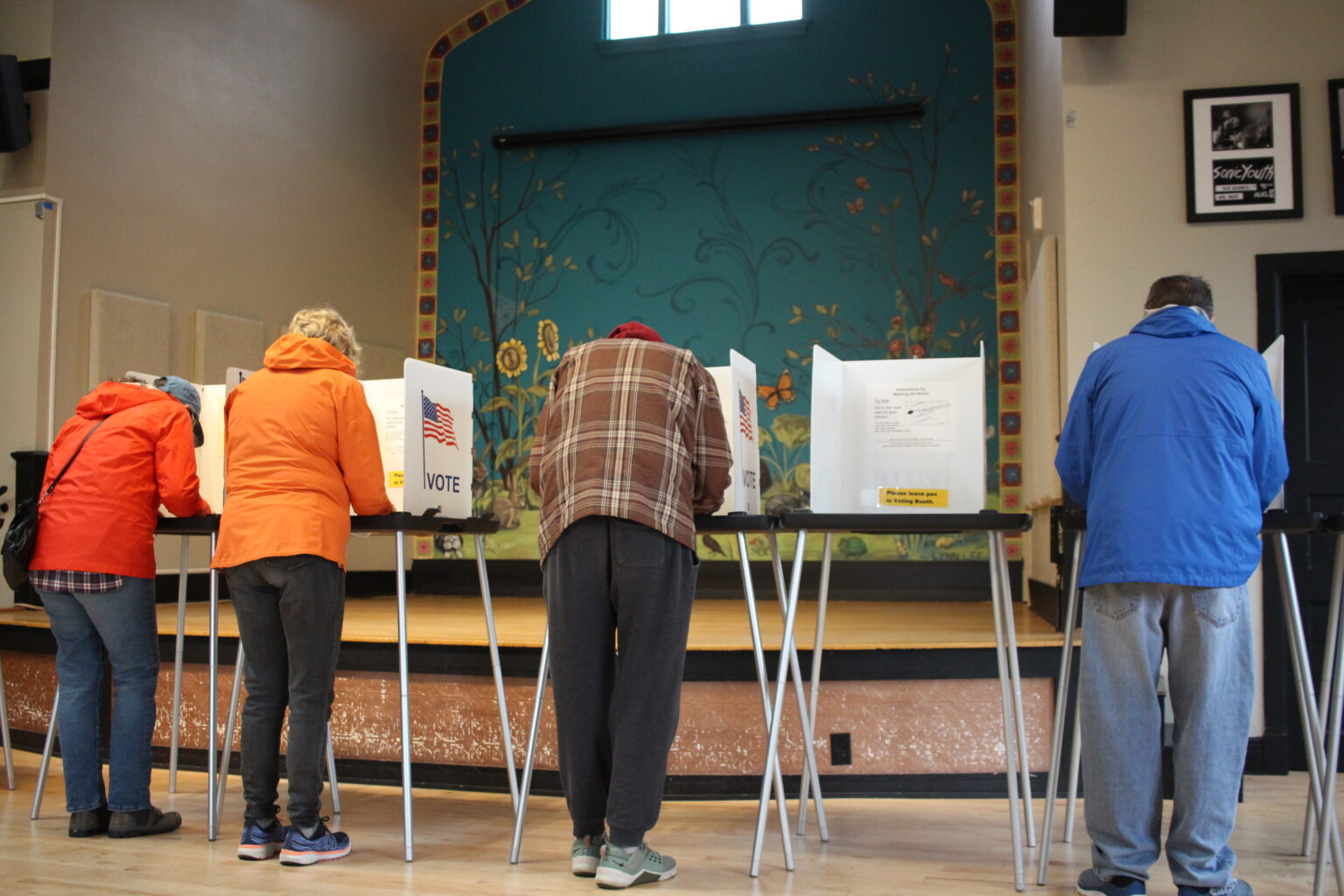
Voters at the Wilmar Neighborhood Center on Madison’s East Side cast their ballots. (Henry Redman | Wisconsin Examiner)
The Wisconsin Elections Commission on Thursday denied a demand from the U.S. Department of Justice for the state’s full voter registration list, including personally identifiable information such as dates of birth, driver’s licenses and Social Security numbers.
At a special meeting Thursday afternoon and in a letter sent in response to the DOJ demand, WEC stated that Wisconsin law explicitly prevents the commission from sharing the personal information of voters.
“The U.S. DOJ is simply asking the commission to do something the commission is explicitly forbidden by Wisconsin law to do,” commissioner Don Millis said.
This is the second time this year the DOJ has requested Wisconsin’s voter database. Both times, the department has been informed that Wisconsin state law requires that the commission charge a fee to obtain the list.Since the summer, the DOJ has requested the voter databases of several states — raising concerns over why the department is seeking massive amounts of voter data, especially as President Donald Trump has remained fixated on conspiracy theories that his 2020 election loss was rigged.
In its demand for the data, sent Dec. 2 as a “confidential memorandum of understanding” the department said it was seeking the data to check if Wisconsin is properly complying with the National Voter Registration Act and the Help America Vote Act.
“The Justice Department is requesting your state’s [Voter Registration List] to test, analyze, and assess states’ VRLs for proper list maintenance and compliance with federal law,” the memo states.
However the WEC response questions the authority with which DOJ is asserting its right to the records. For one, Wisconsin is exempt from the NVRA because it offers same-day voter registration at polling places. Also, WEC wrote in its response letter that HAVA does not grant the DOJ access to confidential voter data.
Compliance with HAVA and the thoroughness of states’ compliance with voter list maintenance requirements have become regular talking points among Republicans who say they’re concerned that there are thousands of people who have active voter registrations when they should be ineligible to vote because they’ve moved, died or otherwise are unable to cast a ballot.
The sources of those complaints include the Wisconsin Institute for Law & Liberty, a right-wing law firm that in October sent a letter to the DOJ asking for the department to assess Wisconsin’s compliance with HAVA.
WEC has said repeatedly that the commission and Wisconsin’s municipal election clerks are properly maintaining the voter rolls. They’ve also noted that the concerns are often overstated because even if a voter is ineligible and their file is deactivated in the database, their name will still appear in the system.
“The joint effort between state and local election officials enhances the integrity of the system by ensuring responsibilities are distributed across thousands of officials in every city, village, and town, rather than concentrated among a small handful of state employees in the Capitol,” the WEC response letter states. “The vast majority of list maintenance work consists of routine updates, and the processes also serve to identify attempts at wrongdoing. Each year, Wisconsin election officials at all levels of government identify and refer to criminal prosecution: felons attempting to vote, double voters, non-citizens, and others trying to circumvent election law.”In the WEC decision to deny DOJ’s request as well as to release the DOJ memo and the response letter, Republican commissioner Bob Spindell was the lone vote against. Spindell pointed to a provision of state law that allows WEC to share restricted information in the voter database with law enforcement agencies. Spindell has often used his role on the commission to indulge conspiracy theories and cast doubt on the security of the election system.
“This is a highly, highly controversial issue throughout the country at this point in time, and my point of view is that this information can be released,” Spindell said. “I believe that through the HAVA Act, the federal government has the appropriate ability to see if we’re doing everything that’s correct and OK. I’ve talked forever about we need to have, in the state of Wisconsin, an independent audit, or whatever, of the registration list to satisfy the many individuals and groups and so forth that question it. And all HAVA is doing here, the federal government is asking for a chance to take a look at us.”
But commissioner Mark Thomsen said there is no way that a provision meant to help law enforcement find information about suspects in criminal investigations could be interpreted to mean WEC can give the personal information of every Wisconsin voter to the federal government.
“Our rights as commissioners are limited by the Fourth Amendment, by state law itself,” Thomsen said. “Mr. Spindel is just flat out wrong that this one provision that he relies on would allow us to legally give Wisconsin citizens’ private information off to someone for some unknown reason. It’s not just a person that’s suspected of a crime, it’s everybody, and Wisconsin has never stood for the proposition that any government is entitled to all this data anytime someone asked. So I think Bob, you’re just making up the law there.”Elections commission denies U.S. DOJ demand for voter personal information was originally published by the Wisconsin Examiner.
If you think stories like this are important, become a member of Urban Milwaukee and help support real, independent journalism. Plus you get some cool added benefits.




















No. Pure. Simple. Honest. Final.
No.
Keep saying it. It’s empowering.
WEC is following the 4th Amendment of the Constitution.
This Administration is using DOJ to interfere with Voters’ right to privacy.