

Senate Committee Debates ‘Community Solar’ Bill
Allowing private companies to construct small solar projects. Utilities oppose it.
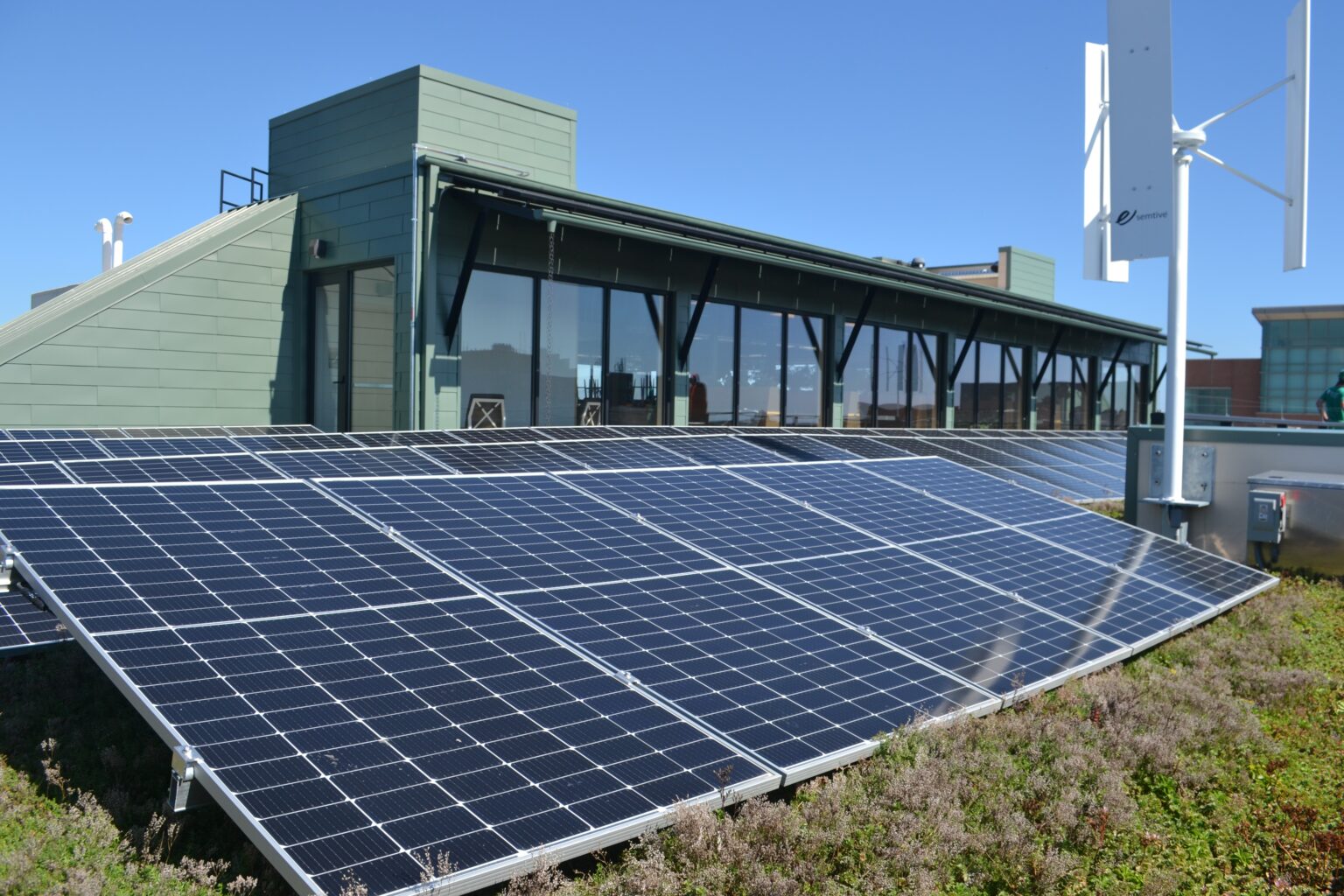
The roof of the Hotel Verdant in Downtown Racine is topped with a green roof planted with sedum and covered with solar panels. (Wisconsin Examiner photo)
A Wisconsin Senate Committee held a public hearing Tuesday on a bill that would allow private companies to construct small solar projects on underutilized farmland and commercial rooftops across the state.
The bill, which would encroach on the monopoly the state’s existing utility companies are allowed to maintain under state law, is being considered while people across the country worry about rising energy costs amid a boom in the construction of data centers and the increased use of electric vehicles and appliances.
Environmental groups in the state have also regularly complained that the utility companies aren’t constructing enough renewable energy projects or sunsetting existing coal and natural gas power plants quickly enough.
The bill, authored by Sen. Patrick Testin (R-Stevens Point) and Rep. Scott Krug (R-Nekoosa), would allow people in Wisconsin to subscribe to get some of their power from a local “community solar” installation. The subscribers would receive credits they can put toward their utility bill. Because the power developed at the local solar installation will still need to travel through the utility company’s infrastructure, the bill includes a provision that all subscribers to the program would have to pay at least $20 per month on their electric bill.
In the hearing of the Senate Committee on Transportation and Local Government, the bill’s authors said allowing community solar projects would increase people’s energy choices while allowing the expansion of solar power in the state that avoids the objections from local residents that often come with large, utility-scale solar projects.
“This change will open a new market sector in a high energy industry, attract economic investments in Wisconsin, create local jobs, drive innovation and competition, and ultimately save consumers and small businesses money on their energy bills,” Testin said.
But the authors also acknowledged there is still a lot of disagreement over the details and the bill is not yet in its final form.
“We’re not exactly there yet. We’re not all agreeing on this being the best way forward just yet, but this public hearing is a really important step to vet that out a little bit more to get us closer to that answer,” Krug said. “So yes, there are still some kinks to work out between the utilities and individuals who want a more market-based approach to solar. I hope we can work through those issues here.”
Over the hearing’s three and a half hours, the testimony split among two groups — the utility companies who are opposed to the bill and a coalition of solar companies, economists, farmers and employers who are in favor.
The utility companies accused the bill of creating a “shell game” that would lower the costs for the subscribers of a given project while raising electric bills for everyone else. Zack Hill, testifying on behalf of Alliant Energy, said the utility estimated that community solar would result in an additional $8.75 billion in costs for ratepayers over the next 25 years.
“How does [the bill] pay for subscribers 10 to 20% energy savings? The short answer: It will shift costs to your other constituents,” Hill said. “Some have said this sounds like community solar voodoo economics, but all you have to remember is this, when a company promises you a discount, someone else has to pay for it.”
People in favor of the bill argued that the generation of more energy could only help lower energy costs while disputing the utility companies’ claims. Will Flanders, the research director at the conservative Wisconsin Institute for Law and Liberty, also said the utilities’ estimates undervalue the benefits that community solar can add.
“This is a model that expands energy choice without large subsidies, without mandates, without turning more power over to monopoly utilities,” Flanders said. “In fact, it introduces competition at a time when Wisconsin needs it the most.”
“We argue that community solar can deliver net savings to the entire system,” he continued. “When we talk about a shell game, what we’re really saying is there’s no real additional resources being put into the system, but obviously there is additional resources being put in when we have these with these programs in place.”
Karl Rabago, a Denver-based energy consultant who testified with Flanders, said that the Alliant $8.75 billion estimate amounted to a threat that if the utilities don’t get to sell the energy, they’ll charge consumers for that loss.
“No one knows where this number comes from, but having seen how utilities make their case in other states, I am 99.9% confident they are basically saying, ‘If we don’t get to make the electricity and sell it, we could potentially lose $8.75 billion and and if we don’t make that money, we’re going to charge you for it anyway,’ and that’s how customer costs could go up,” Rabago said. “That’s the most likely explanation for a histrionic number. The utility position, to summarize, seems to sound a bit like ‘let us do it all and no one gets hurt.’ We’ve heard those kinds of exhortations. Monopolies do it particularly well.”
Toward the end of the hearing, a number of Wisconsin property owners testified, touting the benefits they’ll receive if they’re able to allow solar projects to be constructed on their land.
Duane Hinchley, a Cambridge dairy farmer, said community solar is an “innovative solution” that can give farmers a stable income to hedge against the risks in the agriculture business. Plus, he said, allowing farmers to participate will prevent land that has been farmed for generations from being developed into subdivisions.
“With the right policies in place, our state’s proud agricultural heritage can be a cornerstone of Wisconsin’s clean energy future,” Hinchley said.
But throughout the day, lawmakers from both parties appeared skeptical of the bill’s benefits.
Sen. Van Wanggaard (R-Racine) said repeatedly he didn’t understand how the program would work for the utility companies.
“It sounds like a shell game to me,” he said. “I just, I’m really having a challenge with trying to figure out how that would work, because it would seem to me that the energy company, the regulated company, is the one that’s going to be footing the bill for this.”
Sen. Mark Spreitzer (D-Beloit) questioned how the program wouldn’t eventually raise energy costs for non-participants, but said one selling point for the bill was that it would encourage the increased development of renewable energy.
“I heard you say this is going to force more solar to be built, whether or not you need it,” Spreitzer said to a utility company representative. “And I guess that, to me, is the one selling point of the bill. Is that I look at where we’ve been in the landscape lately, where we have, unfortunately, federal incentives for solar that are going away. We have increasing demand for power from data centers. We’re seeing new natural gas plants get built. We’re seeing coal plants not being retired, when we hoped they would. To me, there’s plenty of need for solar.”
If the utility companies won’t support a community solar proposal, Spreitzer wondered, what do they need from the Legislature to encourage more solar development?
“And so if we’re not going to go down this route, what are the incentives that you all need to make sure that we can continue to drive solar development without increasing rates for customers and without saying, ‘let’s go build a natural gas plant instead?” he asked.
Anti-rights of nature bill
Also on Tuesday, the committee heard testimony on a bill from Sen. Steve Nass (R-Whitewater) that would prohibit local governments in Wisconsin from enacting “rights of nature” ordinances, which grant natural elements legal rights that can be protected in court.
Nass said in his testimony that the idea is anti-American and is contrary to the values of the U.S. Constitution.
“This is a radical departure from our current law. Rights are something that human beings have,” Nass said. “This concept of granting nature rights is something that has been done primarily in foreign countries … and many of these countries lean dramatically towards socialism and communism, and their attitude is not compatible with private property rights in our country.”
But proponents of rights of nature resolutions frequently point to the fact that corporations are granted rights under U.S. law. Communities including Green Bay and Milwaukee have passed or begun drafting rights of nature ordinances and some Democratic lawmakers have introduced a bill that would grant Devil’s Lake State Park some rights that can be protected in court.
In a statement after the hearing, Rep. Vincent Miresse (D-Stevens Point), one of the co-authors of the Democratic proposal, wrote, “As we heard from advocates today, Rights of Nature is one of the strongest tools local governments have to protect clean air, clean water and healthy soil for future generations — so that our grandchildren, and their children after them, can drink our waters, eat food grown in our soils, and hunt in our forests.”
Wisconsin Senate committee hosts heated debate on community solar, ‘rights of nature’ was originally published by the Wisconsin Examiner.
If you think stories like this are important, become a member of Urban Milwaukee and help support real, independent journalism. Plus you get some cool added benefits.




















I can’t believe I agree with WILL for once….