
Milwaukee Legislators Draft Bills to Improve State Prison Conditions
16 bills range from rights to sunlight to county-control of jails.
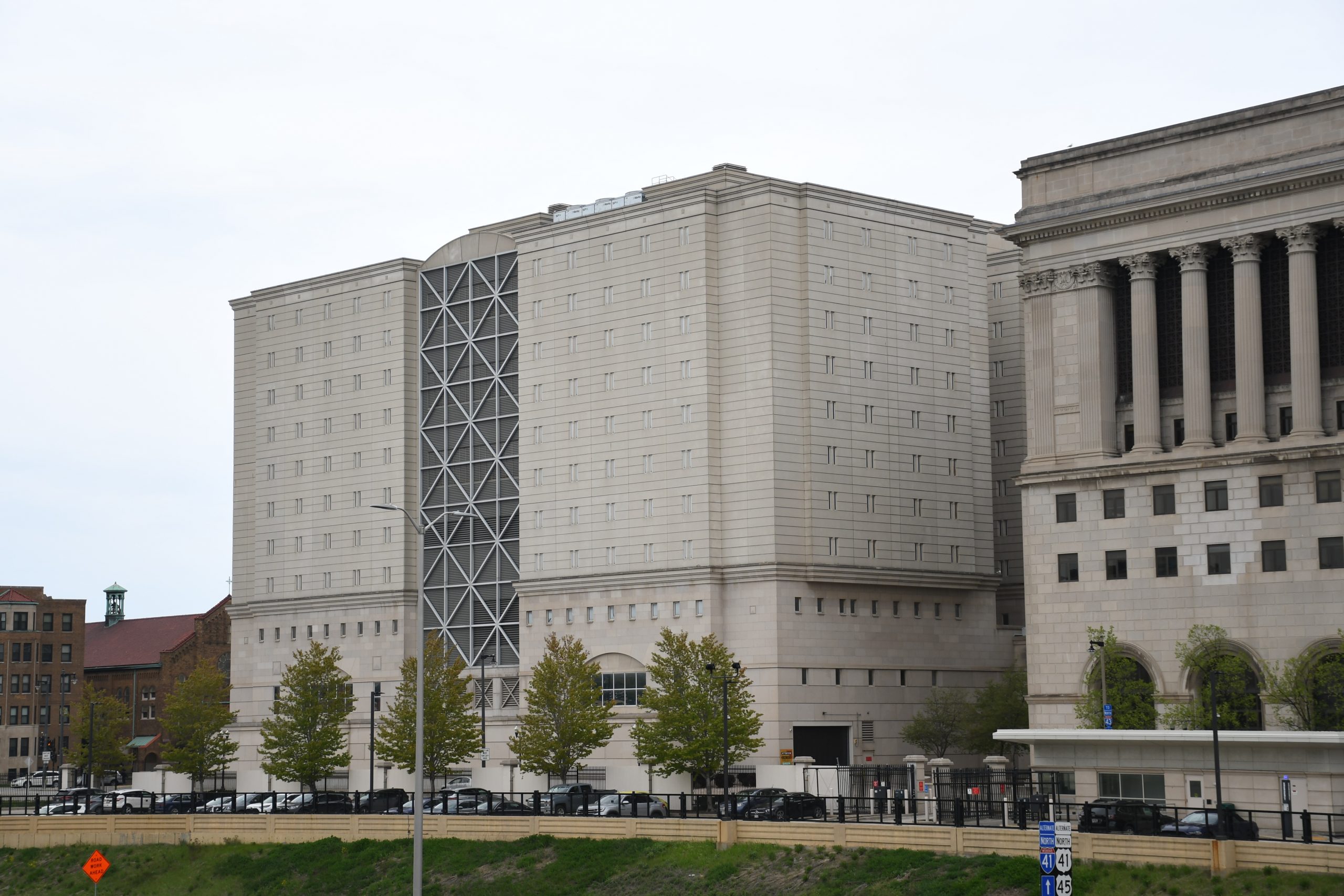
Milwaukee County Jail. File photo by Jeramey Jannene.
A group of state legislators unveiled a package of bills Monday seeking to improve conditions in state prisons and county jails.
The conditions of confinement bill package includes 16 pieces of legislation covering a wide array of issues, including some measures intended to ensure access to things as simple as regular showers with hot water or sunlight. The legislation was drafted, in part, in response to interviews with people currently incarcerated and feedback from former inmates.
The bills were announced Monday on the steps of the Milwaukee County Courthouse by a coalition of Milwaukee-area elected officials including State Reps. Darrin Madison Jr., Ryan Clancy, Sequanna Taylor, Kalan Haywood, Margaret Arney, State Sen. Chris Larson and County Supervisor Justin Bielinski. Officials were joined by representatives of Ex-Incarcerated People Organizing (EXPO), the ACLU of Wisconsin and the Milwaukee Alliance Against Racist and Political Repression (MAARPR).
Andron Lane, a Milwaukee resident who spent 20 years in the state prison system, described the package of bills as “our own small constitution” guaranteeing some level of basic human dignity for people in state prisons and county jails.
The package of bills would create a set of new requirements correctional facilities must follow, and statutory rights for people that are incarcerated. The latest biennial state budget spends approximately $4 billion on corrections.
The bills would require prisons and jails to provide free phone calls and access to in-person visitation, access to hygiene and feminine products, structured programming and recreation. People placed in solitary confinement would have a legal right to personal items and hygiene products, programming, communication and case management within a specific time frame. Correctional facilities would need to maintain climate control systems, provide access to sunlight and the outdoors. Correctional facilities would also be required to publicly report the number of people in solitary confinement and disaggregated data on complaints. State legislators with committee oversight of the Department of Corrections (DOC) would have access to correctional facilities. And county boards would be able to vote to take over control of a jail from a county sheriff.
“Let me be clear, the conditions in Wisconsin’s correctional facilities are not simply unfortunate, they are unacceptable,” Madison said, adding that the bill package was asserting “people who are incarcerated deserve basic human rights.”
A number of the bills would codify in state law policies that the state DOCs could institute without legislative action, Clancy said. Others will require additional funding, to provide for things like hygiene products or facility improvements. Some of the bills were drafted in direct response to visits to prisons and jails across the state, Clancy said.
“When we heard ‘I just want to see the sky and I just want to be outside once this year’ we legislated windows,” Clancy said.
When people come out of these facilities, they should be “on a trajectory for success,” Larson said. Officials and advocates both noted that a bills requiring access to communications and visitation are important policies for tackling recidivism.
“The very thing that reduces recidivism is treated like a privilege instead of a right,” Madison said.
The system, as it exists today, does not treat people humanely, and this does not lower recidivism or help them succesfully transition back to the community, the legislators noted.
“Unfortunately, the way that we have this set up is a broken quote-unquote tough on crime idea that once you touch the criminal justice system, it is cruel to you, it diminishes you, and it never lets you go,” Larson said.
For Lane, the bills represent an effort to return a “degree of dignity” to the people facing isolation and indignity every day in the prison system.
“This is not about being soft on crime,” he said. “It’s about being strong on humanity.”
One bill would allow county boards to vote to take over control of a county jail. In Milwaukee County, the sheriff has unique autonomy in setting jail policy. The county board does not have the authority to pass binding legislation that requires the sheriff to change a policy within the Milwaukee County Jail.
“We cannot force change inside of that facility, and so we do need state legislation to help us with that,” said Bielinski, who chairs the county board’s Committee on Judiciary, Law Enforcement and General Services.
The bill would require an amendment to the Wisconsin State Constitution. To amend the constitution a measure must be passed by the state Legislature twice: once each during two consecutive legislative sessions. It must then be approved by a majority of Wisconsin voters during a statewide referendum.
However, the other bills are also likely to face a challenge in the Republican-controlled Legislature. It is the second time a bill package taking on these issues has been drafted. The bills did not receive a hearing during the last session. Former state representative Michael Schraa was the chairman of the Committee on Corrections then and said the bills were sunk because Democrats did not work with Republicans on them. “That’s not the way that things work here. The majority party brings these bills forward, and if they’re bipartisan bills, they get hearings,” Schraa said in 2024.
Clancy told Urban Milwaukee that some of his Republican colleagues have expressed support for bills in the package, but that Republican leadership will likely determine whether they get a hearing.
“Ultimately, everything comes down to [Assembly Speaker] Robin Vos,” Clancy said. “If Robin Vos wants something to get a hearing, it will. If he doesn’t want it, it won’t.”
Legislation Link - Urban Milwaukee members see direct links to legislation mentioned in this article. Join today
If you think stories like this are important, become a member of Urban Milwaukee and help support real, independent journalism. Plus you get some cool added benefits.


MKE County
-
Incumbents Sweep County Board Elections
 Apr 7th, 2026 by Graham Kilmer
-
Federal Judge Won’t Vacate Dugan Conviction
 Apr 6th, 2026 by Graham Kilmer
-
Sup. Vincent Faces Challenge in Heated Race for District 11
 Apr 6th, 2026 by Graham Kilmer