EnglishEspañolDeutschБългарски
Follow Urban Milwaukee on Twitter Like Urban Milwaukee on Facebook Subscribe to Urban Milwaukee via email Subscribe to Urban Milwaukee via RSS

Next Up? E. Wells Street

Sep 29th, 2010 | By | Category: Cathedral Square, Department of Public Works, East Town, Feature

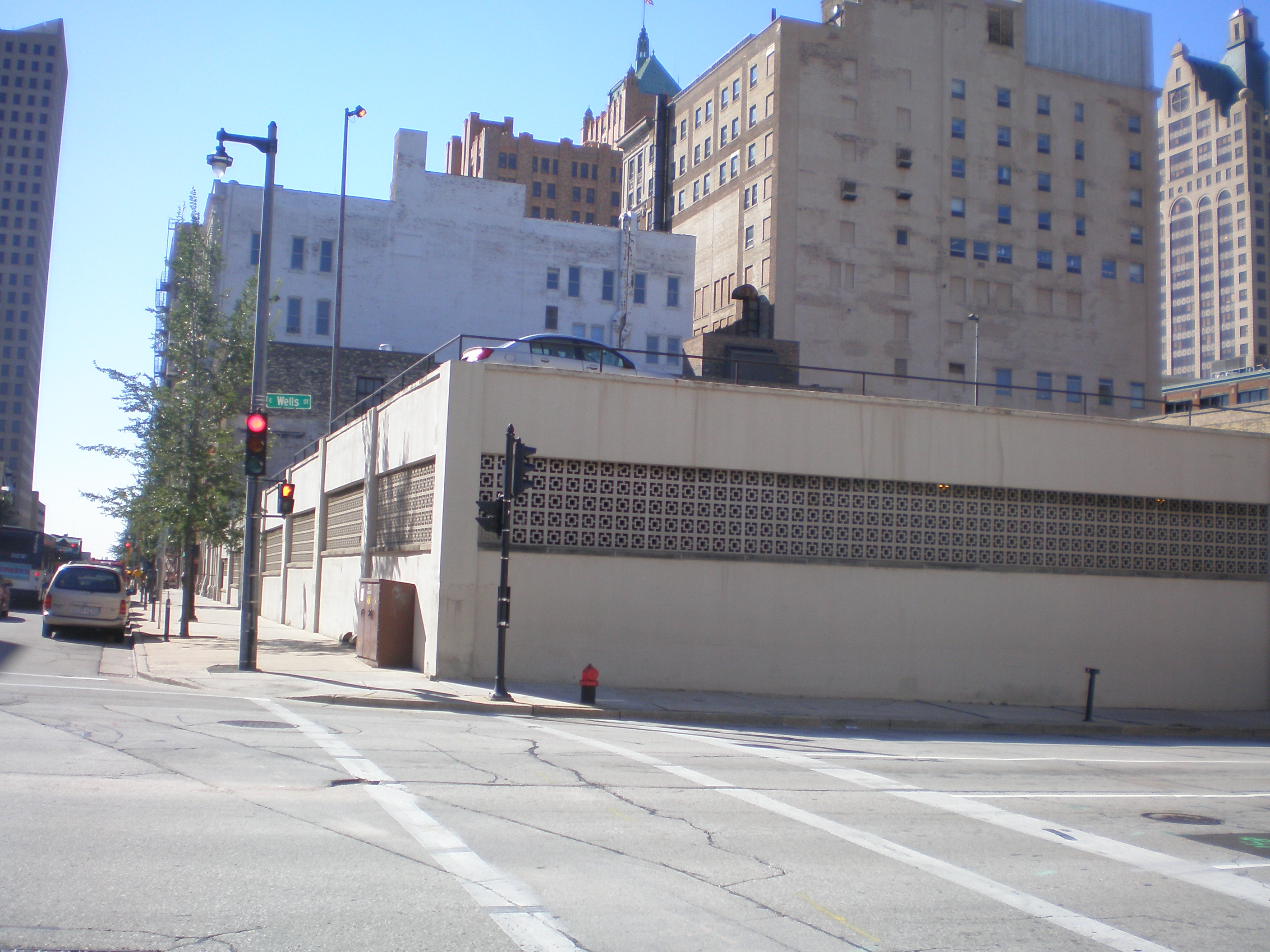
Now that E. State Street has been converted to two-way traffic in East Town, next up for conversion is E. Wells Street.  No longer is it one half of a one-way pair with E. State St., so even engineering professionals can’t make the flawed argument that it needs to remain in its current configuration.  And just like E. State St., anyone who lives in the neighborhood can tell you that on the weekends it is not uncommon to see a car go the wrong way down this street, and that ‘rush hour’ lasts for all of a few minutes around 5 pm.  With a short ‘rush hour’, safety concerns, and the lack of need for it to remain in its current configuration, it’s time for E. Wells St. to be the next two-way street conversion in downtown Milwaukee.

Proposed Redevelopment Site

This conversion project will involve more variables, than the E. State St. project as it has some differences from E. State St.  It is on the route of the planned Milwaukee Streetcar, the corner of Milwaukee St. and Wells St. has long been proposed as a site ready for a significant redevelopment, and it runs through Cathedral Square, an area of heavy evening pedestrian traffic.  Keeping these factors in mind, an important section of E. Wells St., is poised to become more of an activated street with pedestrians and transit riders in the near future, a dramatic change from its current use as a freeway.

To accomplish this properly, focusing on the pedestrian environment needs to be given higher priority than peak automobile traffic days.  The design should make the daily experience more enjoyable to pedestrians by removing a travel lane, converting the street to two-way traffic, possibly adding curb-separated or standard bike lanes, and adding the streetcar and its tracks.  Potentially curb bump-outs and enhanced materials could be utilized at the Jefferson St. and Jackson St. intersections to enhance the square, and streetcar stops need to be designed to fit the character of the area.

If done correctly, reconfiguring this street for two-way traffic, with pedestrians in mind, can improve safety and connectivity, build upon neighborhood assets, all the while building a pedestrian-friendly environment conducive to growth of the neighborhood.


Parking Privatization a Non-Starter For Now

Sep 28th, 2010 | By | Category: Chicago, Feature, Indianapolis

Parking privatization has received a lot of attention recently because of nationwide city-budget shortfalls and a high-profile privatization of Chicago’s meters. Chicago’s deal, one in a series of privatization deals the Daley administration proposed, netted the city over $1 billion. A windfall of cash certainly is tempting for any Mayor looking for a quick fix to get out of a recession ravaged budget. Indianapolis Mayor Greg Ballard, seeking a way to raise revenue without raising taxes, couldn’t avoid the temptation. Currently, a proposed parking privatization deal is up for approval in Indianapolis. Judging by what can be learned from the Indianapolis deal, however, Milwaukee would be wise to stay away.

Parking meter privatization has failed to deliver value to-date

Parking meter privatization has failed to deliver value to-date

It’s hard to argue that the Daley administration bargained for a good deal in exchange for giving up control of 36,000 Chicago parking meters for 75 years. The December 2008 deal netted the city a lump sum payment of $1.15 billion, but in exchange the vendor (Morgan Stanley, Abu Dhabi Investment Authority and Allianz Capital Partners) is budgeting to earning a profit of $9.58 billion. While a dollar today is worth more than a dollar tomorrow, this deal appears to have short-changed future citizens. Worse yet is the flexibility Chicago gave up, the deal is nearly impossible to cancel, and although the concept of street parking is likely to last 75 years, it’s likely that Chicago is going to want to reconfigure or remove a number of the metered stalls along the way. However, each time a stall is removed the vendor must be financially compensated, a move that will make future public space changes for the city a  bit more costly. Chicago is undoubtedly a strong enough city to overcome a lopsided lease of its parking meters, especially given that they came out as winners in other deals. As Aaron Renn noted in his article “Parking Meters and the Perils of Privatization“, the Daley administration has had a number of successes with privatization, including earning a $100 million for a failed deal involving Midway Airport, but the parking deal wasn’t a winner for the city.

But I think it’s fair to say that it’s likely Morgan Stanley got a very good deal on these meters. They closed this deal about the same time the Midway one fell apart. The fact that financing was readily available in tight market for the parking meters while it was impossible for Midway tells you everything you need to know about the relative merits of those deals financially.But even if Chicago didn’t extract the last penny of value out of the parking meters, so what? It’s highly unlikely you are going to win huge in every deal. In fact, the more of them you do – and Chicago has done several – the more likely you’ll encounter a loser. Chicago got massively overpaid for the Skyway and Midway, and on a portfolio basis I feel confident the city is still a net winner from privatization on a cash basis even if it theoretically could have gotten more for the meters.

If one assumed the proposed deal for Indianapolis must be a much more balanced deal, knowing that Chicago got short-changed on their deal, they would be wrong. Aaron Renn, a former resident of Indianapolis, has broken down the proposed deal with 10 key findings in his article “Indy’s “Son of Chicago” Parking Meter Lease to Be a Disaster for City“.

  1. This is the Chicago parking meter lease
  2. The city has no right to terminate the agreement
  3. Penalties are often higher than the actual meter value
  4. The vendor gets the rights to collect parking ticket revenue and sell advertising and naming rights
  5. Residential permit parking is coming to Broad Ripple
  6. The vendor even gets revenue from tickets written by IPD or other city agents
  7. The vendor automatically gets the right to any new meters, but the city has to pay to remove any meters
  8. Temporary closure policies are worse than Chicago’s
  9. Will festival and events organizers see new fees?
  10. Even the city has to pay to use the spots

While the 3,650 stall Indianapolis deal would be 50 years, instead of 75, it’s still long enough to be debilitating. What does Indianapolis get in exchange for giving up its parking meters? The city would collect $400 million over 50 years (including $35 million up-front), while the contractor (Xerox-subsidiary ACS) will collect between $724 million and $1.2 billion.

To quote Renn one last time…

The deal Indy is signing with its vendor (ACS) is so bad and so one-sided, it almost defies comprehension.

There has yet to be a large city that has struck a good deal by privatizing its meters. And that’s understandably so, returning value for giving up control of meters is an undoubtedly tough thing to accomplish. When it comes to the public realm that is the street, parking meters are everywhere. A parking meter lease is essentially a massive land lease that, as the Chicago and Indianapolis deals show, makes it prohibitively expensive to adapt what is currently flexible space to other uses.

If such a lease was put into place in Milwaukee events like Jazz in the Park, Brady Street Festival, the East Town Farmer’s Market and Al’s Run would become prohibitively expensive to pull off as temporarily closing the meters would necessitate a cash payment to the vendor. Likewise, construction projects that utilize metered spaces as staging areas would increase in cost, all for the profit of the vendor. The recent conversion to two-way traffic on East State Street would have been complicated, as the daily peak-time closure of meters would have necessitated daily payments to a vendor.

If the Chicago and Indianapolis deals show what the market will pay for meter revenues, there is no reason Milwaukee should even consider a privatized deal for parking. The Mayor and Common Council have shown the political courage to raise rates and install new electronic meters (something apparently lacking in Indianapolis and Chicago), moves that have generated revenue for the city without compromising flexibility.

If cities are concerned about generating the most money possible from their parking resources they should look not to privatization, but to the market-based policies proposed by Donald Shoup.


Planning and a Pint

Sep 28th, 2010 | By | Category: Events

The UW-Milwaukee Urban Planning Alumni Chapter is hosting a “Planning and a Pint” event on October 6th, 5:30 to 7:30 at Trocadero in Milwaukee. The topic is Economic impacts of High Speed Rail. Panelists are Bob Dennik from Milwaukee County, Dan Ertl from the City of Brookfield and Tom Rave from Gateway to Milwaukee. It should be a lively discussion!

Online registration is strongly recommended. http://www4.uwm.edu/alumni/chapters/urbplan_rsvp_oct.cfm

Flyer


Board of Zoning Appeals Meeting

Sep 27th, 2010 | By | Category: Events

The Board of Zoning Appeals (BOZA) is in independent agency authorized to hear appeals in matters relating to all zoning ordinances and to review zoning ordinance interpretations made by the Department of City Development. Because the Board acts somewhat like a court, it is called a quasi-judicial body and is required to follow accepted procedures and to fairly evaluate the relevant facts in each case that comes before it. The Board schedules approximately 15 hearings per year (one every three to four weeks) and hears roughly 700 cases each year.

Agenda


Weekly Bookmarks – Monday, 27. September 2010

Sep 27th, 2010 | By | Category: Bookmarks


Upcoming Events for the Week of September 27th, 2010

Sep 27th, 2010 | By | Category: Weekly Events
September 28, 2010 12:00 pm to 1:00 pm

Speaker: Michael Paddock, Senior Project Manager, CH2M HILL, and USA Board of Directors, Engineers Without Borders

The UWM School of Freshwater Sciences announces another semester of All Things Water seminars, featuring presentations on freshwater topics by faculty, scientists, and industry and community professionals, followed by discussion. The seminars are geared toward general audiences, and are free [...]

September 29, 2010 9:00 am

The Public Works Committee is responsible for physical services provided by the city such as street and alley maintenance, waste collection, disposal and recycling, sewer, water and flood control projects, assessments, public buildings, land and waterways.

Public Works Committee meetings start at 9:00 a.m. and are held in the Room 301-B, City Hall, unless otherwise noted.[..]

September 30, 2010 9:00 am

The Public Safety Committee is concerned with issues brought forth from the fire, police, health and neighborhood services departments as well as traffic control, emergency medical services and parking. It also licenses alarm businesses and public passenger vehicles and drivers.[...]

October 1, 2010 9:00 am

The Finance and Personnel Committee considers appropriations, finances, taxation, revenues, labor relations, personnel, pensions and other benefits, insurance, audits and city budget.

The Finance and Personnel Committee meetings start at 1:30 p.m. and are held in the Room 301-B, City Hall, unless otherwise noted.[...]

October 1, 2010 1:30 pm

The Finance and Personnel Committee considers appropriations, finances, taxation, revenues, labor relations, personnel, pensions and other benefits, insurance, audits and city budget.

The Finance and Personnel Committee meetings start at 1:30 p.m. and are held in the Room 301-B, City Hall, unless otherwise noted.

October 1, 2010 4:30 pm

Raquel Pinderhughes, Professor of Urban Studies, San Francisco State University

Workforce development programs are gearing up to prepare men and women from low-income communities for jobs and careers in the green economy. The training and preparation for these jobs and careers are seen as a ‘green pathway out of poverty’ strategy, aiming to leverage green economy [...]

October 3, 2010 11:00 am

THE RIDE

Begins 11am @ Tallgrass Grill (1952 N Farwell)
Ends @ Sobelman’s Pub & Grill (1900 W St Paul)
Get a FREE event t-shirt with the purchase of a beer

THE PARTY

Enjoy the afternoon at Sobelman’s Pub & Grill with drink specials, great food, and give aways.

$1 from every burger sold will go to the Bicycle Federation of [...]


E. State St. is Open for Two-way Traffic in East Town

Sep 25th, 2010 | By | Category: East Town, Feature

E. State St.

All throughout this summer the city had been repaving, repainting, and installing stop lights along E. State St. in preparation to open most of it to two-way traffic.  As of this weekend, E. State St. in East Town from Prospect Ave. to Market St. is open to two-way traffic.  Having this stretch of E. State St. open to two-way traffic allows residents of the neighborhood to get home quicker, save money on cab fare, find parking quicker, and save gas by taking shorter routes to their destinations.

Unfortunately, the street design falls a bit short, as it has a couple of key flaws.  First, two-way traffic stops at Market St. instead of continuing on to Water St., as it should, so this gap will delay the ability of city to convert all of State St. to two-way traffic.  Secondly, it is clear that the Department of Public Works continues to design for peak conditions, instead of the normal state of the street.  This is evident because the bike lanes end at Van Buren St., while peak traffic lanes (parking lanes that are used as travel lanes during peak conditions) begin at Van Buren St.  Apparently, these lanes are to handle the handful of cars that head west on State St. around 5 pm each day.  And although these lanes will allow the handful of cars to continue to speed through the neighborhood, they will be an inconvenience to people attempting to park, and are a concern to pedestrian safety.

It’s great to see the city moving to improve connectivity and access throughout downtown, but it’s unfortunate the design continues to come up a touch short.  Up next, E. Wells St., hopefully that street will be done better.


Finance & Personnel Committee Meeting: Budget Hearing

Sep 25th, 2010 | By | Category: Events

The Finance and Personnel Committee considers appropriations, finances, taxation, revenues, labor relations, personnel, pensions and other benefits, insurance, audits and city budget.

The Finance and Personnel Committee meetings start at 1:30 p.m. and are held in the Room 301-B, City Hall, unless otherwise noted.


Finance & Personnel Committee Meeting: Budget Hearing

Sep 25th, 2010 | By | Category: Events

The Finance and Personnel Committee considers appropriations, finances, taxation, revenues, labor relations, personnel, pensions and other benefits, insurance, audits and city budget.

The Finance and Personnel Committee meetings start at 1:30 p.m. and are held in the Room 301-B, City Hall, unless otherwise noted.

Agenda


Public Safety Committee Meeting

Sep 25th, 2010 | By | Category: Events

The Public Safety Committee is concerned with issues brought forth from the fire, police, health and neighborhood services departments as well as traffic control, emergency medical services and parking. It also licenses alarm businesses and public passenger vehicles and drivers.

Agenda