DNR Lead Service Line Replacement Outreach Grant Program Finishes Strong
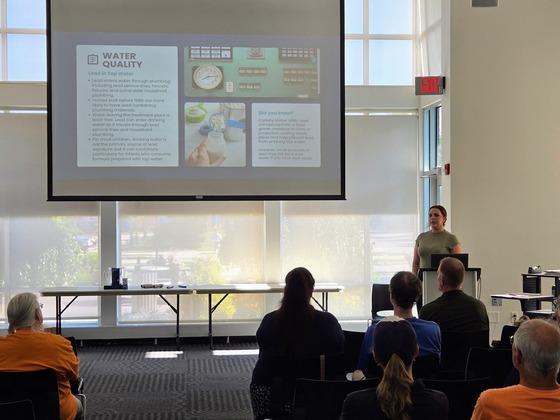
The Cudahy Water Utility used Lead Service Line Community Outreach Grant funds to partner with the local health department on outreach initiatives, which included a Lead in Tap Water Informational Meeting. / Photo Credit: Cudahy Health Department
MADISON, Wis. – The Wisconsin Department of Natural Resources recently concluded the final application cycle for the Lead Service Line Community Outreach Grant. This grant provided funds to municipal water systems to conduct community outreach and education in support of lead service line replacement projects.
With funding from the Bipartisan Infrastructure Law (BIL), the DNR established this grant in 2024 to bolster outreach and education efforts for lead service line replacement. Over the course of two application cycles, the grant program awarded over $3.5 million to 21 communities throughout the state. Although the BIL ends later this year, the outreach work funded by this grant will continue through 2028.
Education and outreach are vital to the success of lead service line replacement projects. There is no safe level of lead in drinking water. When people ingest lead through drinking water, it accumulates in their bodies over time, resulting in damage to the brain, nervous system, red blood cells and kidneys. Lead service line replacement is one of the best ways to minimize the risk of lead exposure through drinking water, but many residents are not aware of the potential dangers and adverse health effects. Gaining homeowner permission and cooperation can be a time-consuming process but a necessary step to move forward with replacements. Delays, legal disputes and public misunderstanding or resistance can cost additional time and money for both utilities and communities.
The scope of lead service line replacement projects in Wisconsin communities can vary widely. Many communities recognize the importance of outreach and education but lack the staff capacity to plan and carry out these efforts in addition to the replacements themselves. Even though the BIL funding is ending, lead service line replacement projects across the state will continue to advance with the support of outreach efforts funded by these beneficial grant dollars. Grant recipients are using awarded funding to directly reach property owners via phone calls, letters, door-to-door outreach, community events, social media campaigns, online resources, partnerships with community-based organizations and more.
One of the grant recipients, Cudahy Water Utility, used the grant funds to partner with their local health department on their outreach initiative.
“We are grateful to work alongside the Cudahy Water Utility on this important initiative,” said Kayla Lane, the Cudahy Health Department public health community liaison. “We value the opportunities we have had to connect with residents, listen to their questions and concerns and share important information about the Lead Service Line Replacement Project. This partnership allows us to bring a public health perspective to the project and work together to make sure residents have the information and resources they need to make informed decisions about their homes and health.”
This work is not just about informing and protecting residents – it is a matter of building trust, meeting regulatory obligations, ensuring equity and controlling project costs.
Learn more about the Lead Service Line Replacement Community Outreach Grant on the DNR website.
Note: The current Lead Service Line Replacement Program, which is a subprogram of the Safe Drinking Water Loan Program and is funded by the BIL, also known as the Infrastructure Investment and Jobs Act, provides funding to municipalities for both public and private lead service line replacements and related lead service line inventory work to protect public health.
NOTE: This press release was submitted to Urban Milwaukee and was not written by an Urban Milwaukee writer. While it is believed to be reliable, Urban Milwaukee does not guarantee its accuracy or completeness.
More about the Lead Crisis
- DNR Lead Service Line Replacement Outreach Grant Program Finishes Strong - Wisconsin Department of Natural Resources - Sep 15th, 2026
- Why Milwaukee’s Lead Pipe Program Is Cheaper, Faster — And Still At Risk - Jeramey Jannene - Jun 1st, 2026
- EPA Announces $94 Million for Wisconsin to Replace Lead Pipes - Danielle Kaeding - May 20th, 2026
- New Documentary Exposes Federal Funding Cliff at the End of 2026, Wisconsins Push to Replace All Lead Pipes - Wisconsin Conservation Voters - May 5th, 2026
- Gov. Evers Signs New PFAS, Lead Regulations - Danielle Kaeding - Mar 2nd, 2026
- City Receives $400,000 Grant For Lead Screening - Sophie Bolich - Feb 24th, 2026
- Rep. Madison Proposes Restoring Local Control Over Lead Inspections - State Rep. Darrin Madison - Jan 6th, 2026
- $43 Million Later, MPS Says Classrooms Are Safe From Lead Dust - Corrinne Hess - Dec 18th, 2025
- MPS Buildings Cleared of Lead-Paint Risks after 10-Plus Months of Work - Milwaukee Public Schools - Dec 17th, 2025
- Wisconsin Moves to Require Lead Service Lines Replaced By 2037 - Danielle Kaeding - Dec 11th, 2025
Read more about Lead Crisis here
Mentioned in This Press Release


Recent Press Releases by Wisconsin Department of Natural Resources