

Fake Polls, Real Polls Muddled Wisconsin Governor’s Race
None of them were very accurate. Yet more pollsters keep popping up.
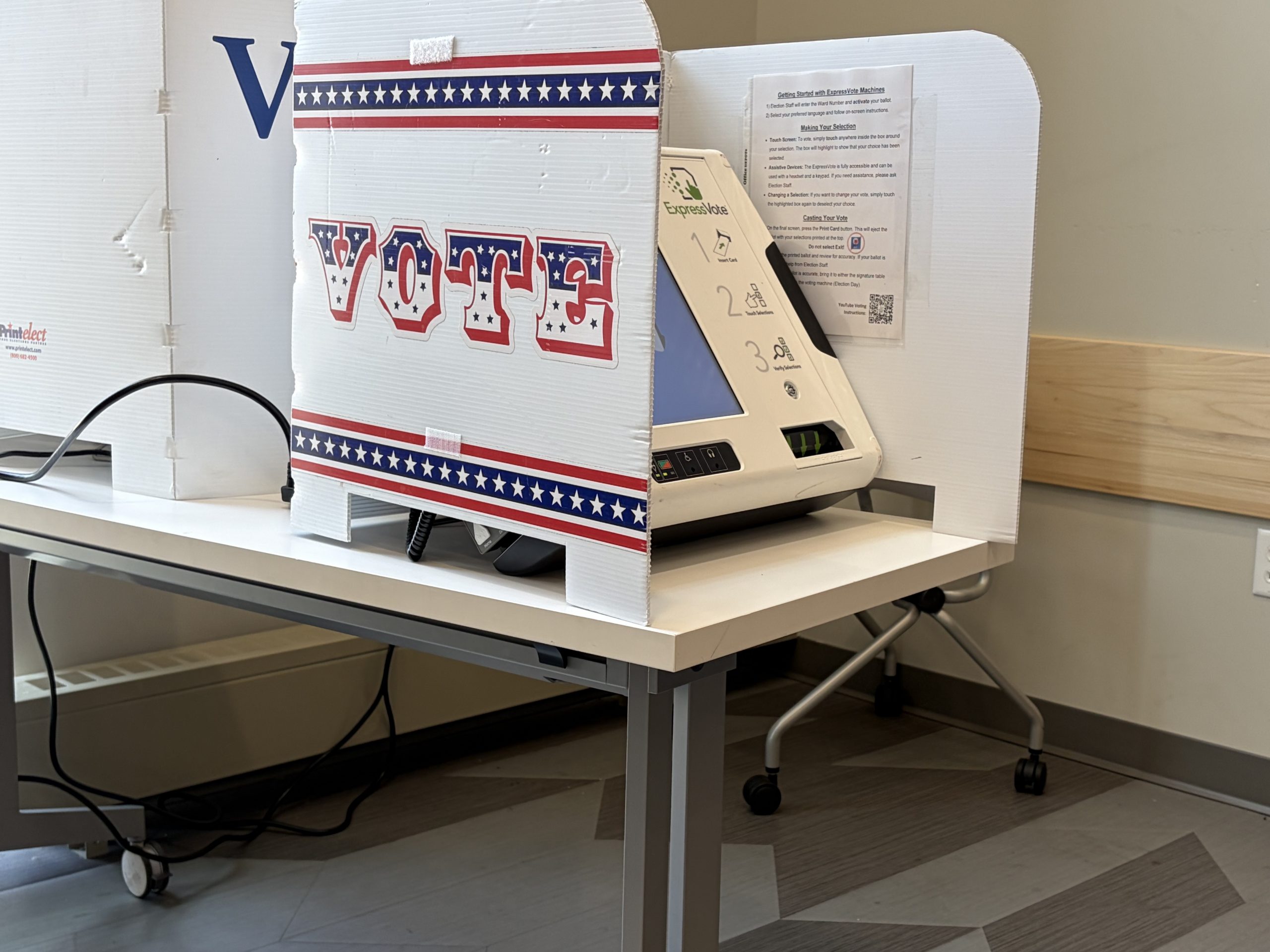
Voting booth. Photo taken July 28, 2026 by Sophie Bolich.
As unpredictable and chaotic as Wisconsin’s Democratic primary for governor was, it was further muddled by fake polls and real polls that seemed misleading. And we may see more of them in the general election.
An outfit called Median Strategies released a poll showing the socialist Democrat Rep. Francesca Hong was leading the Wisconsin Democratic primary for governor by more than 20 percentage points and another showing Mayor Karen Bass was leading by nearly 12 percentage points in the Los Angeles mayoral runoff. In the case of Hong, the 20% lead was close to what more reputable polls had found.
Except that Median Strategies was a fake. On Monday, the group disavowed its polls, with a message on its website saying they “should not be treated as genuine polling data” and were part of an experiment to examine “how purported polling information could enter and spread through the political information ecosystem without independent verification.”
The hoax has gotten national coverage from the media and Median Strategies has refused to disclose the real identities of the people who ran or funded the organization.
Meanwhile, there has been little coverage of Wedgewood Polls, a shady outfit that Urban Milwaukee wrote about back in early July. Wedgewood did a poll showing Hong at 30% at a time when legitimate polls had her with far less of the vote.
As the story noted, Wedgewood appeared to be a Republican front group that passes itself off as liberal. Wedgewood’s website called itself “an independent public-opinion research firm,” while its Twitter account described itself as “Progressive but unbiased,” and it claimed its poll was sponsored by the “Isthmus Political Report.”
That sounds like it was connected to the longtime Madison alternative weekly Isthmus (now a monthly), but its editor Judith Davidoff told Urban Milwaukee it had nothing to do with the poll and that Isthmus had never sponsored a poll or ever endorsed a candidate.
Both the Twitter account for Wedgewood and for Isthmus Political Report (Isthmus pol) have cheerleaded for Hong and other far-left candidates while attacking more mainstream Democrats. Its poll on Hong was promoted by the conservative MacIver Institute, which declined to respond to questions asking who sent the poll to them and what they knew about the Isthmus Political Report.
Meanwhile, the vaunted Marquette Law School’s last poll on the race, released about two weeks before the Aug. 12 election, had Hong at 38% and Milwaukee County Executive David Crowley at just 7%. Crowley eventually won with nearly 40% of the vote, with Hong just a few thousand votes behind. How could the poll have been so far off, many political observers asked.
One veteran Democratic consultant told Urban Milwaukee the polls in general were biased toward younger voters who backed Hong and “were truly excited by her and wanted to tell people. It was the reverse phenomenon of 2016 when Trump voters refused to be polled. This created a frothiness in the poll results.”
But Marquette pollster Charles Franklin, as you might expect, denies any frothiness. He notes his poll didn’t overestimate Hong: she was at 38% and ended up with just over 39% in the election. “The big miss wasn’t on Hong, it was that Crowley had not consolidated support,” he noted. “We saw the older voters were much more undecided, but we don’t think we underestimated their share of the electorate.”
The final poll by State Navigate, released about a week after the last MU poll, had Crowley at 22% but had Hong at 44%. A post-election analysis by State Navigate pollster G. Elliott Morris fell on his sword, saying “A 22-point error… is not a normal polling miss, even by the standards of primaries.” Though it was closer to the final result than the older MU poll, which was off by 31 points.
Morris cited three reasons for the polling errors:
– “The actual primary electorate was older and more moderate than pollsters assumed.
– There was a lot of late movement toward Crowley.
– The older and more moderate voters who did take the poll were still more Hong-friendly than the older and more moderate voters who actually showed up [to vote].”
The end result was to essentially return voters to a time before the age of polls. Indeed, the real polls by Marquette and State Navigate were actually more inaccurate than the biased if not fake poll by Wedgewood.
Yet even as polls become more difficult, as many people refuse to respond to surveys, we seem to get more of them and more reporting of them than ever before. Just two days after the election, a poll was released showing Crowley leading Republican Tom Tiffany by 4 points, 44% to 40%.
“We’re seeing David Crowley coming out with a modest lead here at the beginning,” said Brian Reisinger, CEO of Platform Communications, which did the poll, “which makes sense because he’s coming out of the primary victory where he’s getting a little bit of a bounce.” He declared it “a very, very tight race with Crowley because this is an evenly divided state, and Tom Tiffany’s been running full steam.”
How legitimate is this poll? Platform Communications is a PR agency, not a pollster. It was founded by Republican strategist Keith Gilkes, and Reisinger ran communications for Republican U.S. Sen. Ron Johnson’s 2016 campaign and Walker’s 2018 campaign. The poll was conducted by Gilkes and Democratic strategist Tanya Bjork, Platform says, but would the results have been released if Crowley was ahead by, say, 8 points?
The biggest fear for Republicans, given the huge Democratic turnout in the August 12 election and the recent blowout elections for liberal candidates in Wisconsin Supreme Court races, is a big lead for Crowley. It will discourage donations from fat-cat conservatives, who will instead look to races they have a better chance of winning.
This was a strategic poll meant to calm the distress of Republicans who were thrilled to run against a socialist Democrat who opposes the Thanksgiving holiday and now must face Crowley. And if the Democratic primary for governor taught us anything, it’s that you should take all polls with a grain of salt and look carefully at who did them. It might just be a trick by a fake liberal or faux conservative or some kind of bizarre science experiment. That’s the state of American politics today.
If you think stories like this are important, become a member of Urban Milwaukee and help support real, independent journalism. Plus you get some cool added benefits.
Political Contributions Tracker
Displaying political contributions between people mentioned in this story. Learn more.


Murphy's Law
-
How Republicans Helped Elect Crowley
 Aug 17th, 2026 by Bruce Murphy
-
Crowley Is Only One Who Could Beat Hong
 Aug 5th, 2026 by Bruce Murphy
-
Journal Sentinel Story on Mandela Barnes Is Irresponsible
 Aug 3rd, 2026 by Bruce Murphy


















The problem is the media which loves polls, loves the horse race (as opposed to discussing policy distinctions), and loves that the articles basically write themselves. Charles Franklin is a nice and knowledgeable guy – but his polls tend to undermine insurgent candidates in favor of those with name ID (ie career politicians or those that can purchase big early ad spends).
What Dan Adams says is my takeaway from this as well. Media can’t get enough of poll stories and horse races, and polls are weapons that partisans can use to drive coverage. And drive donation decisions and voting decisions. I openly admit that the LACK of polling in the Dem primary caused a lot of problems for those of us who were trying to vote strategically, but bad, misleading polling is even more hazardous.
What this Median Strategies outlet is saying that they are telling bad-faith outlets that they can send out misinfo and hope someone amplifies it. And our lazy corporate media is more than happy to go along with it.
Who responds to polls? I delete all unsolicited texts, emails and never answer callers who aren’t in my contacts list, like everyone else I know. I’m having a hard time imagining younger voters eagerly responding to unrecognized calls and text messages and clicking on links from unknown sources. What am I not understanding here?
I don’t think that, for example, 1,864 people responding to a poll is indicative of the general voting population of hundreds of thousands of people. And as noted by Lizwah, who is responding to these polls? Are those who do respond providing honest answers? One has to assume they are, but that is a huge assumption without any way of verifying the results.
Regardless of polling it will be a tight race. Potentially in recount territory. Even though Tiffany is a proud MAGA republican whose voting record betrays the interests of his constituency, many people are too easily swayed by his folksy mannerisms and vague platitudes. “I believe kids should read” was something he actually said in a recent ad. Never mind the trump induced inflation and the war that could have paid for Medicare for all. Its about the kids, right? Crowley will have to contend with the bad faith undecided moron voters who feint indecision but will predictably cast their vote for tiffany because of “the economy” or whatever they tell themselves. I think it would be prudent for him to instead engage the progressive voters affiliated with Hong. Corporate democrats lack the enthusiasm found in the progressive base. That enthusiasm could carry him over the finish line.
Maybe some tie in to the prediction markets. Some folks are now questioning this possibility.
Would be wonderful if any of the large media orgs would analyze and investigate.
Polls are an unfortunate byproduct of democracy. Who doesn’t like seeing their candidate atop a poll? Exposing fake polls in Wisconsin and LA is not the end. It’s the beginning. The Trump mindset, to lie about everything, is seeping into every corner of society. Fake polls will become standard in campaigns. While some would say it’s the job of journalists to root them out and the job of voters to stay informed, fake polls are yet another sign of democracy under attack.