

New Maps Make Wisconsin Legislature A True Tossup For Both Parties
For the first time since 2010, Democrats and Republicans both see paths to majorities in Madison.
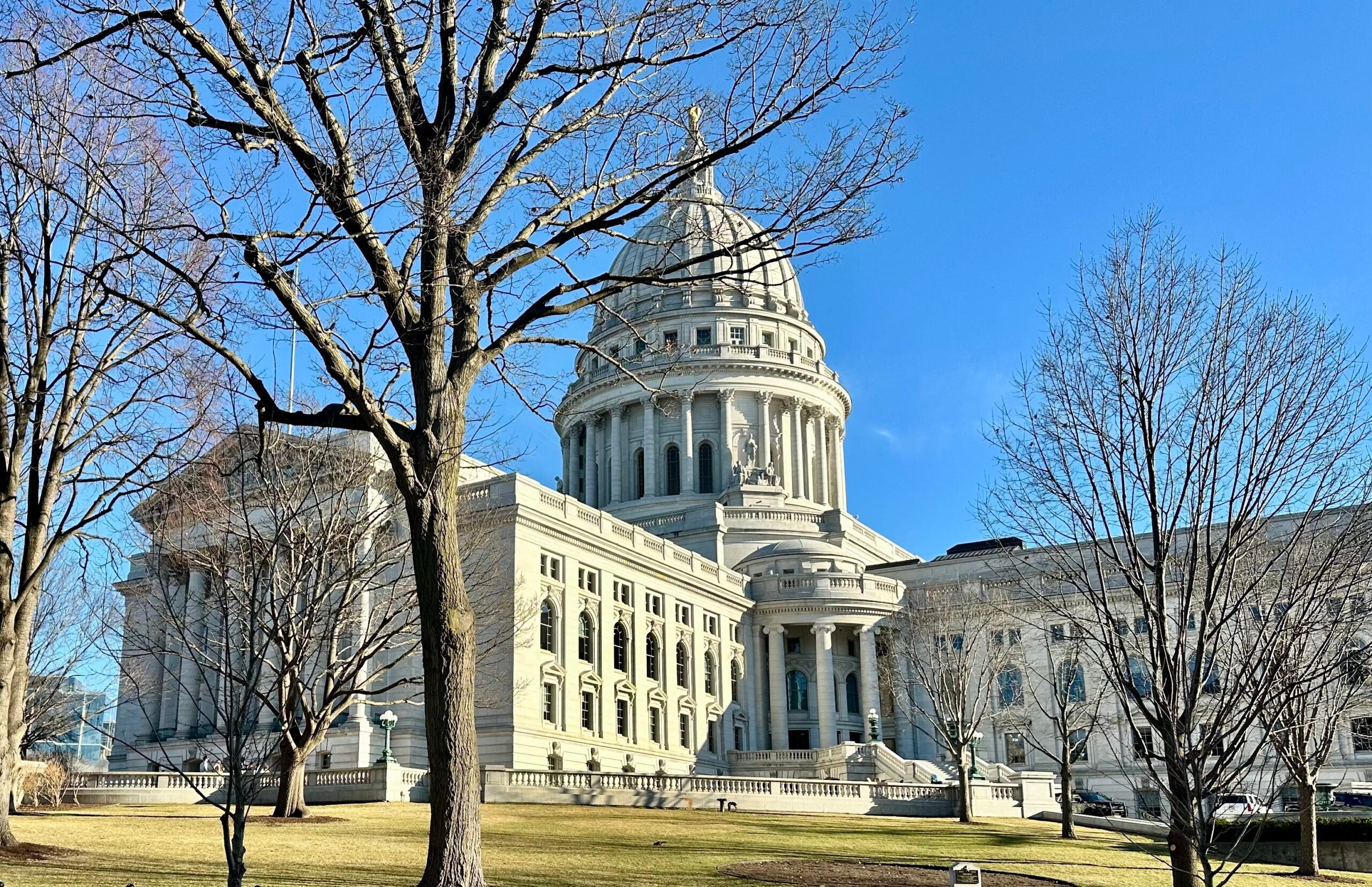
The Wisconsin State Capitol, in Madison, Wis., pictured on March 9, 2026. Anya van Wagtendonk/WPR
For the first time since 2010, both Democrats and Republicans have a shot at winning majorities in Wisconsin’s state Assembly and Senate.
That’s according to Marquette University Law School researcher John Johnson, who said new voting maps enacted two years ago substantially shifted the balance of power in the state.
Republicans have maintained majorities in the Wisconsin Assembly and Senate for the last 15 years, in large part because of GOP-drawn state legislative districts passed after a GOP wave election in 2010. In late 2023, a new liberal majority on the state Supreme Court ruled those districts unconstitutional. Faced with the possibility that the court itself would draw new districts, Republican leaders passed revamped maps that had been drawn by Democratic Gov. Tony Evers.
Wisconsin had divided government throughout Evers’ term, and the Democratic governor frequently butted heads with GOP legislative leaders. This year, Democrats hope to win a “trifecta” — maintaining the governor’s office and taking control of the Legislature.
It’s worth taking a moment, Johnson said, to “think about how unusual that is in Wisconsin’s recent political history.”
Wisconsin’s state senators serve staggered four-year terms. That means that in 2024, only half of the senate was up for reelection under the new maps.
“Now, in the second election with these new maps, truly either party could win it all,” Johnson said. “I think the most likely outcome is that we’ll get a split between at least one of the chambers of the Legislature and the governor’s mansion.”
Wisconsin Senate rated as ‘lean D’ after some GOP lawmakers decline to run
In 2024, the new Senate map helped Democrats whittle a GOP supermajority down to a slim 18-15 majority. To take the majority, Democrats need to gain a net of two seats among the 17 up for election this year. They already hold 10 seats in the chamber that are not up for reelection this year.
Johnson’s analysis, considering past election results within current boundaries as well as how incumbents have fared, rates seven of this year’s Senate races as either “safe” for Democrats or “lean D.”
“If the Democrats win all of the seats that individually lean Democratic, based on the totality of evidence that I consider, they’ll win a majority of the state Senate,” Johnson said.
Wisconsin’s 17th Senate District in far southwestern Wisconsin is perhaps the most hotly contested race, as evidenced by the hundreds of thousands of dollars pouring in from Republican and Democratic groups. It’s been held comfortably by Sen. Howard Marklein, R-Spring Green, since 2014, but Johnson considers it a “tossup” this November.
After a contentious, three-way Democratic primary, state Rep. Jenna Jacobson, D-Oregon, will move on to face Marklein. She’s already received nearly $280,000 from Democratic Party groups, the state’s largest teachers union and individual Democratic lawmakers. In late June, Marklein received $100,000 from the GOP’s Committee to Elect a Republican Senate and his campaign reported having more than $1 million in the bank.
On paper, Johnson said, the district should be an easy pickup for Democrats. But Marklein is popular in his district, outperforming Republicans running for governor and even President Donald Trump.
What’s really bolstered Democrats’ hopes for a Senate majority, Johnson said, is a string of retirement announcements this year from other Republican incumbents who have regularly outperformed the top of their party’s ticket in past elections.
Wisconsin’s 21st Senate District, covering Racine and southern Milwaukee counties, is one of those districts. In March, Sen. Van Wanggaard, R-Racine, announced he wouldn’t seek re-election. Based on spending by the Democratic and Republican parties, it’s clear the open seat is a target. Republican Jim Croft has gotten more than $113,000 in transfers from Republicans and allied fundraising groups. Democrat Trevor Jung has received around $82,000 in transfers from Democrats and allied groups. Johnson now rates the 21st Senate District as “lean D.”
Another Republican retirement came in the 5th Senate District of West Allis, Wauwatosa and eastern Waukesha County, when Sen. Rob Hutton, R-Brookfield, announced in January that he wouldn’t seek a second term. That race has also seen heavy transfers of campaign cash going to Republican Mike Roberts and state Rep. Robyn Vining, D-Wauwatosa. Without the power of a GOP incumbent on the ballot, Johnson rates the 5th District as “lean D.”
And a late GOP shakeup in western Wisconsin’s 31st Senate District race has helped Democrats’ chances of keeping it blue in November. Incumbent Sen. Jeff Smith, D-Brunswick, was going to face incumbent Republican Sen. Jesse James, who was drawn into Smith’s district under the 2024 maps. But James announced his retirement in April, shortly after a criminal complaint was filed against his daughter for allegedly stealing money from his campaign. Johnson rates the 31st Senate race as “lean D.”
“I really do believe that incumbency advantage is important, even though it’s small in these razor-thin districts — one or two or three points can be all the difference,” Johnson said.
Assembly leans GOP, but 3 tossup races mean it could go either way
Flipping Wisconsin’s Assembly is more of an uphill battle for Democrats. Republicans hold 54 of the chamber’s 99 seats; Democrats hold 45. All Assembly members are up for reelection every two years.
By Johnson’s analysis, 47 seats are considered “safe” or “lean D” under current maps, while 49 are listed as “safe” or “lean R.”
That leaves three races Johnson rates as “tossups.” He expects control of the Assembly to come down to those three.
The 88th Assembly District has trended Democrats’ way in recent years, according to Johnson’s analysis, but Rep. Benjamin Franklin, R-De Pere, eked out a narrow victory in 2024. He’s facing Democrat Brandy Tollefson, who is a member of the De Pere School Board. Johnson said the district would be listed as “lean D” if not for Franklin’s incumbency, which moves it to “tossup” in his analysis.
In Wisconsin’s 61st Assembly District, southwest of Milwaukee, Democrats have spent huge sums of money trying to defeat Rep. Bob Donovan, R-Greenfield, in 2022 and again in 2024. This year, he’ll face Army veteran Ben Brist, who on Tuesday night beat fellow Democrats Lawanda Chambers and Brian Bock in a three-way primary. Johnson describes Donovan as “Assembly Democrats’ white whale” because he’s seen his margins improve even in the face of being massively outspent. Johnson rates the contest between Donovan and Bristi as a “tossup.”
The final tossup Assembly race, according to Johnson’s math, is the 51st District held by Rep. Todd Novak, R-Dodgeville. Novak’s seat is solidly blue, but he’s been able to beat back Democratic challengers since 2014. Democratic challenger Ben Gruber, a DNR conservation warden, will face Novak in November.
As with other races, Johnson stressed the power incumbents have going into these races. He said it highlights a paradox in political science, wherein polling shows “people hate the legislature and they love their own legislators.”
“State legislative Republicans in Wisconsin are consistently more popular than the Republican at the top of the ticket, and it’s for that reason that I think Republicans have a strong chance at keeping the Assembly, even if a Democrat wins statewide.”
Primaries set up battle for control of Wisconsin Legislature was originally published by Wisconsin Public Radio.
If you think stories like this are important, become a member of Urban Milwaukee and help support real, independent journalism. Plus you get some cool added benefits.
Political Contributions Tracker
Displaying political contributions between people mentioned in this story. Learn more.

















At last, we may have some competitive elections. Representative democracy returns to WI?
Gov Evers is leaving quite a legacy; His proposed maps and backing of David Craowley as his successor may finally put WI back on its original path of caring for the environment and working people. Well done, Gov. Evers.
Republicans are a waste of tax dollars.