

Democratic Candidates for WI Governor Mostly Agree, Avoid Attacks in Debate
Most agree not to cut police funding, to reduce the voucher program and better regulate data centers.
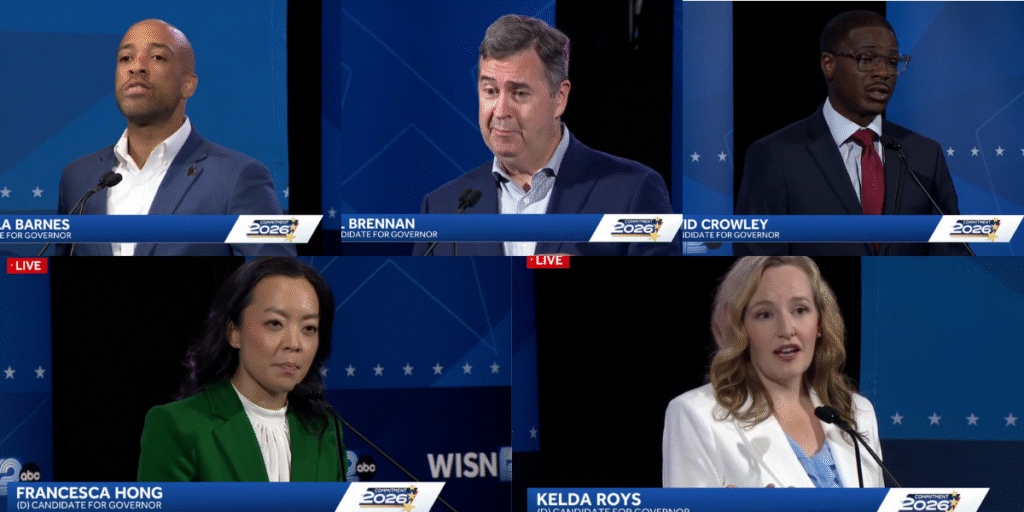
Democratic candidates for governor largely avoided direct attacks on one another during their only televised primary debate Tuesday night. (Screenshots via WISN-12)
Democratic candidates for governor largely avoided direct attacks on one another during their only televised primary debate Tuesday night, with two weeks remaining before the Aug. 11 primary, instead laying out differences on issues including school vouchers and data centers.
This year’s election is the first open race for governor in Wisconsin since 2010, and the five candidates left in a field that used to include seven are former Lt. Gov. Mandela Barnes, Joel Brennan, former state Department of Administration chief, Milwaukee County Executive David Crowley, state Rep. Francesca Hong and state Sen. Kelda Roys.
More than 40% of Wisconsin voters have not made up their minds about which candidate to support.
Recent polls show Hong leading the race.
The debate was hosted by WISN 12 on the Marquette University campus and moderated by Gerron Jordan and Matt Smith, WISN 12 journalists and hosts of “Upfront,” on the first day of in-person early voting. The candidates were told at the beginning that they were allowed to speak to one another at the start of the debate, but direct back and forth and criticism was minimal throughout the hour-long debate.
The winner of the primary will likely face U.S. Rep. Tom Tiffany, the presumptive Republican nominee in November.
Addressing criticisms
The debate started with each candidate addressing a critique of their candidacy.
Crowley, who recently reentered the race for governor with the endorsement of Gov. Tony Evers, was asked about his decision to drop out and then restart his campaign and whether he is a “prop” of the Democratic establishment.
“I was never born into the establishment. I was actually born into struggle… I’m not here to protect the establishment. I’m here to deliver real results for Wisconsinites all over our state,” Crowley said, adding that the “stakes are too high and that’s why I got back into this race.”
Barnes, who served as lieutenant governor in Evers’ first term, was asked about entering the race after losing his 2022 U.S. Senate race against Sen. Ron Johnson, his failure to garner Evers’ endorsement, and why voters should trust him to win in November when he previously lost.
Barnes said that his narrow loss to Johnson taught him about the influence of money on elections as well as “how low Republicans can go.” He said that he thinks his campaign will have the resources and support to win, and he appeared to take a poke at Crowley.
“I have zero interest in upholding the status quo. I have zero interest in being the establishment candidate,” Barnes said. “That is the difference right here on the stage because I am pushing the envelope to make sure that we are as bold as we can possibly be in the Donald Trump era, because that’s what people have been calling for Democrats to be all along.”
Hong, who identifies as a democratic socialist, was asked whether she supports the full platform of the Democratic Socialists of America, which includes abolishing the U.S. Senate. Tiffany has been criticizing her for a tweet from 2021, in which she said “Abolish the Senate.” She said no.
“I do not support the full platform of the national DSA and I am not endorsed by DSA National,” Hong said. She then focused on defining democratic socialism, saying it is a “form of government that puts working class people first.”
Brennan and Roys, who are both polling in the single digits, were asked about whether voters were “wasting” their vote by voting for them.
“The challenge that I have had from day one is not that anybody thinks I’m unqualified for the office,” Brennan said, noting his experience as a cabinet member under Evers. “The challenge I have had is that people don’t know me as well as they know some other candidates around the state.”
Brennan said the recent upheaval in the race — as well as the perception of insiders “putting their thumb on the scale” — has gotten people more engaged and that will help his candidacy.
Roys responded to the same question by saying, “If you want the best public schools in the nation for your children, if you want to open up the state’s healthcare plan so that everyone can buy in and we can lower costs for all Wisconsinites, if you want a candidate who is going to stand up and fight Donald Trump and bring an end to this authoritarian regime, then you should vote for me.”
Public safety funding
Each candidate said he or she would not sign a budget that cut funding to law enforcement and all said that they would sign a bill requiring police across the state of Wisconsin to wear body cameras.
Candidates were asked about the killing of Corey Ruiz, a Black man, by Madison police. Hong was asked about her public speech on the site of the killing in which she called it an example of state-sanctioned violence and an “execution.” Hong suggested during the debate that she would not have made the comments before an investigation as governor, since the office has “the largest microphone in the state” and there is “deep responsibility” with that. “It was clearly the type of violence where no one’s life should have been taken,” Hong said.
Asked about previous comments she made supporting defunding the police, Hong said she would not cut funding for public safety, but wants to invest in local governments and communities to help reduce crime including by investing in schools, addressing the opioid epidemic and ensuring people coming out of incarceration have proper resources.
“The governor cannot defund police, and I am not here to govern by slogan,” Hong said. “I am here to make sure I am the governor that’s most serious about public safety.”
Barnes faced criticism during his 2022 Senate campaign over comments supporting reducing police funding. He said during the debate he would not sign a budget that decreased police funding in part because he said police departments must be able to afford body cameras, which Madison police do not have.
Roys said that she wouldn’t cut police funding and added that the state also needs to invest in local governments, so they can invest in evidence-based programs that reduce and prevent crime.
“We have to invest in proven strategies that actually do that, unlike what Republicans like Tom Tiffany have done, which is cut funding to local governments and take away local control,” Roys said.
“We cannot defund the police. We should be investing in public safety,” Crowley said, adding that that includes investing in wraparound services.
Brennan said there needs to be robust funding for local governments, and that the state should look to Minnesota as a model for how to reduce crime, spend less and reduce the prison population while investing in early childhood and K-12 education.
Voucher program
When it comes to the state’s school voucher system, candidates took different positions.
Barnes said he would reduce the voucher programs in the state, including in Milwaukee where nearly half of students in the city use publicly funded private school vouchers.
Roys laid out her three-step plan to sunset the voucher programs including implementing transparency and accountability measures to close schools that don’t adhere to higher standards, end the statewide program in the first state budget and wind down the programs while allowing current participating students and their siblings to continue attending private schools with vouchers.
Hong said she would not put a “firm” number on when the voucher programs would need to end, but she supports strengthening public schools and would wind down the voucher program through a “responsible program and process where we work directly with the families and the different schools.”
Crowley said he would not sign a bill reducing the programs, though he added that he doesn’t want to see them expand either.
“I don’t think the question is whether or not we should have vouchers,” Crowley said. “The question should be, how do we continue to invest in our public schools to make sure that they’re the school of choice.”
Brennan offered the strongest argument for not signing a bill to reduce or close the programs. He said he wants to cap enrollment and disclose costs of private voucher schools on taxpayers’ property tax bills, but he said reducing the program is not politically feasible.
“There is not going to be a bill passed in the Legislature that is put on the governor’s desk right now to end vouchers in Milwaukee. There are representatives in Milwaukee… for whom more than half the people who live there are sending their kids to private schools. We have to live in the real world. This is dividing Democrats,” Brennan said. “I wouldn’t put legislators in a position where they’re going to have to tell parents that they can’t send their kids to their schools of their choice.”
Brennan added that he wants to make Wisconsin’s public schools better than any private school.
Data centers
Data center construction has become a key issue in the race for governor with polling suggesting that 76% of Wisconsinites say they believe the costs of data centers outweigh the benefits. Candidates provided different solutions for regulating data centers.
Hong touted the fact that she is the only candidate to call for a moratorium on data centers and said she would call a special session on the issue to have lawmakers take action on a bill that would impose regulations on data center construction in the state.
“This moratorium is necessary so that we can responsibly put in enforcement mechanisms to protect communities,” Hong said, noting that some local governments have already imposed moratoriums. “We also want to make sure that there are the guard rails, the legal resources, and that if data centers are going to come here in our state that they pay their own way and actually pay up front.”
Crowley said that he did not think a moratorium would address the long-term concerns, and said he would rather focus on ensuring that data centers have to pay for their energy use, grid upgrades and use clean energy.
Brennan said he has not called for a moratorium, but would put a 100-day pause on construction. He said he would also ensure that Wisconsinites are not paying for the construction, ensure there are regulations with “teeth” and that companies are using renewable energy, ensure that union workers are employed on the projects and ban non-disclosure agreements between companies and local governments.
“If we can do that in the first 100 days, it’s not going to make everybody happy, but it’s going to set the bar and take away that uncertainty and take away another reason why people distrust government and why they’re so angry,” Brennan said.
Barnes said that he wanted no new data center construction without guardrails being put in place to ensure the state’s natural resources and air quality are protected and that residents’ energy bills are not climbing.
“If a community rejects a data center proposal, then there should be no new data center constructed,” Barnes said.
Roys said she doubted a moratorium bill could pass, but a bill focused on strong regulations could be successful.
“I will not stop there,” Roys said. “I will also establish a public negotiating team so that any community that decides it would like to engage with a data center has the opportunity to have expert negotiators. I will increase shared revenue so that communities don’t feel desperate … I will also end the subsidies for data centers because they should be paying us and not the other way around.”
In 30-second closing statements, as each candidate made a pitch for voters’ support, Barnes made some of the most pointed remarks of the night taking shots at Crowley and Hong.
“I want you to know that the establishment is trying to rig this election. They want you to choose between their preferred candidate and also Republican billionaires are lining up to the tune of three and a half million dollars to choose a democratic nominee in this race,” Barnes said, referring to the money the Republican party has invested in ads widely seen as aimed at boosting Hong. “I’m here to say, that’s BS. I’ve been a progressive fighter who’s taken on the tough fights.”
Brennan suggested he is the only one who could win the general election, Roys and Crowley each emphasized their experience and Hong said she was already beating Tiffany by garnering statewide support and would be a fighter for working class voters.
Wisconsin Democratic candidates for governor debate, mostly hold back direct attacks was originally published by Wisconsin Examiner.
Political Contributions Tracker
Displaying political contributions between people mentioned in this story. Learn more.





















Brennan believes he would be the best candidate to run against Tiffany. In the past, the safe candidate, one that didn’t rock the boat when it came to democratic oligarchs. He’s white, male, and older. What worked in the past. This election will not take place in the past. Today’s voters are demanding a change from safe candidates. They are looking for leadership like Mamdani. Voters are looking for candidates who deal with the same problems as voters. Candidates who focus on the needs of working families because those are the same needs they face.
State party officials are again seeking out a safe candidate for governor. They fear non-conventional candidates like Hong and Barnes. In their safe little cave, they cannot see that voters are calling for bold politicians, who are committed to implementing bold campaign promises. Voters do not want the status quo because the status quo that literally is transferring wealth from working families, to wealthiest and most powerful.