

Milwaukee Needs a Grand Fountain
Chicago's Crown Fountain provides an example. Milwaukee's historic tiled fountains provide inspiration.
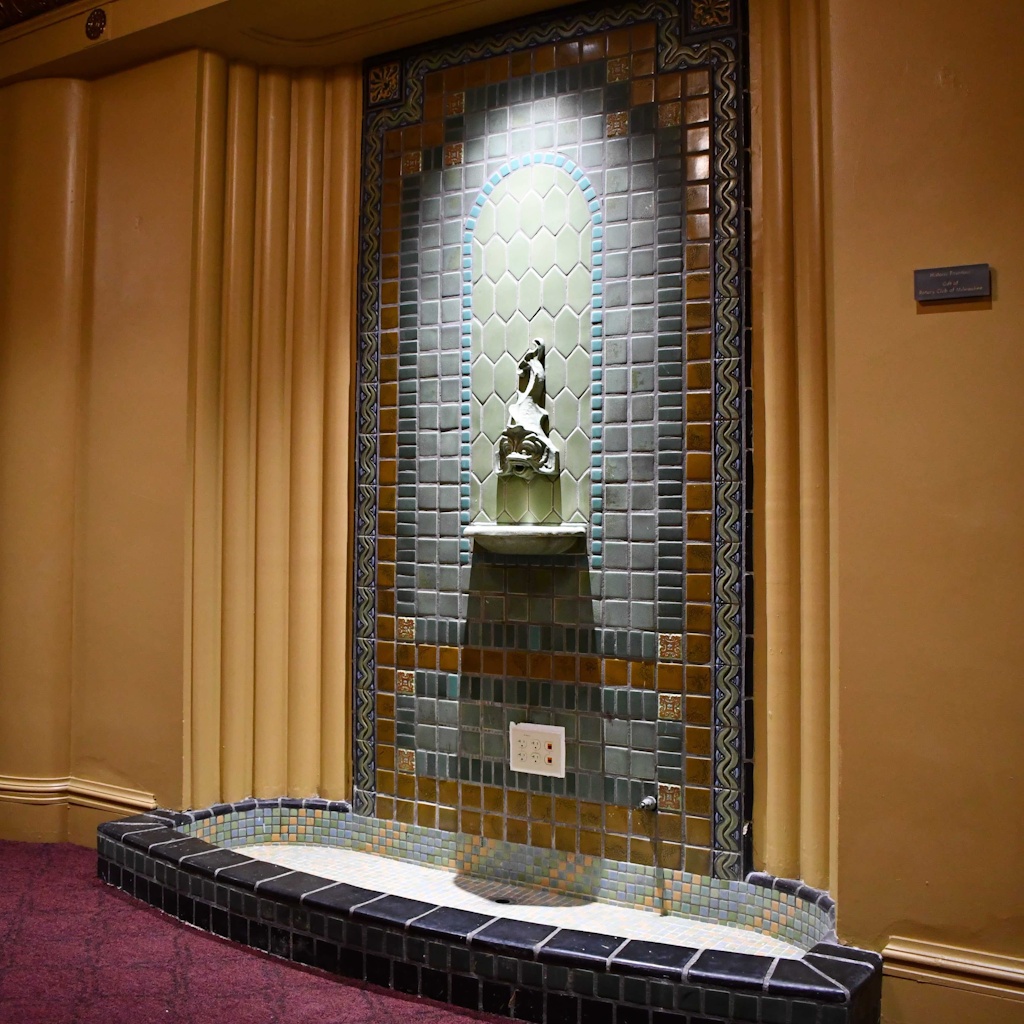
The secluded fountain inside the historic Warner Theater, now the Bradley Symphony Center, was created in 1930. © Ben Tyjeski.
Milwaukee has yet to see the construction of a grand public fountain.
A number of fountains exist throughout the city, but none that could be called grand.
With running, potable water throughout Milwaukee, three rivers flowing through the city and Lake Michigan at its doorstep, a designed spectacle of water may seem unnecessary or even decadent. But the symbolic function of a public fountain can be very powerful.
The eminent designer of tiled fountains, Ernest Batchelder, once referred to the ancient Greek city of Panopeus as an example of why fountains are necessary. “A city without a public fountain of water,” he asked, “is it even a city?”
Such a claim would have ignited discussion in the Milwaukee metro area during the 1920s, a decade that saw the highest number of fountains constructed, mostly with faience tiles. These fountains were not a mere luxury but proof of urban modernity and elegance.
But they lacked visibility. The fountains were not constructed in public spaces but rather were largely indoors or in private gardens. Unless they were a resident or guest of these wealthier homes, Milwaukeeans could have no clue about these artistic treasures.
If only some of this artistic ingenuity, showcasing water as a dramatic and visually pleasing spectacle, were applied to a significant, designed public space, Milwaukee could create a powerful new symbol.
History offers countless examples. From the canals of Ollantaytambo in the Andes to the qanat tunnels of old Persia to the aqueducts of Rome, these creations of the past demonstrate how investment in engineering water has supported public life. Though now archaic, the infrastructure and sites connected to these projects still have a mystique and draw the curious from across the globe.
Art may be argued as secondary to all these feats of engineering, but a well-designed fountain is essential. It can even be the focal point of a city.
Milwaukee’s historic public fountains are few. Hennecke & Co. designed the Courthouse Square Fountain (now missing) and another in front of Soldiers Home. Other fountains without ornamentation are found at the Milwaukee Art Museum, the county courthouse, UW-Milwaukee and the North Point Water Tower.
With the exception of Hennecke’s fountains, none of these creations attempts to be a work of art and they are, at best, rudimentary pools of splashing water. Are they even worthy of being considered a fountain?
The Latin word for pertaining to a spring or fountain, “fontanus,” combines the Latin words “fons” and “annulus” to translate literally in English to “a spring in a ring.” And that is what you witness at too many sites in Milwaukee: soothing but uneventful rings of water.
These fountains draw no crowds to them.
A visit to Chicago offers something quite different. Jaume Plensa’s Crown Fountain is a crown jewel of urban fountains. Crowds are always drawn to the site, spending minutes, hours, even the day around this spectacle. People gather here to relax, play music, laugh, take off their shirt and run around or just listen. Here, in a city where water too often is a commodity for industry to harvest, humanity gets to celebrate the sheer joy of flowing water.
But the tide may be turning for a grand fountain in Milwaukee, especially one that reminds the community of its need to access clean water for play and recreation.
On the corner of Greenfield Avenue and 1st Street, a rainwater garden designed by James Wasley features large spouts dripping water like gargoyles over pools woven between groups of native plantings and trees. Down the road at Harbor View Plaza, a collaboration between Ayres Associates and Quorum Architects has created a playful kind of fountain by pumping water through pools filled with natural stones.
For a metropolis that seeks to claim the title of the “Freshwater Capital” or “Fresh Coast City,” this type of public space is exactly what we need.
But the question of grandness in Milwaukee has yet to be explored. While location and surrounding infrastructure are important criteria, design is equally pivotal in creating something great that attracts the public. The recent designs on Greenfield Avenue show the potential impact of living fountains and natural materials. Chicago’s Crown Fountain shows how the built environment can showcase the human element in design and the sheer impact of its size.
Any prospective site for a new fountain has much to consider, but century-old tiled fountains in this city could be another way to inspire the idea of a grand Milwaukee fountain.
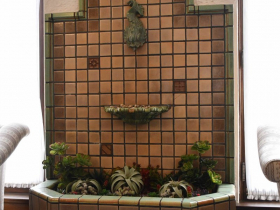
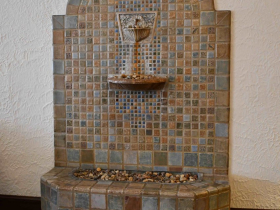
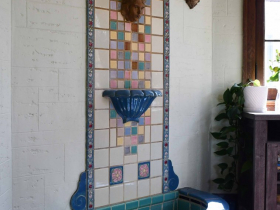
With the historic tiled fountains being mostly private, Urban Milwaukee presents the following images in this special feature of Tile Town. All images are found in the city of Milwaukee, but to respect the privacy of these sites and their owners, the locations are not published for several of the images.
Fountains
If you think stories like this are important, become a member of Urban Milwaukee and help support real, independent journalism. Plus you get some cool added benefits.


Tile Town
-
Ornamental Owls are Mentors in Milwaukee’s Schools
 Oct 6th, 2025 by Ben Tyjeski
-
Handmade Tiles Found in 101 Milwaukee Apartment Buildings
 Aug 4th, 2025 by Ben Tyjeski
-
Secret Garden Unveils Classic Batchelder Fountain
 Aug 28th, 2024 by Ben Tyjeski




















Beautiful private, indoor tiled fountains. But aside from the MAM’s fountain (without seating) or the beautiful North Point Water Tower at East North Avenue (with seating), nothing here approaches that of Chicago’s incredible Buckingham Fountain at Grant Park (Google it to see photos). I too would love to see something beautiful here along the Lake. But both the City and County can’t afford this, and Milwaukee’s big business seems more concerned about it’s bottom line than civic pride. And it may be tough for Milwaukeeans to exhibit civic pride without achieving adequate housing, health care, employment, transportation, youth based activities, and education, all free from violent and petty crime. Hopefully we can achieve sometime before the turn of the century! But with $1/2 billion in deferred maintenance in County Parks, another $1/2 billion in deferred maintenance of other capital assets, and a looming $1 billion for a new Courthouse, that support probably won’t come from taxpayers in the near future!!!
As a Milwaukee native (26th and Mineral, 39th and Galena), I visit my hometown as often as possible. Friends and I regularly discuss Milwaukee’s great neighborhoods, interesting people, thriving arts scene, etc. It also has major league sports, corporate headquarters, major universities, an extraordinary park system, close to half a million people, and all of those other qualities of a “city,” traffic, potholes and condescending suburbs, “My God, how can anyone live there?”. But, in these discussions, we always said to one another, something is missing, it isn’t even really a “city.” Now we get it: it doesn’t have a fountain. Who knew?
I now live in a city with fountains: Lincoln Center, the fountains at the World Trade Center September 11 memorial and the great Bethesda Fountain in Central Park. Just think, without these fountains, I would not be living in a city, but in an 8 million person, Wall Street run labor camp with a subway.
It’s a shame we don’t have a beautiful round grand non-tile fountain in Milwaukee. If there were one, I think it could fit nicely at the grounds near the north end of Summerfest. It would fit beautifully with the two grand museums there. It’s a public space. If water were pumped, it would be just a few hundred feet from Lake Michigan. It’s really a shame that businesses and corporations around Milwaukee, and the entire United States, have become so money focused. It’s like pulling teeth to get some art around here. As the saying goes, “It takes money to make money.” Spending money to install a beautiful and very impressive fountain next to this beautiful lake Michigan would be an investment in our public infrastructure that could bring people here together, give us something to brag about, and bring others to the city to see it.
A beautiful grand fountain would be a perfect way for a donor or group of donors to give Milwaukee another focal point. A big bold, fun gathering point.
We have an opportunity to build a grand fountain as part of the new courthouse. I remember when McArthur Square had a fountain that was a gathering place.
I thank Ben for raising this vision and providing a solid set of benefits that would flow from its actualization. Hopefully some proud Milwaukeean (or corporation) with the resources to make it happen, picks this notion up and runs with it.
A work of art by an acclaimed designer would become a lasting and notable landmark worthy of international attention, while providing a public amenity that would accomplish many of the benefits outlined in comments above.
As a past member of the board of Preserve Our Parks, I’ve had the opportunity to review many wildly inappropriate notions seeking placement on our beautiful lakefront. But a fountain of notable beauty? That’s may be an idea worthy of a lakefront siting, given careful review by those groups and governmental committees who have to date provided us with a lakefront that is second to none.
mpbehar: I don’t think this is something we ever expected of our municipal institutions, but rather from those venerable patrons, and the collective will of people organizing and raising funds to create beautiful, public infrastructure as an asset for the community. Children in Cincinnati schools raised pennies to build stunning Rookwood tiled drinking fountains for their buildings… Washington High School here in Milwaukee did somethings similar with senior class gifts… it can be done. We deserve this. We can make excuses that other things are more important, but that does not imply we are not entitled to this privilege. And Milwaukee has already done this. We built the Quadracci Pavilion showcasing the work of Calatrava. But it doesn’t end there. We need to keep thinking grand.
mkwagner: If we are investing 897 million in a court house… we better deliver on something worthy of that … and not something that will be demolished in another 100 years. If we are building things to be disposable, then should we be building them at all?
As for comments on location: one thing I really want to stress is a location where people gather already, where there are businesses that can cater to them… you know have an espresso and ice cream, etc. I think it would be unfortunate if a grand, artistic work of beauty that told that story of our place was only a destination people visited and left within a few minutes. In order to be grand and meaningful, it would need to be gathering place people want to hang out, eat, play music, slow down, and savor their surroundings, too.