
US Supreme Court Ruling on Campaign Finance Mirrors Wisconsin System
2015 Wisconsin law passed by Republicans allows unlimited contributions to political parties.
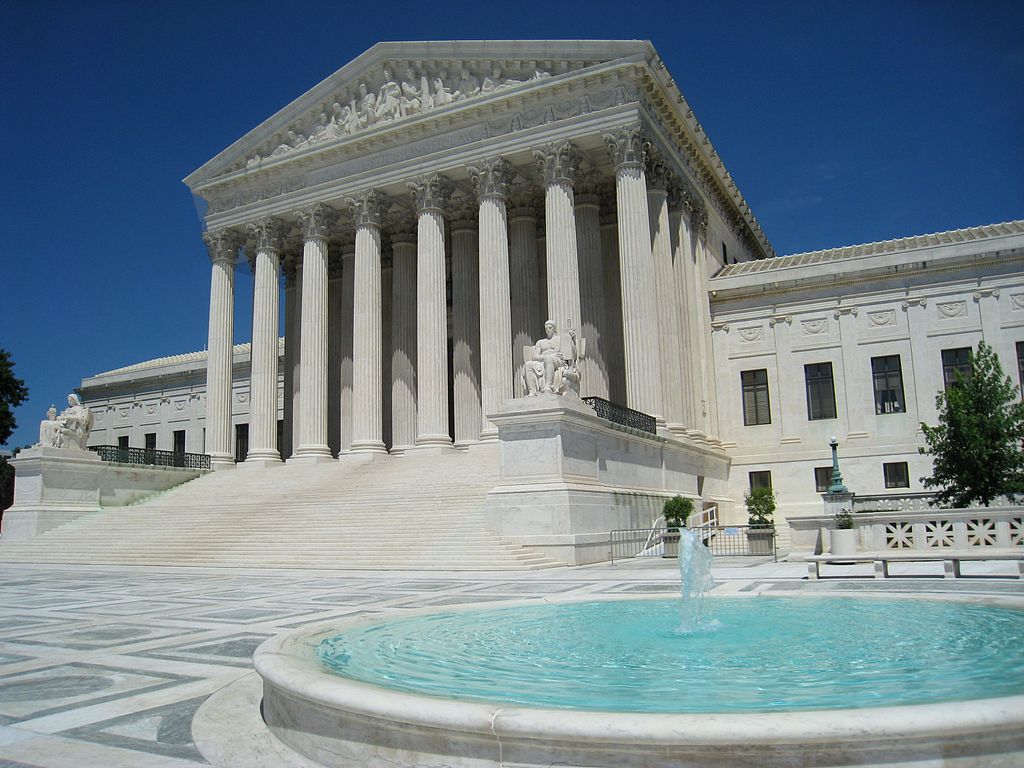
U.S. Supreme Court Building. Photo is in the Public Domain.
The U.S. Supreme Court ruled on Tuesday that political parties can raise and spend as much as they want on campaigns. That will change the campaign finance landscape nationwide — but a little less so in Wisconsin, where state parties have been allowed to transfer unlimited money to campaigns for years.
In a 6-3 decision, the court’s conservative justices said that limiting party spending violates the First Amendment. That overturns a portion of the Federal Election Campaign Act, a 1970s-era law, expanded in the wake of the Watergate scandal, aimed at lessening the risk of electoral corruption.
Writing for the majority, Justice Brett Kavanaugh said that all political participants should be treated equally.
The ruling “will allow all political parties —including the DNC and RNC and the respective Senate and House campaign committees, as well as other parties and party committees—to participate more freely and compete more fully in the political process, and to coordinate more closely with their candidates,” Kavanaugh wrote.
The ruling also loosens restrictions on coordination between donors and their preferred candidates. Unlike a political action committee, which cannot directly coordinate with a political campaign, political parties can. Plaintiffs in the case successfully argued that limiting the amount that political parties can transfer to their candidates effectively limits their ability to coordinate things like campaign messaging, which constitutes a limit on free expression.
In Wisconsin, state parties have been allowed to raise and spend unlimited money since 2015. That year, then-Gov. Scott Walker and the Republican-led Legislature overhauled state campaign finance law, arguing that — unlike political action committees — state parties are subject to public disclosure. They also said that this would help businesses compete with unions, many of which have powerful political lobbying arms.
Democrats that year argued that the change would lead to widespread corruption. That argument lost, and Wisconsin Republicans successfully lifted the limits on campaign party spending.
That argument was echoed at the U.S. Supreme Court in the leadup to Tuesday’s ruling. In a dissent, Justice Elena Kagan argued that the ruling opened the door for quid pro quo deals between major donors and elected officials.
“The caps prevent easy circumvention of contribution limits; and so the former, as much as the latter, are needed to avert corrupt deals between candidates and their supporters,” she wrote.
‘Exporting’ the Wisconsin model
At the time that Wisconsin loosened its campaign finance laws, Democrats argued that the change was a naked attempt for Republicans to raise more money. That happened for a time.
But in recent years, it’s been Wisconsin Democrats who have leveraged the state law in their favor, especially during highly expensive judicial races.
When the ideological balance of the court was up for grabs in 2023, the Democratic Party put $10 million towards helping to elect now-Justice Janet Protasiewicz. In 2025, both parties chipped in about $10 million, contributing to what became the most expensive judicial race of all time, with a price tag eclipsing $100 million. Now Justice Susan Crawford, another liberal, prevailed in that contest.
Jeff Mandell, the president of Law Forward, a liberal law firm that filed a brief in the U.S. Supreme Court case, argued that Tuesday’s ruling essentially exports Wisconsin’s model, paving the way for other states to experience similarly massive elections.
“It is essentially taking this Wisconsin model, which I would argue has been really, really unfortunate,” he said. “I don’t think anybody believes that the problem with our judicial elections is that there’s too little money spent, that they’re not seeing enough campaign ads, they’re not getting enough information in the mail.”
“And we’re taking that, and we’re exporting that to everywhere else in the country,” he added.
US Supreme Court ruling on campaign finance mirrors decade-old Wisconsin system was originally published by Wisconsin Public Radio.
If you think stories like this are important, become a member of Urban Milwaukee and help support real, independent journalism. Plus you get some cool added benefits.